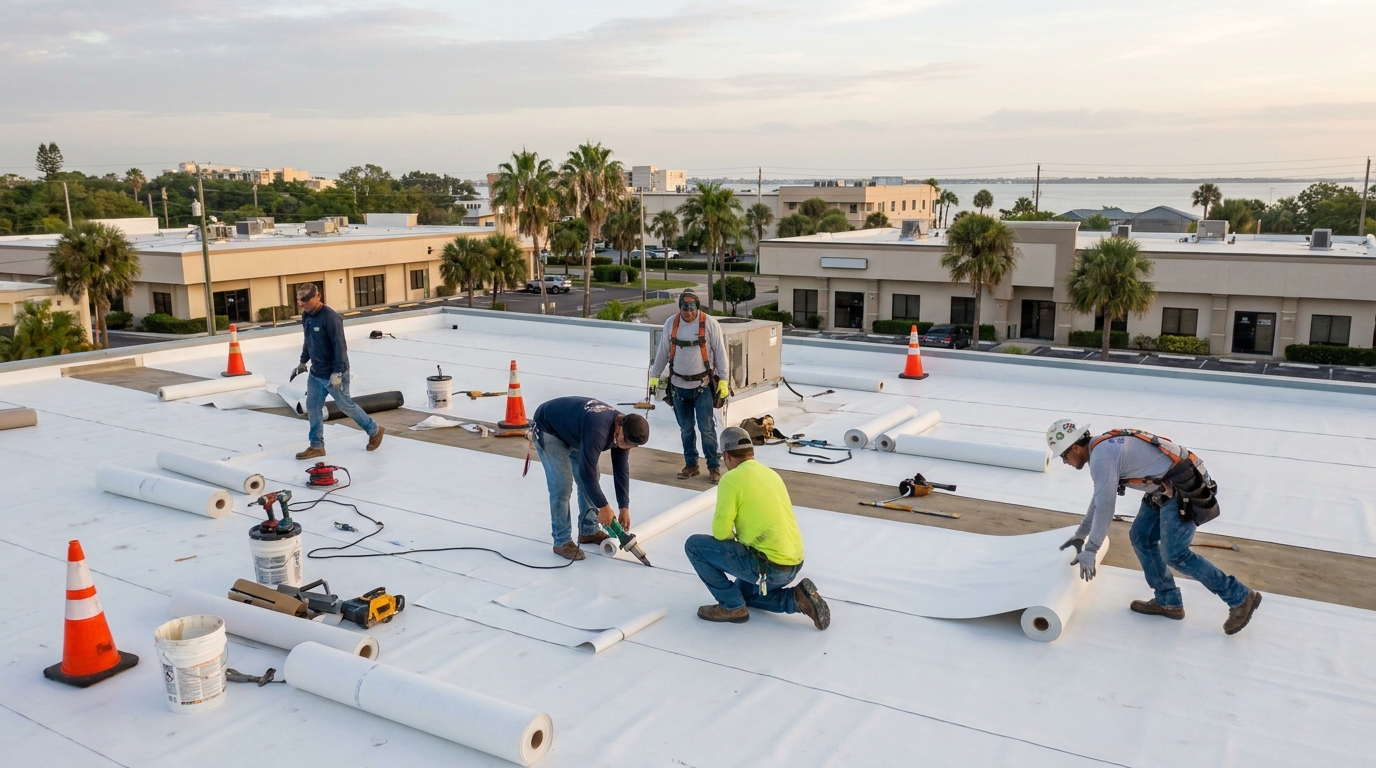
Budgeting for a commercial roof replacement in St. Petersburg, FL means planning for an installed cost of roughly $7–$15 per square foot for low-slope systems and $14–$25+ per square foot for standing seam metal — before Pinellas County permit fees, tear-off, and hurricane wind-uplift upgrades. For a typical 10,000-square-foot flat roof, that puts the working reserve target between $55,000 and $150,000, with metal assemblies pushing higher. Smart owners begin funding that reserve 3–5 years before the assembly reaches end of life, not the quarter the leaks start.
What follows is the mechanism under the hood — how each dollar in that budget actually gets spent, why St. Pete costs run above national averages, and how to phase a capital plan so the number doesn't arrive as a surprise.
What does a commercial roof replacement actually cost in St. Petersburg, FL?
In St. Petersburg, expect installed costs of $7–$15 per square foot for TPO, EPDM, and modified bitumen low-slope systems, and $14–$25+ per square foot for standing seam metal. A 10,000-square-foot project typically lands between $55,000 and $150,000 depending on system, tear-off, and wind-code upgrades. Roof coating or restoration, when the deck qualifies, runs $3–$6 per square foot.
Those ranges reflect Florida-specific pricing, which sits above national commercial guides because of hurricane wind-uplift code requirements, salt-air exposure, stricter underlayment rules, and the post-Hurricane Ian demand curve that has kept insurance-driven work steady across the Tampa Bay market.
Cost by system type
| System | Florida installed cost (per sq ft) | Best fit |
|---|---|---|
| TPO (Thermoplastic Polyolefin) | $6–$12 | Budget-conscious low-slope, reflective white membrane |
| EPDM (Rubber Membrane) | $7–$13 | Long-life single-ply, simple geometries |
| Modified Bitumen | $7–$13 | Heavy-traffic roofs, redundant waterproofing |
| Standing Seam Metal | $14–$25+ | Long service life, wind-uplift performance |
| Roof Coating / Restoration | $3–$6 | Deferring full tear-off on eligible substrates |
Why do St. Pete roofs cost more than the national average?
St. Petersburg roofs cost more because Florida's coastal building code demands upgraded wind-uplift fastening, enhanced underlayment, and salt-air-rated fasteners and flashings that inland markets don't require. Pinellas County permit fees add several hundred dollars to every re-roof, and post-Hurricane Ian insurance-driven demand has kept crews, materials, and inspection queues at premium pricing across Tampa Bay.
The four cost pressures unique to this market:
- Wind-uplift code compliance — assemblies must meet coastal fastening and attachment specs, which drives labor hours and hardware cost.
- Salt-air corrosion protection — coastal proximity from Downtown to the Gulf beaches pushes owners toward corrosion-rated metals and specialty coatings.
- Pinellas County permitting — required by law on every re-roof, with inspection sequencing that can extend schedules.
- Insurance-driven demand — carrier requirements often dictate assembly type and documentation, narrowing the field of qualifying products.
At SCM Roofing, LLC, we see these four factors show up on nearly every commercial estimate we write in the 33701–33716 corridor — they are the reason a St. Pete number won't match a Dallas or Atlanta number for the same square footage.
How should building owners phase the reserve fund?
Fund the reserve over the last 5 years of the assembly's expected service life, targeting 20% of the projected replacement cost per year. For a $100,000 flat roof, that's $20,000 annually into a dedicated capital line. Pair the reserve schedule with annual professional inspections so you catch premature degradation early and adjust the timeline before a failure forces an emergency replacement at peak-season pricing.
A workable phasing framework:
- Years −5 to −3: Commission a condition assessment. Confirm remaining service life, document deck condition, price a coating/restoration option at $3–$6 per square foot as a possible bridge.
- Years −3 to −1: Lock in the assembly type and get firm bids. Fund the reserve aggressively; verify insurance carrier requirements haven't shifted.
- Year 0: Bid, permit, and schedule outside of hurricane season peak — typically late winter through early spring in Tampa Bay — for cleaner scheduling.
What line items belong in the budget beyond the base price?
The per-square-foot ranges quoted by contractors cover installed material and labor for the assembly itself — nothing else. Owners routinely underfund by 15–25% because they forget tear-off, decking repairs, insulation upgrades, permit fees, and wind-code hardware. Add these line items separately so the number you carry on the capital plan reflects the true delivered cost, not the headline rate.
- Tear-off and decking replacement: approximately $1–$3 per square foot on top of the base system cost.
- Insulation and cover board: often required to meet current energy code or manufacturer warranty terms.
- Pinellas County permit fees: required on every re-roof; several hundred dollars typical.
- Wind-uplift upgrades: enhanced fastening patterns, edge metal, and perimeter attachment for coastal code.
- Drainage and structural repairs: not included in per-square-foot pricing; scoped separately after tear-off inspection.
- Contingency: 10–15% reserve for surprises found beneath the existing membrane.
How does system choice change the long-term math?
System choice trades upfront cost against service life and insurance posture. TPO at $6–$12 per square foot has the lowest entry price but a shorter service window than standing seam metal at $14–$25+ per square foot, which can outlast two membrane cycles. Coating at $3–$6 per square foot defers replacement entirely if the existing assembly qualifies — the cheapest option on the board when it fits.
The right answer depends on how long you'll hold the building. Owner-occupiers planning 20+ years often pencil out metal despite the sticker; investors on a 7–10 year hold usually optimize for single-ply membranes that meet code and carrier requirements without over-capitalizing the asset.
Are there rebates or incentives to factor in?
No current manufacturer rebates or utility incentive programs specific to commercial roofing were identified in available sources for the St. Petersburg market as of this writing. Budget the full replacement cost from owner reserves, insurance proceeds where a claim applies, or financing — do not model incentive offsets into the capital plan unless a contractor confirms an active program in writing at bid time.
Frequently Asked Questions
How much should I budget per square foot for a commercial roof in St. Petersburg?
Budget $7–$15 per square foot installed for low-slope systems like TPO, EPDM, and modified bitumen, and $14–$25+ per square foot for standing seam metal. Add roughly $1–$3 per square foot for tear-off and decking replacement, plus Pinellas County permit fees and any wind-uplift upgrades required by Florida coastal code. A 10,000-square-foot project commonly totals $55,000–$150,000.
How far in advance should I start funding the reserve?
Start funding the reserve at least 5 years before the assembly reaches end of life, contributing roughly 20% of the projected replacement cost annually. Pair the schedule with yearly professional inspections so degradation is caught before it forces an emergency replacement. Emergency work during hurricane season commands premium pricing and constrained crew availability across Tampa Bay.
Does coating count as a real alternative to replacement?
Yes, when the existing assembly qualifies. Roof coating or restoration runs $3–$6 per square foot in Florida — roughly half the cost of a new low-slope membrane. Eligibility depends on substrate condition, moisture content, and remaining service life of the deck below. A contractor should core-sample and moisture-scan before quoting coating as a viable option rather than a bridge.
Why do Florida commercial roofs cost more than national averages?
Florida commercial roofs cost more because of hurricane wind-uplift code requirements, salt-air exposure, stricter underlayment rules, and post-Hurricane Ian insurance-driven demand across Tampa Bay. Pinellas County permit fees add several hundred dollars per project, and coastal proximity often pushes owners toward corrosion-rated hardware and enhanced perimeter attachment that inland markets don't require by code.
What's typically missing from a low bid?
Low bids typically omit tear-off allowances, decking repair line items, insulation or cover board upgrades required for warranty compliance, wind-uplift hardware upgrades, and adequate contingency for hidden deck damage. Always compare bids line-by-line, not by bottom-line number. A 10–15% contingency and clearly scoped tear-off pricing are baseline signs the estimator has actually looked at the roof.
How do I know if my building qualifies for coating versus full replacement?
Qualification comes down to substrate condition — deck integrity, existing membrane adhesion, moisture content, and remaining structural service life. A qualified commercial roofer should perform core samples and infrared or capacitance moisture scanning before recommending coating. If more than roughly 25% of the assembly is wet or delaminated, coating is a short-term patch rather than a genuine capital deferral.
Planning the next step
A commercial roof replacement in St. Petersburg is a five-to-seven-figure capital event on most buildings, and the owners who navigate it without stress are the ones who started planning years before the first leak. Get the condition assessment early, phase the reserve, and price the full delivered cost — not the headline rate. Building owners in St. Petersburg, FL who want this scoped, bid, and phased professionally can reach SCM Roofing, LLC at https://scmroofingfl.com to schedule a commercial condition assessment and budget consultation. SCM Roofing, LLC works commercial and residential projects throughout the Tampa Bay market.