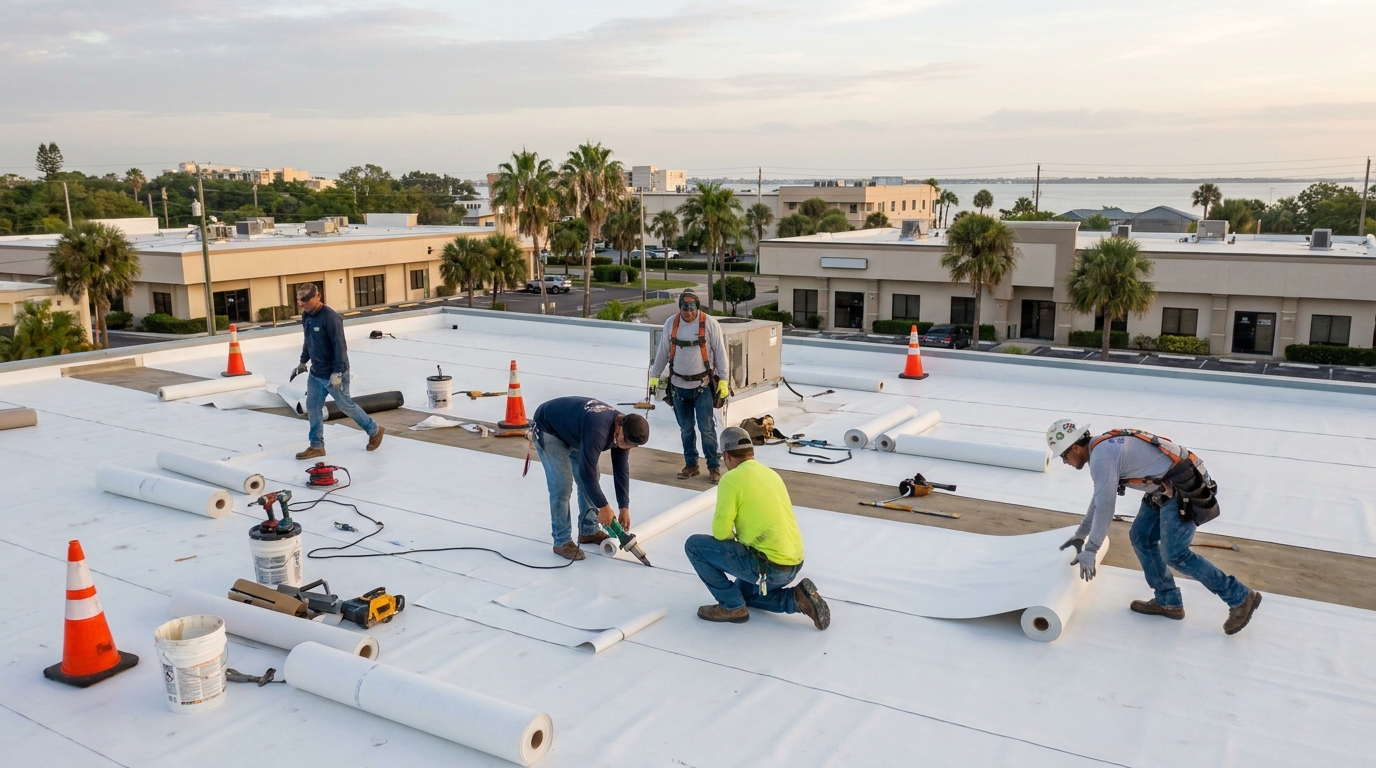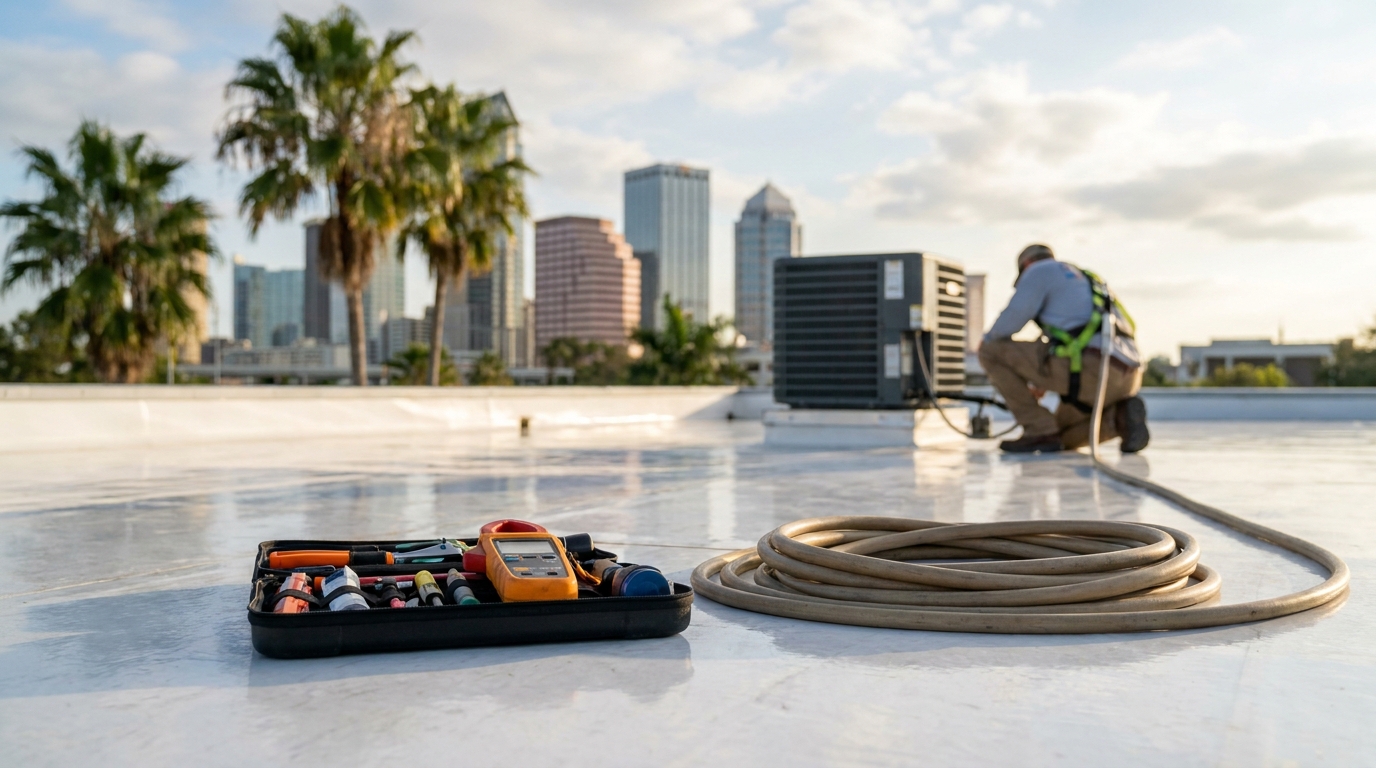
If you manage a commercial property in Tampa, your flat roof is working harder than almost any other building component you own. Between summer humidity, daily afternoon thunderstorms, salt-laden Gulf air, and a hurricane season that runs June through November, a flat roof here ages faster than the same membrane installed in a drier climate.
A reactive approach — wait until it leaks, then call someone — is the most expensive way to own a roof in this market. A documented maintenance schedule is the cheapest insurance you can buy.
This is the schedule we recommend to property managers across Tampa, from warehouses in the Port Tampa Bay industrial corridor to office buildings near the Westshore business district and retail centers in South Tampa. Use it as a checklist you can hand directly to your facilities team.
Why Tampa Commercial Flat Roofs Need a Stricter Schedule
Tampa's climate is uniquely hard on low-slope roofing systems. Average annual rainfall exceeds 50 inches, much of it falling in intense bursts between June and September. UV exposure is relentless. Nighttime humidity drives condensation under poorly ventilated assemblies, and salt air accelerates corrosion on fasteners, flashings, and HVAC curbs.
Layer on Florida Building Code requirements for wind uplift resistance — Hillsborough County sits in a high-velocity wind zone — and the case for preventive roof maintenance becomes obvious. A small membrane separation that would be a minor issue in Atlanta can become a catastrophic uplift failure here during a tropical storm.
The schedule below assumes a typical TPO, modified bitumen, or built-up roof. If you have a specialty system like PVC or a fluid-applied coating, intervals may shift slightly.
Monthly Flat Roof Maintenance Tasks
Every month, regardless of season, walk the roof or have a qualified technician walk it. The goal is early detection — most failures announce themselves weeks before water reaches a ceiling tile.
Monthly Walkthrough Checklist
- Clear debris from drains, scuppers, and gutters — palm fronds and oak leaves are the top culprits in Tampa
- Check for standing water 48 hours after a heavy rain (ponding longer than 48 hours violates most membrane warranties)
- Inspect membrane seams, T-joints, and field splices for separation or fish-mouthing
- Look for punctures near HVAC units, satellite mounts, and any path foot traffic takes
- Examine flashings at parapet walls, curbs, and penetrations for cracks or pulled fasteners
- Check sealant at pitch pans and pipe boots — Tampa UV degrades these faster than manufacturers' generic lifespan estimates suggest
- Note any blistering, ridging, or membrane discoloration and photograph for your log
- Verify rooftop equipment is secured and not vibrating against the membrane
Keep a written log with dates and photos. When you file an insurance claim after a storm, documented maintenance history is often the difference between a covered loss and a denied claim.
Seasonal Maintenance Tasks for Tampa Commercial Roofs
Monthly walks catch the small stuff. Seasonal tasks address the bigger systems — and the timing matters enormously in this market.
Spring (March–May): Pre-Hurricane Season Prep
This is your most important inspection window of the year. Anything you don't fix before June 1 becomes a hurricane-season liability.
- Schedule a comprehensive professional inspection — ideally a full infrared moisture scan if your roof is more than five years old
- Verify all rooftop equipment is anchored to current Florida Building Code wind-load requirements
- Re-secure or replace any loose perimeter metal, coping caps, and edge flashing (wind uplift starts at the edges)
- Reseal or replace deteriorated pitch pans, pipe boots, and penetration sealants
- Confirm drains and overflow scuppers are fully clear and tested
- Trim back any tree limbs overhanging the roof — common around older properties in Hyde Park and Seminole Heights
- Photograph the entire roof for pre-storm documentation that your insurer can compare against post-storm conditions
Summer (June–August): Hurricane Season Monitoring
Once hurricane season starts, your maintenance posture shifts from repair to surveillance. The goal is to keep the roof exactly as it was when you finished spring prep, and to respond fast after any named storm.
- Inspect after every tropical storm, hurricane, or severe thunderstorm — even if no obvious damage is visible from the ground
- Check for displaced ballast, lifted membrane corners, and punctures from windborne debris
- Clear drains immediately after any heavy rain event
- Watch for interior signs of leaks at perimeter walls and around skylights
- Avoid scheduling non-essential rooftop work during named-storm watches
Fall (September–November): Storm Recovery and Cooling-Season Prep
September and October are statistically Tampa's peak hurricane months. Once the immediate threat passes — typically by late November — use this window to address anything storm season exposed.
- Conduct a full post-hurricane-season inspection and repair any storm-related wear
- Re-caulk and reseal areas where summer UV has degraded sealants
- Clean and inspect HVAC curbs before cooling-system runtimes drop (it's easier to work around the units when they're not running constantly)
- Address any ponding water issues that developed over the rainy season
- Update your maintenance log and share it with ownership and your insurance carrier
Winter (December–February): Deep Maintenance Window
Tampa's mild, dry winter is the ideal time for larger repairs, recoating projects, and any work that requires extended dry weather. Take advantage of it.
- Schedule any planned recoating, restoration coating, or partial membrane replacement
- Address insulation issues identified by infrared scans
- Replace failing skylights, hatches, or roof accessories
- Review the next year's capital budget with your roofing contractor based on current roof condition
- Plan and schedule the spring pre-hurricane inspection now — qualified crews book up fast as June approaches
What Property Managers Often Miss
Three patterns we see repeatedly on Tampa commercial properties:
Drain neglect. A single clogged drain during a summer downpour can put thousands of pounds of standing water on a roof not designed to hold it. Monthly drain checks are the single highest-ROI maintenance task in this market.
HVAC tech damage. Service technicians walking the same path to rooftop units month after month wear membranes thin. Install walk pads on common service routes — it's a one-time fix that prevents years of premature wear.
Sealant lifespan assumptions. Manufacturer-rated sealant life assumes average UV exposure. Tampa is not average. Plan to inspect and refresh penetration sealants on roughly half the manufacturer's stated interval.
Frequently Asked Questions
How often should a Tampa commercial flat roof be professionally inspected?
Twice a year at minimum — once in spring before hurricane season and once in fall after it ends. Roofs older than ten years, or any roof that has been through a named storm, benefit from quarterly professional inspections.
Does preventive maintenance actually extend flat roof lifespan?
Yes, materially. A well-maintained TPO or modified bitumen system in Tampa can reach or exceed its rated service life. A neglected one often fails 30–40% sooner due to compounding small issues — clogged drains, failed sealants, and unaddressed punctures that allow moisture into the insulation.
Are roof permits required for commercial repairs in Tampa?
Permit requirements in Hillsborough County and the City of Tampa depend on the scope of work. Minor repairs typically don't require a permit, but recoating projects, partial replacements, and any structural work generally do. Always confirm with your roofing contractor before work begins — they should handle the permit process for you.
What should be in a commercial roof maintenance log?
Date of each inspection, name of the inspector, photos of every penetration and drain, notes on any defects found, work performed, materials used, and any recommendations deferred. This log is essential for warranty claims and insurance documentation.
Working With a Local Commercial Roofing Partner
A maintenance schedule only works if someone executes it consistently. For many Tampa property managers, that means partnering with a local commercial roofing company that knows the climate, the code requirements, and the realities of working around active tenants.
SCM Roofing, LLC works with commercial property owners across the Tampa area on preventive maintenance programs, post-storm inspections, and full roof replacements. Reviews from clients consistently highlight responsiveness and clear communication — one recent reviewer described the experience as "great communication, great customer service, and a great overall roofing product," which reflects the standard we hold ourselves to on commercial work as well.
If you'd like a qualified set of eyes on your flat roof — or help building a maintenance schedule tailored to your specific building — you can reach SCM Roofing, LLC at https://scmroofingfl.com for a free inspection and estimate. Whether you take that step or handle maintenance in-house, the checklist above will protect your asset through another Tampa hurricane season.