If you own or manage a warehouse, distribution center, or light industrial building in Bradenton, the roofing decision in front of you usually comes down to two systems: TPO single-ply membrane or standing seam metal. Both perform in Florida's heat and UV. Both can hit Class A fire ratings. But they're built for different roof geometries, different budgets, and different holding periods.
Here's how the two systems actually compare for commercial properties along the Gulf Coast — and how to decide which one fits your building.
The Short Answer for Bradenton Warehouse Owners
For flat or low-slope warehouses on a budget, TPO is the practical choice at roughly $5–$8 per square foot installed. For long-term owners who want maximum hurricane resilience and a 40-to-70-year service life, standing seam metal is the stronger investment at $8–$13 per square foot installed in Bradenton, with coastal specs and premium finishes pushing toward the upper end of the Florida range.
That's the headline. The nuance is where the real decision lives — especially in a market where June-through-November storms set the standard for what a roof actually has to survive.
Installed Cost: TPO Wins Upfront, Metal Wins Lifecycle
TPO membrane systems for commercial roofs typically run $5–$8 per square foot installed in Bradenton, depending on membrane thickness (45 mil, 60 mil, or 80 mil), attachment method, and insulation specification. Across Florida broadly, that range extends to $5–$10 per square foot for premium assemblies with tapered insulation or cover board.
Standing seam metal lands at $8–$13 per square foot installed in Bradenton — with the Florida statewide range running $9–$20 per square foot depending on material, gauge, finish tier, coastal requirements, and trim complexity. Coastal Bradenton projects requiring hurricane-rated components and corrosion-resistant finishes can push pricing toward that upper end.
So upfront, TPO can come in at meaningfully less than standing seam. But that's not the full economic picture. TPO carries a 15–25 year service life. Standing seam metal delivers 40–70 years. Spread the cost over the life of the assembly and the gap narrows considerably — sometimes inverts.
Worth flagging: these are market estimates from contractor and industry guides, not fixed prices. A Bradenton-specific bid will move based on roof size, tear-off versus recover, wind-uplift design requirements, insulation thickness, access, and labor conditions. Get the bid before you finalize the math.
Service Life and What It Means for a Bradenton Facility
A warehouse roof is a 20-to-50-year decision. Replacement isn't just the cost of the new roof — it's the operational disruption to a working facility, which for a Bradenton distribution center serving the Tampa Bay corridor can be the bigger expense.
TPO membrane: 15–25 years, depending on assembly quality, manufacturer tier, and maintenance discipline. Seams and membrane condition are the long-term variables. Warranty coverage runs 10–30 years depending on system and manufacturer, with higher warranty tiers available on premium assemblies.
Standing seam metal: 40–70 years with proper installation. Manufacturer product warranties vary by system and finish tier. PVDF finishes and aluminum substrates are generally preferred for coastal Florida applications where corrosion resistance matters most.
If you're holding the property for the long haul — or you operate the building yourself — standing seam's longevity usually justifies the upfront premium. If you're a five-to-ten-year owner planning to sell, TPO's lower entry cost often makes more sense on the spreadsheet.
Hurricane and Wind Performance
This is where the Bradenton context matters most. Manatee County sits squarely in the hurricane-impact zone, and Florida Building Code wind-uplift requirements are some of the most stringent in the country. Whatever system you install has to meet those requirements — but the systems perform differently in practice.
Standing seam metal is engineered for strong wind resistance when properly specified, with some systems rated Class 90 wind uplift resistance. The concealed-fastener design — where clips secure panels without penetrating the surface — eliminates the exposed-fastener leak points that plague older metal systems after a major storm. Coastal-grade specifications are required in the Bradenton area.
TPO performs well when properly fastened and detailed, but membrane systems are more vulnerable to puncture from wind-borne debris and to long-term wear at seams and flashings. After a significant storm event, TPO roofs often need more inspection and patching than standing seam assemblies.
For warehouses storing high-value inventory, sensitive equipment, or temperature-controlled goods, the storm-resilience argument for standing seam is hard to ignore.
Energy Performance in Florida's Climate
Both systems can deliver real cooling-load reductions, which matters when summer dew points stay elevated for months on end.
TPO's white membrane surface offers high solar reflectivity right out of the gate — no coating selection required. According to verified specifications, TPO meets a minimum solar reflectance of 0.34, thermal emittance of 0.89, and an SRI of 37. For a large warehouse running rooftop HVAC units, that reflectivity translates to measurable savings on conditioning costs.
Standing seam metal can match or exceed that performance with the right coating. SMP and PVDF paint systems both offer reflective options, and PVDF is the preferred finish tier for coastal Florida applications. The catch is that you have to specify the coating intentionally — default finishes won't necessarily get you there.
For Bradenton facility managers focused on energy bills, either system can perform. TPO is reflective by default; standing seam requires a deliberate specification.
Roof Geometry: Which System Fits Your Building
This is often the deciding factor before cost ever enters the conversation.
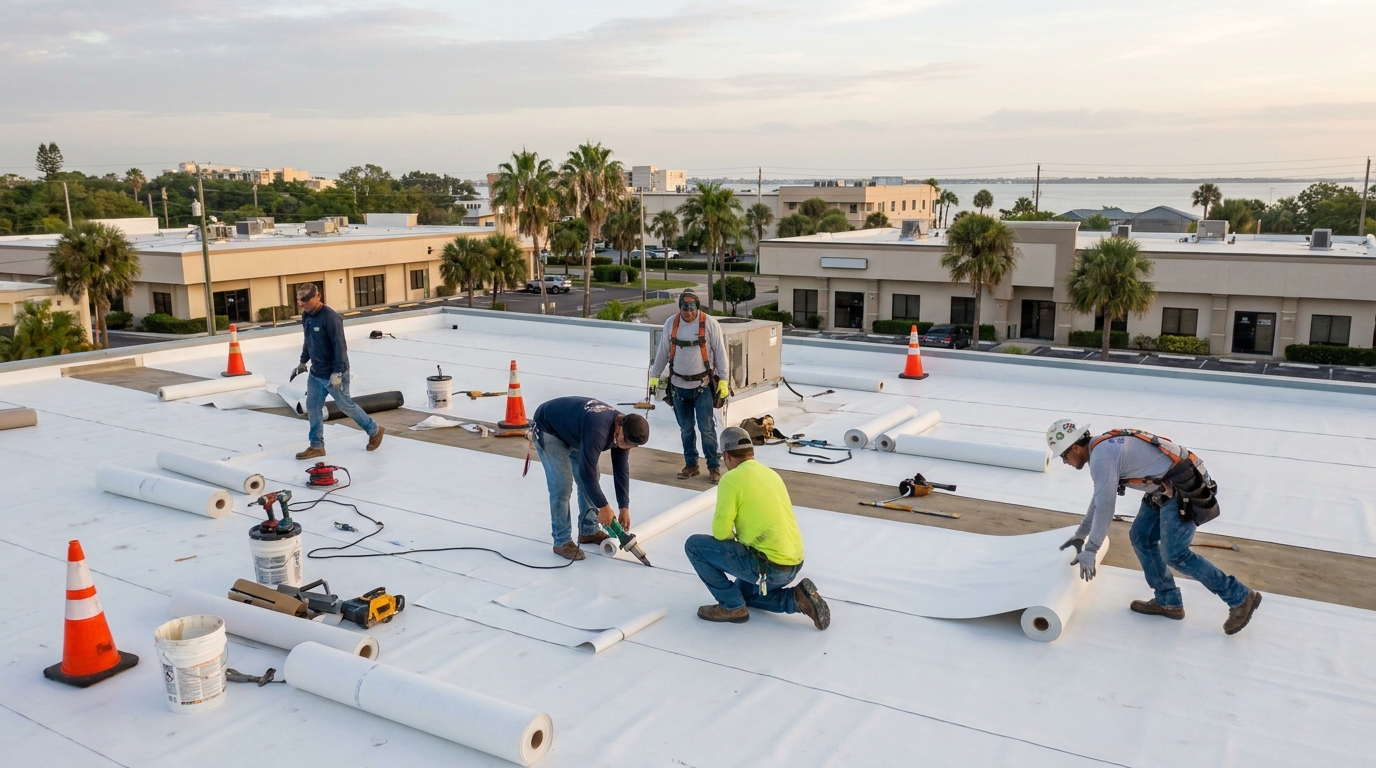
TPO is engineered for flat or low-slope roofs — the typical warehouse, distribution center, retail box, or office building profile you see throughout the industrial corridors near SR-70 and the Port Manatee logistics zone. It installs via mechanically fastened, fully adhered, or ballasted methods.
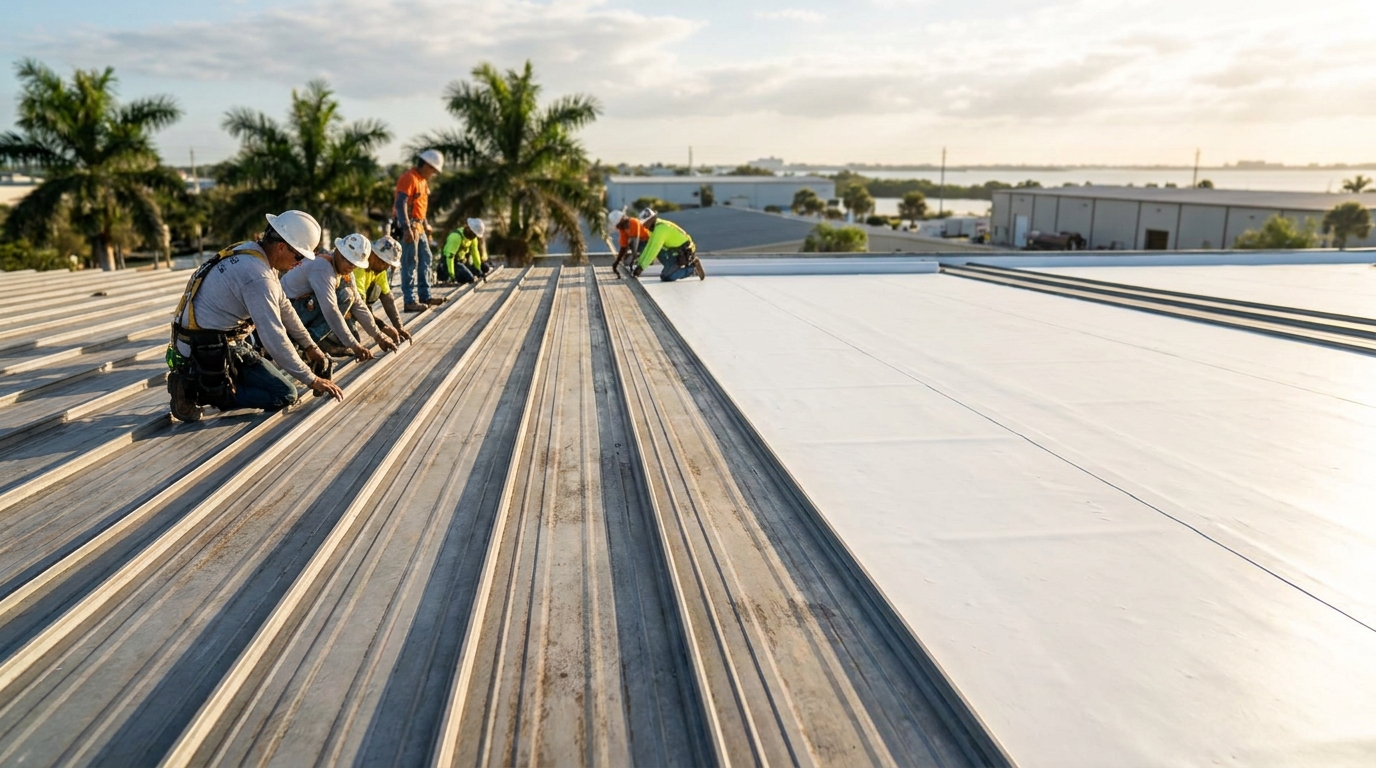
Standing seam metal requires adequate slope for most standard systems. That rules out most flat-roof warehouses unless you're building new and can design the slope in. Standing seam shines on pre-engineered metal buildings, manufacturing facilities with sloped roofs, and architecturally visible commercial properties where the panel profile is part of the aesthetic.
If your warehouse has a flat or near-flat roof, TPO is almost certainly the right system. If you're building new or your facility has adequate slope, standing seam becomes a real option.
Installation Complexity and Project Timeline
TPO installs faster. The membrane goes down in large sheets, attachment methods are flexible, and the labor pool of qualified TPO installers is broader. For a working warehouse where every day of roof work means operational impact, that speed matters.
Standing seam metal is more complex. Concealed-fastener systems require specialized labor, panels are cut and seamed on site or shop-fabricated to length, and trim details around penetrations and parapets demand experienced crews. Expect a longer install window — and a higher labor cost component within the per-square-foot price.
FAQs
Can I install standing seam metal over my existing flat warehouse roof?
Generally no — standard standing seam profiles require adequate slope. A flat or near-flat warehouse roof is a TPO project unless you're undertaking a structural slope addition, which is rarely cost-effective.
How long does a commercial roof install take on a Bradenton warehouse?
It depends on square footage, tear-off requirements, and weather. TPO projects move faster than standing seam by a meaningful margin. Planning the work outside peak hurricane season (June through November) is standard practice on the Gulf Coast.
What warranty should I expect?
TPO warranties run 10–30 years depending on product line and system design. Standing seam metal manufacturer warranties vary by system and finish tier; buyers should verify specific terms with their chosen manufacturer and contractor. Always confirm specifics in the manufacturer's warranty document — terms vary meaningfully across products.
Are both systems Class A fire-rated?
Both can achieve Class A ratings. Steel standing seam panels are inherently non-combustible, which can matter for insurance underwriting on certain facility types.
Which system offers better value for a Bradenton warehouse held long-term?
For long-term ownership, standing seam metal generally delivers better lifecycle value despite its higher upfront cost of $8–$13 per square foot installed in Bradenton. Its 40–70 year service life means fewer replacement cycles, lower long-term maintenance expense, and stronger wind and storm performance — factors that matter significantly in coastal Manatee County over a multi-decade hold period.
What finish or material should I specify for standing seam metal near the coast?
For coastal Bradenton applications, PVDF finish and aluminum substrate are the preferred combination. PVDF paint systems offer superior corrosion and UV resistance compared to mill or SMP finishes. Galvalume steel is also used but aluminum is generally favored for marine-adjacent environments. Specifying the right finish upfront protects your investment and keeps the roof within warranty terms over its full service life.
Choosing the System That Fits Your Building
The honest framing: TPO and standing seam metal aren't really competitors for the same roof. They're answers to different questions. TPO is the answer for flat-roof warehouses, budget-sensitive projects, and moderate holding periods. Standing seam metal is the answer for sloped roofs, long-term ownership, and properties where hurricane resilience is a top priority.
The right choice depends on your roof's geometry, your hold period, your insurance posture, and what your facility actually does day to day. A logistics tenant warehouse and an owner-occupied manufacturing plant should not necessarily land on the same system.
Bradenton commercial property owners and facility managers who want a professional assessment of which system fits their building can reach — at https://scmroofingfl.com for a free estimate. A walkthrough of your roof — geometry, condition, drainage, penetrations, and your operational profile — is usually the fastest way to turn the TPO-versus-standing-seam question into a clear answer.