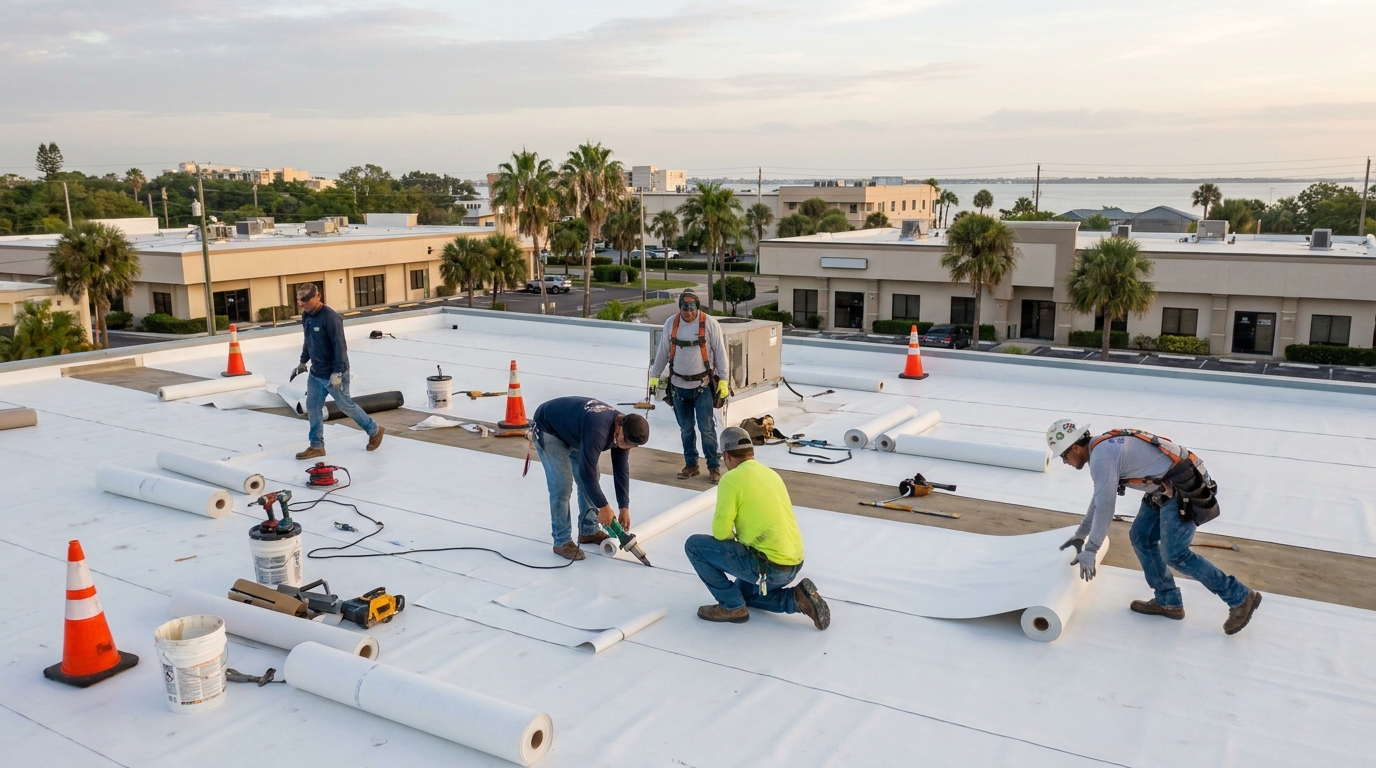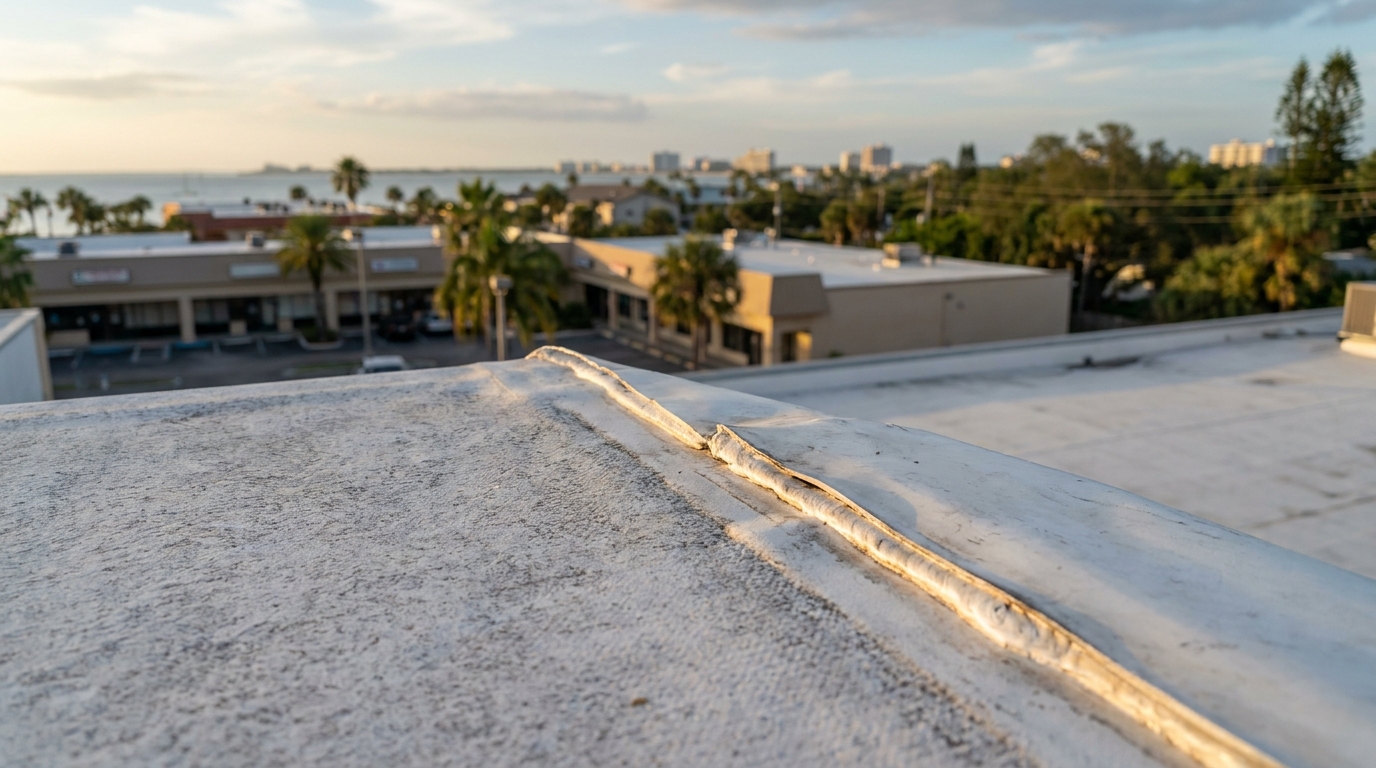
Commercial roof replacement in Clearwater, FL typically costs between $4.50 and $14 per square foot installed for common flat-roof systems like TPO, EPDM, and modified bitumen — with standing seam metal running $8 to $15+ per square foot and coating systems starting as low as $1.50 per square foot. For a 10,000-square-foot commercial building, that translates to a total project cost of roughly $40,000 to $180,000, depending on the system chosen, tear-off requirements, and deck condition.
That's a wide range. The reason it's wide has less to do with materials and more to do with what Clearwater does to a roof — salt air off the Gulf, near-constant UV, and Pinellas County wind-uplift requirements that don't apply to inland Florida jobs. Below is what property owners should actually expect to pay in 2026, how to decide between coating and replacement, and what makes this market different from Tampa or St. Pete.
How Much Does a Commercial Roof Cost Per Square Foot in Clearwater in 2026?
Expect $4 per square foot at the low end and $15+ per square foot at the high end, installed. Most Clearwater commercial re-roofs land in the $4.50–$14 per square foot range because TPO, EPDM, and modified bitumen dominate the flat-roof stock on retail plazas, medical offices, and light industrial buildings across Pinellas County.
Here's how the systems break down by installed cost:
- Acrylic, polyurethane, and silicone coatings: $1.50–$6.00/sq ft — restoration, not replacement
- Restoration overlay (TPO/PVC/mod-bit over existing): $4–$9/sq ft — no full tear-off
- TPO full replacement: $4.50–$14.00/sq ft — 20–30 year lifespan, highly reflective
- EPDM full replacement: $4.00–$7.55/sq ft — 20–30 year lifespan, flexible rubber membrane
- Modified bitumen full replacement: $5.00–$8.50/sq ft (premium systems up to $16.00/sq ft) — 15–25 year lifespan
- PVC membrane full replacement: $6.50–$9.50/sq ft — chemical and grease resistant, suited to restaurants
- Built-up roofing (BUR): $5.50–$11.00/sq ft
- Standing seam metal: $8.00–$15.00+/sq ft — longest lifespan, highest upfront cost
A 5,000-square-foot TPO or modified bitumen replacement in the Tampa Bay market typically runs $15,000 to $45,000. Double the footprint and the math scales roughly linearly, though economies come in on labor and staging as buildings get larger.
Why Clearwater Costs Differ from Inland Florida
Three local factors move Clearwater pricing away from generic Florida averages: salt-air corrosion, hurricane-zone wind-uplift requirements, and hospitality/medical building density near the beach.
Buildings within a few miles of Clearwater Beach and along the Gulf-to-Bay corridor absorb salt spray year-round. That's tough on metal fasteners, mechanical curbs, and anything with exposed steel. For coastal properties, contractors typically specify stainless or coated fasteners and heavier-gauge flashing — small line items that compound across a 10,000-square-foot roof.
Pinellas County sits in Florida's high-velocity hurricane zone. Commercial roofing here is permitted through local building departments under the Florida Building Code, and wind-uplift ratings, secondary water barriers, and attachment schedules are enforced more strictly than in interior counties. That means engineered attachment plans on many jobs and product approvals (NOA or Florida Product Approval numbers) on every membrane and fastener. Contractors who skip that paperwork can't legally close out the permit.
Then there's the building mix. Medical offices near Morton Plant, hospitality properties along the beach, and light industrial around the US-19 corridor each carry different scope requirements — grease-resistant PVC for restaurant kitchens, sound-conscious tear-off schedules for medical tenants, tapered insulation for older warehouses with ponding issues.
Roof Coating vs. Replacement for Commercial Buildings in Clearwater
Coating makes sense when the existing membrane is structurally sound but weathered; full replacement is the right call when the deck is compromised, leaks are chronic, or the roof is past 80% of its expected life. A silicone or acrylic coating at $1.50–$6.00 per square foot can extend a viable roof by 10–15 years — a fraction of the $4.50–$14 per square foot for a TPO tear-off.
The decision framework most Clearwater property owners should run:
- Age of the existing system. A 12-year-old TPO in good condition is a coating candidate. A 24-year-old modified bitumen with alligatoring is not.
- Moisture in the insulation. An infrared or core-sample survey answers this. Wet insulation under a coating just traps the problem.
- Deck integrity. Rusted metal deck or rotted plywood means tear-off, period.
- Warranty needs. A restoration overlay (TPO or PVC over existing) at $4–$9 per square foot resets the warranty clock without a full tear-off — a middle path worth pricing.
- Insurance posture. Some Florida carriers now require a documented remaining roof life. A fresh coating can affect renewals; a full replacement resets the underwriting conversation entirely.
Signs a Commercial Roof Needs Replacing in Clearwater
Replace — don't patch — when you see any combination of the following:
- Interior leaks in more than one location, especially after routine summer thunderstorms
- Widespread membrane blistering, seam separation, or alligatoring visible from a walkover
- Ponding water that persists more than 48 hours after rain — a sign of insulation compression or drainage failure
- Rust bleed at parapets, curbs, or scuppers — the salt-air tell in Pinellas County
- Insulation that feels soft underfoot or shows moisture on core samples
- The roof is at or past its expected lifespan — 15–25 years for mod-bit, 20–30 for TPO, EPDM, and PVC
- Rising energy bills as the reflective surface degrades and cooling loads climb
For hospitality and medical properties, a related trigger is insurance renewal season. Florida commercial carriers have tightened underwriting significantly, and roofs flagged as end-of-life often drive premium hikes or non-renewals. Timing a replacement before hurricane season (June through November) — ideally in late winter or early spring — avoids both weather delays and the pricing pressure that hits Florida contractors during peak demand.
Incentives and Ways to Lower Total Cost
There is no manufacturer MSRP, factory rebate, or standardized incentive program for commercial roof replacement. Savings come from three places: competitive bidding, right-sizing the scope (repair vs. overlay vs. full replacement), and energy-efficiency programs tied to cool roofs or insulation upgrades through local utilities or federal tax provisions.
Cool-roof TPO and PVC systems, in particular, can qualify for utility rebates or accelerated depreciation on the commercial books — worth asking a CPA about before signing a contract. These programs change frequently and are not standardized, so verify current eligibility rather than assuming last year's numbers still apply.
How to Choose a Commercial Roofing Company in Clearwater
Pricing is only part of the decision. What separates a good Clearwater commercial roofer from a merely cheap one:
- Licensed and insured in Florida, with a verifiable CCC or CGC number
- Familiar with Pinellas County permitting and the wind-uplift documentation that comes with it
- Manufacturer certifications for the specific membrane system being installed (warranty transfers require them)
- Written scope of work that specifies insulation R-value, attachment pattern, edge metal gauge, and warranty terms — not a one-page quote
- References on similar buildings — a contractor who has done ten hotels understands things a house-only roofer doesn't
SCM Roofing, LLC works with commercial property owners across Clearwater and Pinellas County on TPO, EPDM, modified bitumen, PVC, and metal systems, and provides scoped bids that reflect coastal Florida code and wind-uplift requirements rather than generic pricing pulled from a national calculator.
FAQ
What's the cheapest way to extend a commercial roof's life in Clearwater?
A silicone or acrylic coating at $1.50–$6.00 per square foot, applied over a structurally sound membrane. It can add 10–15 years but only works when the underlying insulation is dry and the deck is intact.
How long does a commercial roof last in coastal Florida?
TPO, EPDM, and PVC systems are rated for 20–30 years, modified bitumen for 15–25 years, and standing seam metal considerably longer. Salt exposure and UV in Clearwater tend to push real-world lifespans toward the lower end of those ranges unless the system is maintained.
Do I need a permit to replace a commercial roof in Clearwater?
Yes. Commercial re-roofs in Clearwater and Pinellas County require permits through the local building department, with product approvals and wind-uplift documentation tied to the Florida Building Code. A licensed contractor pulls this on your behalf.
Should I replace before or after hurricane season?
Before. Scheduling a replacement in late winter or early spring — ahead of the June–November hurricane window — avoids weather delays, peak-demand pricing, and the risk of storm damage to an already-failing roof.
The Bottom Line
Commercial roof replacement in Clearwater is a $40,000–$180,000 decision for most buildings, and the right answer depends on the age of the current system, the condition of the deck, and how the building is insured. TPO and modified bitumen remain the workhorses; PVC earns its premium in restaurants; metal makes sense for owners with 30-year horizons; coatings buy time when the underlying roof still has structural life.
Property owners in Clearwater, FL who want a scoped bid rather than a per-square-foot estimate can reach SCM Roofing, LLC at https://scmroofingfl.com for an on-site inspection and written proposal.