If you're staring down a leaky roof or a replacement quote that made you flinch, you're not alone. Sarasota's coastal climate is hard on roofing systems — salt air, UV, hurricane exposure, and heavy summer rain accelerate wear on every home from Siesta Key to Lakewood Ranch. And because Florida enforces one of the strictest wind-resistance building codes in the country, cutting corners isn't really an option here. The real question isn't how cheap can I go — it's how do I find an honest, licensed contractor who will do code-compliant work at a fair price?
This guide walks through that process step by step, tailored to the Sarasota market.
What "Affordable" Actually Means in Sarasota
Let's set expectations first. According to published local guidance, full roof replacements in Sarasota typically run between $12,000 and $35,000 or more. Smaller homes with asphalt shingles tend to land at the lower end — roughly $12,000 to $20,000 — while mid-to-large homes with tile or metal often reach $25,000 to $35,000+.
Truly "cheap" roofing in this market is rare, and usually a red flag. What Sarasota homeowners realistically mean by affordable roofing is one of three things:
- Right-sized scope. Repair instead of full replacement when the roof still has usable life.
- Material substitution. Asphalt shingles in place of tile or metal, where HOA rules and code allow.
- Financing. Spreading payment over time rather than reducing total project cost.
Understanding which of these applies to your situation is the first step toward a budget-friendly outcome.
Step 1: Verify the License Before Anything Else
Every legitimate roofing contractor in Florida holds a state-issued Certified Roofing Contractor license with a CCC prefix. You can — and should — verify it yourself through the Florida DBPR online license lookup before you even schedule an estimate.
This one step eliminates most of the storm-chaser fraud risk that spikes in Sarasota after every major weather event. Door-to-door solicitations offering suspiciously low prices are a documented concern along the Gulf Coast, and unlicensed work will fail Sarasota County inspections regardless of how good it looks from the ground.
Also confirm the contractor carries:
- General liability insurance
- Workers' compensation insurance
Reputable firms will provide certificates on request without hesitation.
Step 2: Understand Sarasota's Permit and Code Requirements
Any roof replacement or major repair in Sarasota County requires a building permit, pulled by the Sarasota County Building Department. Under Florida law, that permit must be pulled under the contractor's license, not the homeowner's. If a contractor asks you to pull the permit yourself, walk away — it's a sign they may not be properly licensed for the work.
Inspections happen during and after installation to verify wind-resistance, underlayment, and fire-safety compliance. This is why the Florida Building Code is described as one of the strictest in the country: coastal Sarasota sits in a designated high-wind zone, and code-compliant fastening, underlayment, and material selection are baseline requirements, not upgrades.
The upside for budget-conscious homeowners: a properly permitted, inspected roof holds its value with insurers and future buyers. A cash-under-the-table job saves nothing when your carrier drops coverage or a future sale falls through in due diligence.
Step 3: Get Three Written Estimates
Sarasota roofing prices vary widely by contractor, materials, and scope, so a single quote tells you nothing. Aim for three written estimates from licensed local firms.
Each estimate should spell out:
- Tear-off scope (full or partial)
- Underlayment type and fastening pattern
- Material brand, product line, and warranty
- Flashing, drip edge, and ventilation work
- Debris removal and cleanup
- Permit and inspection fees
- Payment schedule
Beware the outlier — if one bid is dramatically lower than the others, ask exactly what's being left out. In this market, that gap usually reflects thinner underlayment, cheaper fasteners, or an intent to change-order you later.
Step 4: Ask About Financing — But Read the Fine Print
Several Sarasota roofers offer financing with monthly payment plans, which can make a $20,000 project feel manageable. Financing spreads the cost; it doesn't reduce it. Always confirm the APR, term length, and whether there's a prepayment penalty before signing.
Financing offers are subject to credit approval and individual lender terms, so the advertised monthly payment isn't guaranteed to be your payment.
Step 5: Know Your Insurance Rights (and Red Flags)
Two Florida-specific rules every Sarasota homeowner should know:
- Waiving your deductible is illegal. Any contractor offering to "eat" or "cover" your homeowners insurance deductible is proposing an illegal transaction under Florida law. Decline and move on.
- Assignment of Benefits (AOB) contracts carry real legal weight. An AOB transfers your insurance claim rights to the contractor. It's not automatically bad, but it has significant implications — review any AOB carefully, ideally with your insurance agent or an attorney, before signing.
Step 6: Factor in HOA Rules Early
Many Sarasota-area communities — particularly in Lakewood Ranch, Palmer Ranch, and the barrier island neighborhoods — are governed by HOAs that restrict roofing materials and colors. Some require tile, which effectively removes the lowest-cost shingle option from the table.
Pull your HOA architectural guidelines before you start collecting bids. It's a five-minute step that prevents you from budgeting for a $15,000 shingle roof only to learn you're required to install a $30,000 tile system.
Step 7: Time the Project Thoughtfully
Sarasota's rainy season and hurricane window run roughly June through November. Contractors are busiest — and often priciest — immediately after named storms. If your roof isn't actively failing, scheduling non-emergency replacements during the drier winter and spring months, before hurricane season peaks, tends to yield better scheduling and sometimes better pricing.
Snowbird homeowners in particular should plan replacements during their in-season months so they can be on-site for material delivery, walk-throughs, and the final inspection.
Frequently Asked Questions
Is roof repair always cheaper than replacement in Sarasota?
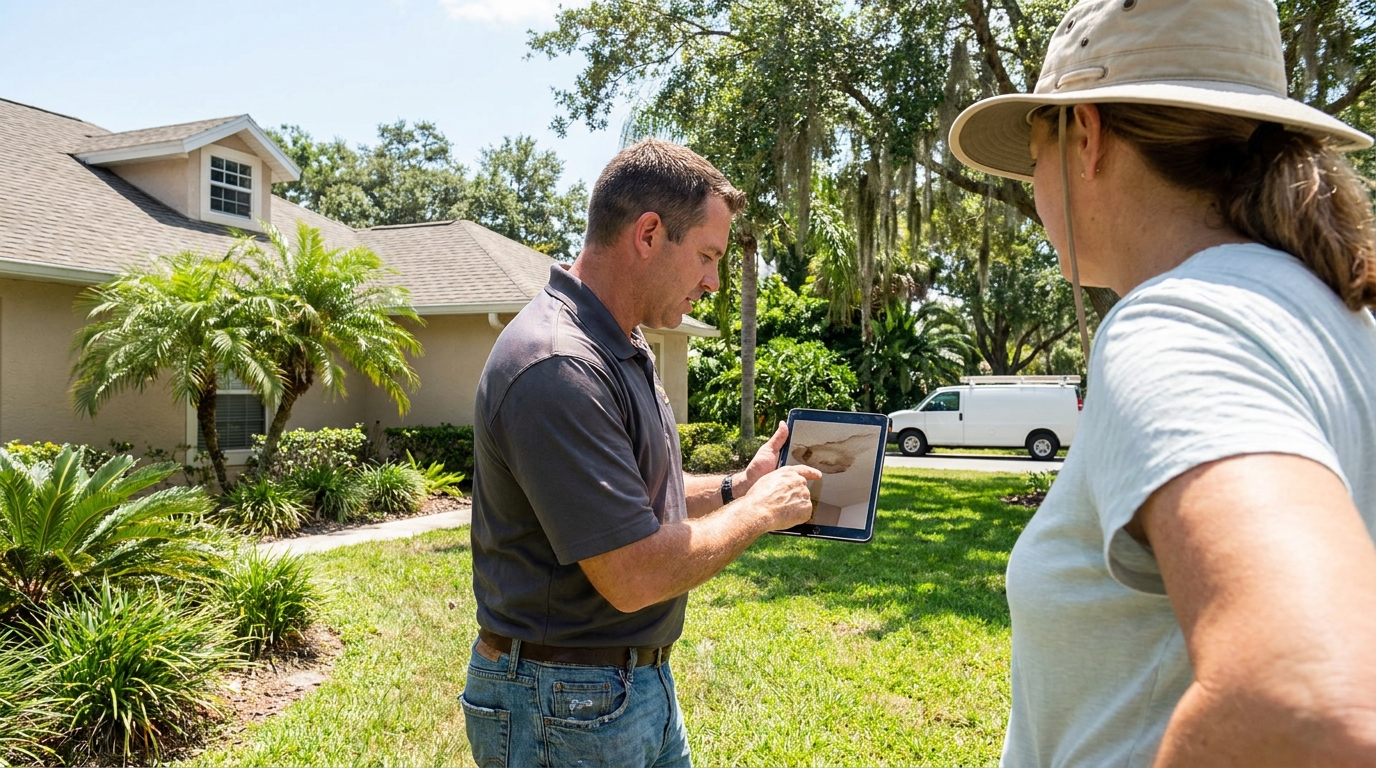
Usually, yes — but not always. If your roof has widespread underlayment failure or has been patched multiple times, repeated repairs can outpace a single replacement. A licensed local contractor can inspect and tell you honestly which side of that line you're on.
How can I tell if a Sarasota roofing contractor is legitimate?
Verify their CCC-prefix license through the Florida DBPR site, confirm active general liability and workers' compensation insurance, check that they're pulling the permit under their own license, and look for established local presence — a physical Sarasota-area address, verifiable reviews, and years of local work history.
Do I need a permit for a small roof repair?
Major repairs and replacements require a Sarasota County building permit. Very small repairs may not, but the threshold is set by the county — always ask your contractor, and be skeptical of anyone eager to skip permitting on substantial work.
What's the single biggest way to overpay on a Sarasota roof?
Hiring the first contractor who knocks on your door after a storm. Storm-chaser fraud is a documented Gulf Coast problem, and unsolicited post-storm bids are consistently among the most expensive — and least accountable — options in this market.
The Bottom Line
Finding an affordable roofing contractor in Sarasota isn't about chasing the lowest number on a quote sheet. It's about matching the right scope to your roof's actual condition, verifying licensing and insurance, understanding what the Florida Building Code requires, and getting enough competing bids to know what fair pricing looks like for your specific home.
Homeowners in Sarasota, FL who want this handled professionally can reach SCM Roofing, LLC at https://scmroofingfl.com for a free estimate and a straightforward walkthrough of repair-versus-replacement options for their property.