If you own or manage a commercial property in Tampa, the roof over your building is doing more work than any other single system. It's fighting UV punishment, afternoon thunderstorms, salt air off the Bay, and the annual threat of a hurricane rolling in from the Gulf. So when it's time to specify a new roof — or replace one that's finally given up — the decision usually narrows to two systems: TPO membrane or standing seam metal.
Both can be engineered to meet Florida Building Code high-wind requirements. Both can qualify as cool roofs. But they solve different problems, cost different amounts, and last for very different lengths of time. Here's how to think through the choice for a Tampa Bay commercial building.
The Short Answer
For most large flat or low-slope commercial roofs in Tampa — warehouses in the Port Tampa Bay industrial corridor, retail strips along Dale Mabry, office buildings near Westshore — TPO is usually the better fit on cost and cooling performance. Installed pricing typically runs $6–$12 per square foot for mid-range TPO systems, with a 20–30 year service life.
Standing seam metal earns its keep on sloped or visible roofs, storm-critical facilities, and buildings held for the long term. Installed costs run $10–$20 per square foot for mid-range systems, and service life stretches to 40–70+ years. Over a 40–50 year horizon, that longevity can offset the higher upfront number by avoiding a full TPO replacement cycle.
Now the details.
Installed Cost in the Tampa Bay Market
Cost is where the two systems diverge most sharply.
- TPO: $5–$8 per sq ft entry-level, $6–$12 mid-range, up to $14+ for premium 70–80 mil membranes. A 10,000 sq ft project typically lands between $60,000 and $120,000 installed.
- Standing seam metal: $8–$14 per sq ft basic, $10–$18 mid-range, $18–$25+ for premium architectural assemblies in aluminum, zinc, or copper. That same 10,000 sq ft project runs $100,000–$200,000.
In practical terms, TPO is roughly 1.5 to 2 times less expensive than standing seam metal for comparable code-compliant assemblies in Tampa Bay. That gap widens if your building is close enough to the water — think Rocky Point, Davis Islands, or anywhere along the coastal edge — to require upgraded corrosion-resistant metal specifications like aluminum panels or premium coatings.
Every quote is affected by tear-off vs. overlay, substrate condition, insulation thickness required by Florida energy code, and the wind uplift engineering your specific building demands.
Hurricane and Wind Performance
This is Tampa. Wind performance isn't optional.
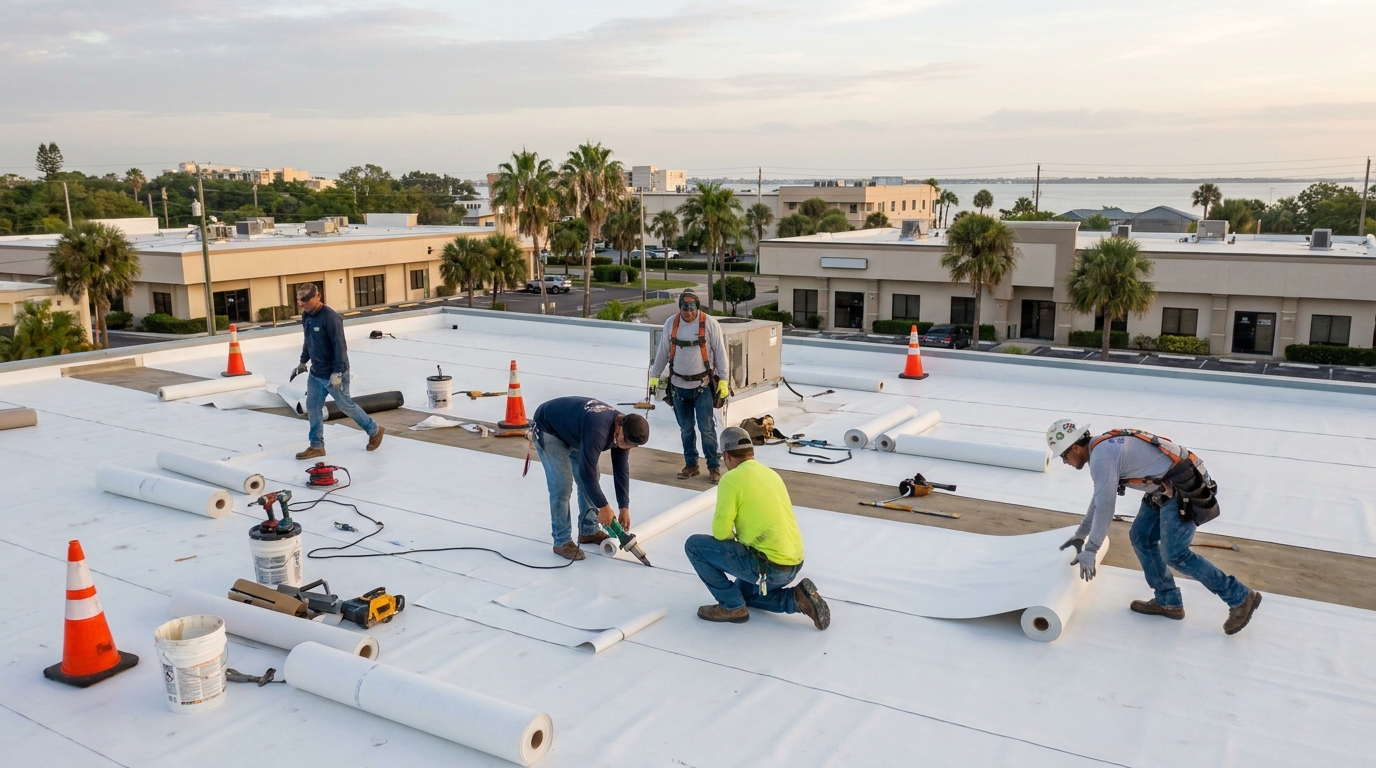
Both systems can achieve wind uplift ratings up to roughly 180 mph when properly engineered and fastened. TPO gets there with induction-welded systems like RhinoBond and careful seam and flashing detailing. Metal gets there through concealed clip systems and appropriate panel gauge.
Where they differ is in debris resistance. When a hurricane sends tree limbs, signage, or roof-mounted equipment airborne, a standing seam metal panel shrugs off impacts that would puncture a TPO membrane. Quality metal systems are often Class 4 hail-rated, and thicker 22–24 gauge panels are especially tough. TPO, by contrast, is vulnerable to punctures — even from routine foot traffic and dropped tools by HVAC techs.
For storm-critical facilities — hospitals near the USF Health corridor, emergency operations centers, data centers, schools designated as shelters — metal is generally the more defensible specification. Florida property insurers may also offer better premium credits for high-wind-rated metal roofs, though you'll want to confirm that with your specific carrier.
Energy Efficiency in Tampa's Cooling Climate
Tampa buildings run air conditioning eight to nine months a year. Roof reflectance matters.
White TPO membranes achieve up to about 88% UV and solar reflectance and meet ENERGY STAR cool roof criteria. On a big flat warehouse or distribution center, that translates to meaningful reductions in cooling load — one reason TPO dominates the industrial flat-roof segment across West-Central Florida.
Metal roofing tops out closer to 70% solar reflectance with high-reflective PVDF/Kynar 500 coatings. It's still a genuine cool-roof option, and well-insulated metal assemblies can approach TPO's energy performance, but on a pure reflectance basis TPO has the edge.
Service Life and Warranty
Metal outlasts TPO by a wide margin.
- TPO service life: 20–30 years with good installation and maintenance. Seams and flashings are the typical failure points.
- Metal service life: 40–60+ years for steel standing seam; 70–100+ years for copper.
Warranties reflect that gap. TPO carries 10- to 30-year material/system warranties, with the longer terms unlocked by thicker membranes and manufacturer-certified installers. Metal systems typically offer 30–50 year panel/substrate warranties, 20–40 year paint/finish warranties on PVDF/Kynar 500 coatings, and workmanship warranties of 5–20 years depending on the contractor. Warranty terms are usually prorated — read the fine print.
Maintenance, Fire, and Roof Geometry
A few quieter factors that often tip the decision:
- Maintenance: TPO needs regular inspection of seams, flashings, and drains, with repairs handled by heat-welded patches. Metal needs periodic checks of fasteners, sealants, and coatings — significantly less ongoing attention.
- Fire: Metal is non-combustible and typically achieves Class A fire ratings with appropriate assemblies. TPO offers good fire resistance but isn't non-combustible.
- Slope: TPO is the standard for flat and low-slope roofs. Most metal standing seam systems require a minimum slope around 1:12 or 1.5:12, though some structural systems go lower with careful detailing. If your roof is dead flat, TPO is likely your only realistic choice.
- Chemical exposure: TPO can struggle with grease, oils, and certain industrial chemicals. Restaurant properties with heavy exhaust discharge, for example, may see faster TPO degradation.
Which System Fits Which Owner?
The clearest way Tampa commercial roofers frame it: under 15 years of ownership, TPO usually wins on ROI; over 20 years, metal's lifecycle math takes over.
TPO makes sense when:
- You're a developer or investor with a hold period under 15–20 years
- The building has a large flat or low-slope roof — warehouse, distribution, big-box retail, office
- Upfront budget is the binding constraint
- Cooling load reduction is a top priority
Standing seam metal makes sense when:
- You're a long-term owner or institution with a 20–40+ year horizon
- The facility is storm-critical or mission-critical
- The roof is sloped, architecturally visible, or both
- You want the lowest possible maintenance burden
FAQ
Do both systems meet the Florida Building Code for Tampa?
Yes — both TPO and standing seam metal can be engineered and installed to meet Florida Building Code high-wind uplift requirements. The specific fastening pattern, insulation attachment, and assembly details will be dictated by your building's wind zone and exposure category.
Which system is better for a coastal Tampa property?
Both work, but coastal proximity to Tampa Bay or the Gulf typically requires enhanced corrosion-resistant specifications for metal — often aluminum panels or upgraded coatings — which increases cost. TPO isn't affected by salt corrosion the same way.
Can I put metal panels over an existing flat roof?
Only if the slope meets the metal manufacturer's minimum, which most flat commercial roofs do not. Retrofitting slope with tapered insulation or a structural sub-frame is possible but changes the project scope and cost significantly.
How long does a Tampa commercial reroof typically take?
It varies with square footage, tear-off requirements, and weather. Scheduling before the peak of hurricane season and around Tampa's afternoon thunderstorm patterns is a common planning consideration.
The Bottom Line for Tampa
There is no universally correct answer — only the right answer for your building, your budget, and your holding period. For a 10-year-hold warehouse in Brandon or a retail center off Kennedy Boulevard, TPO usually pencils out. For a hospital wing, a school, or a family-held commercial property meant to outlive the current ownership, standing seam metal earns its premium.
Commercial property owners in Tampa who want a system-specific recommendation grounded in their building's slope, exposure, and hold period can reach SCM Roofing, LLC at https://scmroofingfl.com for a free estimate. A walk-through by an experienced commercial roofer is usually the fastest way to turn the TPO-vs.-metal question into a defensible spec.