Choosing a commercial roofing contractor in Tampa isn't like hiring one anywhere else. Between the 8th Edition Florida Building Code, hurricane season pressure, and a licensing system that separates state-certified contractors from locally-registered ones, the vetting process here has real teeth. Get it wrong and you're looking at stop-work orders, insurance headaches, or a roof that fails its next major weather test.
This checklist walks through what property managers, building owners, and facilities directors in Tampa, FL should verify before signing a contract — from license type to product approval numbers to what happens when a repair crosses into full-replacement territory.
Start With License Verification
Florida separates roofing contractors into two categories, and the distinction matters for commercial work in Tampa.
- Certified Roofing Contractor (CCC) — issued statewide by the Florida Department of Business and Professional Regulation (DBPR) under Chapter 489, Florida Statutes. Valid anywhere in Florida.
- Registered Roofing Contractor (CCC-R) — issued by a local jurisdiction and valid only within that jurisdiction's boundaries.
For a commercial project in Tampa or unincorporated Hillsborough County, either can be lawful, but a CCC license carries broader authority and a more rigorous qualification path — the state trade exam, the Business & Finance exam, and a minimum of four years of combined education and experience with at least one year on the job.
Verify the license at MyFloridaLicense.com before anything else. Confirm it's active, in the contractor's legal business name, and free of open disciplinary actions. CCC licenses renew biennially, so check the expiration date too.
Confirm Insurance and Financial Responsibility
Florida sets minimum insurance thresholds for roofing contractors, and any legitimate commercial roofer in Tampa should exceed them for a project of meaningful size. Ask for a current Certificate of Insurance showing:
- At least $100,000 in public liability coverage
- At least $25,000 in property damage coverage
- Workers' compensation for all employees — or a filed exemption with the Florida Division of Workers' Compensation for a true sole proprietor
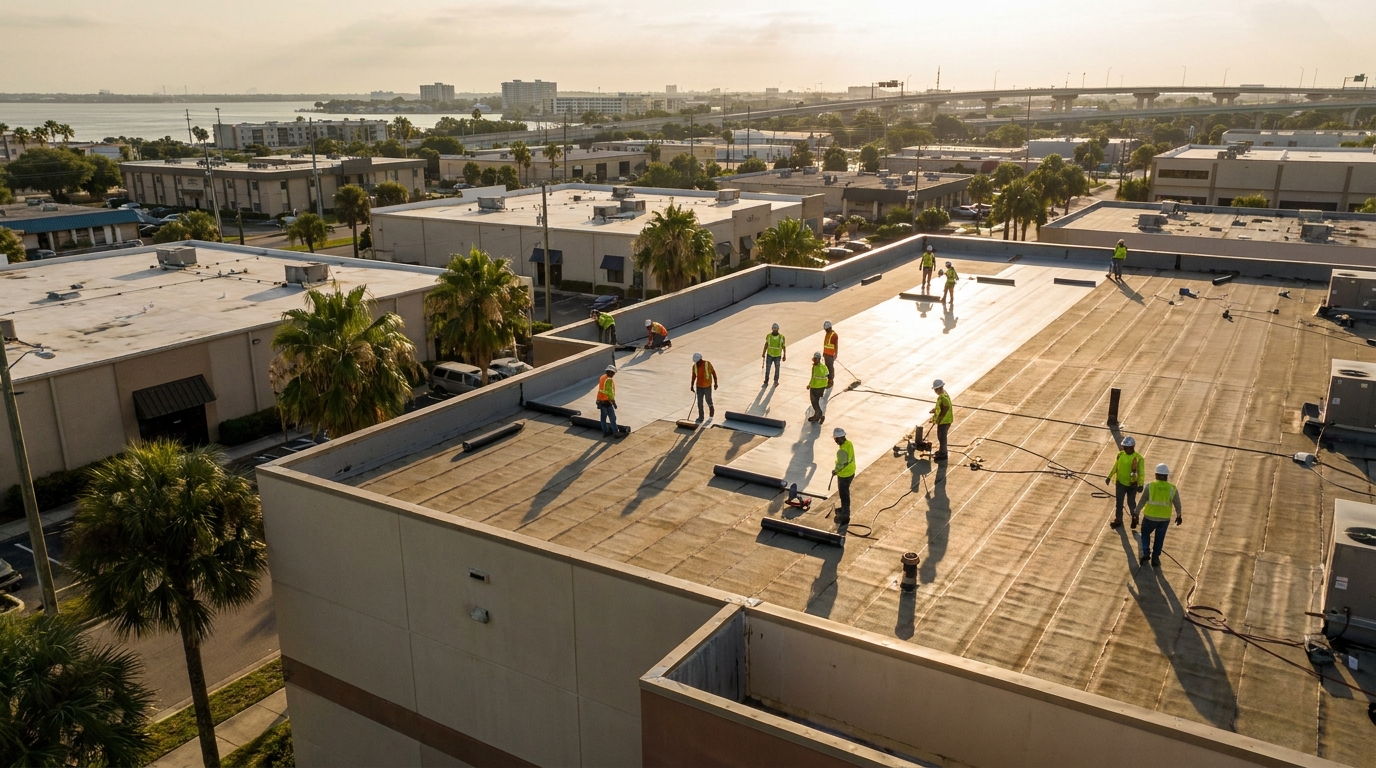
There's also a bonding question worth raising. Under DBPR/CILB financial responsibility rules, applicants with a FICO score below 660 must provide a construction license bond or irrevocable letter of credit. A contractor bonded under that provision isn't necessarily a red flag — but for a large flat-roof replacement on an office park near the Westshore business district or a warehouse in East Tampa, you want visibility into the firm's financial footing regardless.
Ask Who's Pulling the Permit
In Tampa and Hillsborough County, the licensed roofing contractor pulls the permit for commercial roof replacements and significant repairs. Not the property owner. Not a handyman. Not a subcontractor working under someone else's number.
If a bidder suggests you pull the permit yourself, or offers to skip it entirely to save money, walk away. Unpermitted commercial roofing work can trigger stop-work orders, code enforcement fines, and serious complications when the property is sold or insured. Retroactive as-built permits and additional inspections are expensive fixes for a shortcut that shouldn't have been taken.
All work must comply with. A contractor who can't speak fluently about current code requirements is a contractor to keep looking past.
Demand Florida Product Approval Numbers
Every roofing assembly installed in Tampa must carry a valid Florida Product Approval (an FL number). Miami-Dade NOA-approved products are also acceptable statewide, though Tampa is not in the High-Velocity Hurricane Zone — that designation applies only to Miami-Dade and Broward counties.
Before signing, ask the contractor to list the FL numbers for:
- The membrane or roof covering
- Fasteners and attachment systems
- Insulation board
- Edge metal and flashing
Reputable commercial roofing companies in Tampa — SCM Roofing, LLC among them — will have these documented and ready to hand over. A vague answer here often signals a contractor who's used to residential work or who mixes and matches components in ways the building official will flag at inspection.
Understand the Repair vs. Replacement Rules
This is the piece that catches Tampa building owners off guard most often., the old "25% rule" was eliminated. Under the previous rule, if repairs exceeded 25% of a roof section in a 12-month period, the entire roof had to be brought up to current code.
Now,. That can meaningfully change the economics of a repair-versus-replace decision on a strip center in Brandon-adjacent Hillsborough County or a mid-rise near downtown Tampa. Roofs built under earlier codes are subject to different rules — a competent contractor will pull the original permit history before quoting.
Vet Storm-Season Readiness
Tampa's Atlantic hurricane season runs June 1 through November 30, and demand for legitimate commercial roofers spikes hard when a system enters the Gulf. Ask any prospective contractor:
- What's your typical response time for emergency tarping after a named storm?
- Do you prioritize existing commercial clients over new inquiries post-event?
- Do you carry your own tarp inventory, or source it after the fact?
- How do you handle insurance claim documentation — photos, moisture readings, scope-of-loss reports?
The answers separate contractors who plan for storm season from contractors who simply endure it.
Questions to Ask Before You Sign
A short list to run through during the final walk-through:
- What's your DBPR license number, and is it a CCC or CCC-R?
- Can you provide a current Certificate of Insurance naming us as certificate holder?
- Who from your team will pull the permit, and who is the on-site superintendent?
- What FL Product Approval numbers apply to every component of this assembly?
- What's the manufacturer warranty, what's your workmanship warranty, and what voids each?
- How do you handle change orders — written approval before work proceeds?
- What's your process if a named storm arrives mid-project?
Frequently Asked Questions
Does a General Contractor license cover commercial roofing in Tampa?
Industry sources indicate that a General Contractor (CGC) license alone does not authorize roofing work in Florida — a CCC or CCC-R credential is required. This should be verified directly with DBPR or against Chapter 489, Florida Statutes, before relying on it for a specific project.
How long should a commercial roof replacement in Tampa take?
Timelines vary widely by square footage, deck condition, and weather. What matters more than a calendar estimate is a contractor who commits to a schedule in writing and communicates delays proactively — especially during the summer thunderstorm cycle when afternoon rain routinely interrupts work.
What happens if my contractor works without a permit?
City of Tampa and Hillsborough County building officials can issue stop-work orders, impose fines, and require removal of non-compliant work. The property owner often ends up paying to correct it, and unpermitted roofing frequently surfaces during insurance underwriting or property sale due diligence.
Are Miami-Dade NOA products required in Tampa?
No. Tampa is not in the High-Velocity Hurricane Zone, so Florida Product Approval (FL number) products are acceptable. Miami-Dade NOA products can be used statewide, but they aren't required here.
The Bottom Line
Vetting a commercial roofing contractor in Tampa comes down to verifiable credentials, correct product approvals, code fluency, and a clear-eyed plan for what happens when a storm interrupts the schedule. The paperwork isn't bureaucratic overhead — it's what separates a roof that performs from a roof that becomes a liability.
Property managers and building owners in Tampa, FL who want this handled by a licensed commercial roofing team can reach SCM Roofing, LLC at https://scmroofingfl.com for a free estimate and a no-obligation review of scope, code compliance, and product options.