Why Proper Roof Ventilation Saves New Port Richey Homeowners Thousands in Energy and Repairs
Opening Hook (Quotable): "In New Port Richey's punishing summer heat, your attic can reach 150°F without proper ventilation—pushing your air conditioner to work overtime while your roof shingles deteriorate from the inside out. A well-ventilated attic in Pasco County homes stays 30-40°F cooler, cuts cooling costs by $35-55 per month, and extends shingle life from 15 years to 22-25 years. That's thousands in energy savings and fewer premature roof replacements."
---
Table of Contents
1. How Attic Ventilation Works in Florida Heat 2. The 1:150 Ratio: Meeting Florida Building Code 3. Moisture, Humidity, and Attic Rot: Why Pasco County Homes Need Proper Venting 4. How Poor Ventilation Voids Your Roof Warranty 5. What SCM Roofing Recommends for New Port Richey Homes 6. Signs Your New Port Richey Home Needs Better Attic Ventilation 7. Common Ventilation Mistakes New Port Richey Homeowners Make
---
How Attic Ventilation Works in Florida Heat
Think of your attic like a heat trap. Without ventilation, hot air gets trapped under your roof deck with nowhere to go. In New Port Richey's brutal summer climate, unventilated attics regularly exceed 150°F—that's 60°F hotter than the air outside.
The Basic System: Intake and Exhaust
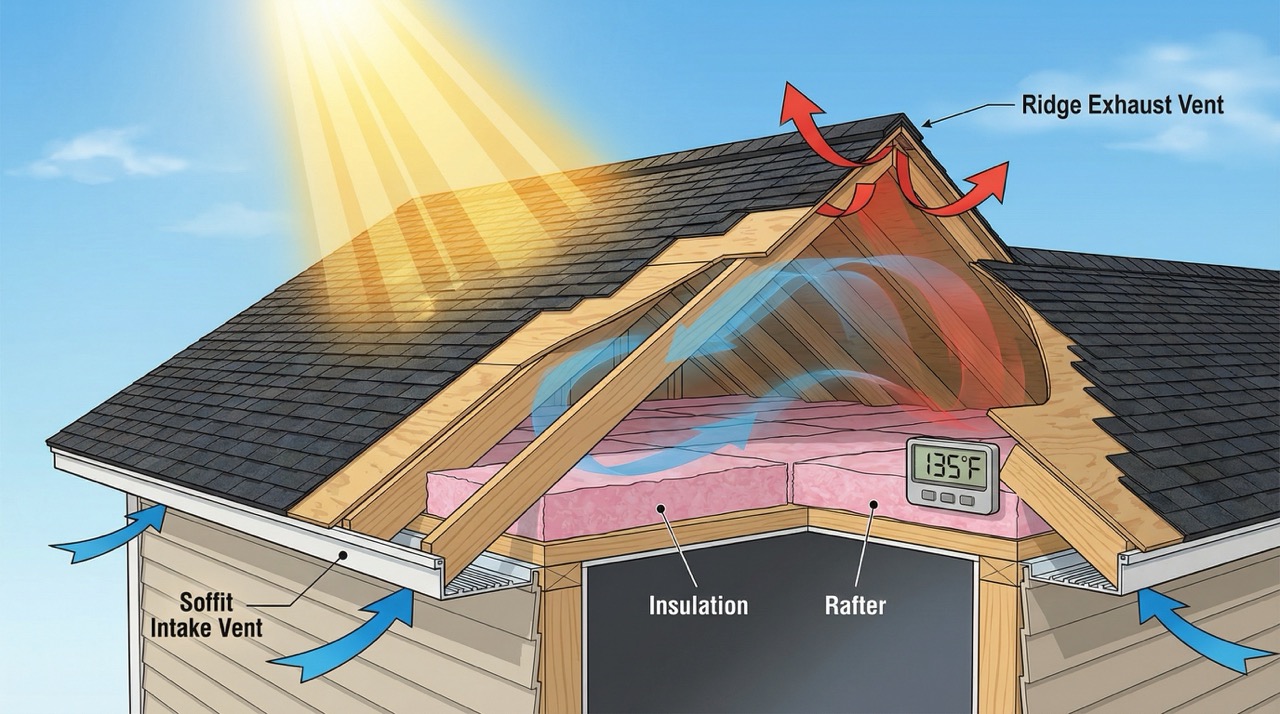
Proper attic ventilation uses two types of vents working together:
- Soffit vents (intake): Located under the roof eaves at the lowest points, these vents draw cool air into the attic
- Ridge vents (exhaust): Located at or near the peak of the roof, these vents let hot air escape at the highest point
As outside air enters through the soffits and warms in the attic, it naturally rises toward the peak. When it reaches the ridge vent, it exits. This creates a steady, passive airflow powered by natural convection—no electric fans needed in most cases.
The cooler air creates negative pressure that continuously draws more fresh air in through the soffits, creating a circulation cycle throughout your entire attic space.
Why This Matters in Pasco County
Florida's relentless sun beats down on dark shingles for 12+ hours a day, even in winter. Without ventilation, that heat penetrates your roof deck and radiates down into the attic. Studies show that balanced attic ventilation reduces peak attic temperatures by 30-40°F compared to unventilated spaces.
That 30-40 degree difference is the difference between:
- An unventilated attic at 160°F that destroys shingles in 15 years
- A properly ventilated attic at 120°F that keeps shingles performing for 22-25 years
---
The 1:150 Ratio: Meeting Florida Building Code
If you've heard a contractor mention "1:150" or "1:300," they're talking about net free ventilation area (NFA)—the legal requirement in Florida for how much vent space your home needs.
The Math Is Simple (But Critical)
The Florida Building Code and International Residential Code require a minimum of 1 square foot of net free vent area for every 150 square feet of attic floor space. This is the standard ratio.
For example:
- A 1,500 sq. ft. attic requires 10 sq. ft. of net free ventilation area (1,500 ÷ 150)
- A 2,000 sq. ft. attic requires 13.3 sq. ft. of net free ventilation area (2,000 ÷ 150)
The 1:300 Exception
You might see contractors offer a 1:300 ratio (half the ventilation required by 1:150). This reduced ratio is only legal in Florida if:
- A vapor barrier is installed over the living space insulation, OR
- There's at least 3 feet of vertical height difference between soffit intake vents and ridge exhaust vents
Most New Port Richey homes built in the 1970s-1990s don't meet these criteria, so they need the full 1:150 ratio.
Why This Matters to Your Warranty
GAF, the roofing material manufacturer used by SCM Roofing, explicitly requires ventilation systems meeting the 1:150 ratio to maintain warranty coverage. Failure to meet GAF's minimum ventilation requirements can void your warranty entirely.
If your attic was under-ventilated when your roof was installed, your warranty might already be compromised.
---
Moisture, Humidity, and Attic Rot: Why Pasco County Homes Need Proper Venting
New Port Richey sits in Pasco County, one of Florida's most humid regions. When humid air gets trapped in an unventilated attic, moisture condenses on wood framing, creating the perfect environment for mold and rot.
The Moisture Problem in Hot, Humid Climates
In summer, warm outside air enters your home through air leaks. Some of that humid air works its way into your attic (through ceiling penetrations like light fixtures, exhaust ducts, and gaps around pipes). If that humid air can't escape through vents, it condenses on cool surfaces—particularly the underside of the roof deck and wooden rafters.
The result: Mold growth, wood decay, delaminating roof decking, and structural damage that shows up 5-10 years later as soft spots in your roof or stains on ceiling drywall.
Why Ventilation Solves This
A properly ventilated attic keeps humid air moving. Fresh air from the soffits picks up moisture-laden air and carries it out through the ridge vent. Without this airflow, moisture builds up and causes damage.
Pasco County homes built before 2000—which includes many New Port Richey neighborhoods—often have undersized or blocked soffit vents, blown-in insulation that covers the vent areas, and inadequate ridge ventilation. These homes are especially vulnerable to moisture damage.
Signs of Moisture Problems:
- Musty, moldy smell in the attic
- Dark stains on rafters or decking
- Soft, spongy wood when poked with a screwdriver
- Visible mold or mildew on framing
- Attic insulation that looks wet or matted down
---
How Poor Ventilation Voids Your Roof Warranty
This is critical: Inadequate ventilation is one of the most common reasons GAF shingle warranties are voided.
What GAF Requires
GAF's Golden Pledge warranty—the premium 25-year workmanship coverage offered exclusively by Master Elite contractors like SCM Roofing—requires:
- Ventilation meeting the 1:150 net free area ratio (or 1:300 with vapor barrier/height difference)
- Balanced intake and exhaust vents (at least 50% of vent area should be intake)
- Properly installed roof deck underlayment
- No blocked soffit vents
- Proper vent spacing and installation per manufacturer specs
What Voids the Warranty
If your attic ventilation doesn't meet these specs:
- Manufacturing defects are not covered (this is huge—GAF won't pay to replace shingles that failed due to trapped heat)
- Workmanship coverage can be challenged
- Any moisture-related damage voids coverage
- Shingle voiding or granule loss from thermal stress isn't covered
Real-World Example
A homeowner in New Port Richey had his shingles curling and granules missing at year 10. He called expecting warranty coverage. But the roofer who installed the roof had blocked his soffit vents with insulation and didn't install a ridge vent. GAF denied the warranty claim because inadequate ventilation caused accelerated shingle failure. The homeowner had to pay $12,000-15,000 for a replacement roof.
SCM Roofing is a GAF Master Elite Certified contractor. We calculate and install ventilation systems that meet or exceed GAF's requirements to protect your warranty and your investment.
---
What SCM Roofing Recommends for New Port Richey Homes
Based on 25+ years of experience roofing Pasco County homes, here's what we recommend:
For Most New Port Richey Homes Built 1970-2000:
These houses typically need a balanced ridge vent and soffit vent system. Many have:
- Inadequate original soffit venting (vents clogged with insulation, missing baffles)
- No ridge vent or undersized ridge vent
- Blocked or undersized attic air intake
Our Recommended Solution: 1. Install (or upgrade to) continuous ridge venting along the entire roof peak 2. Ensure adequate soffit vent area under the eaves—typically 6-12 linear feet per gable end, depending on attic square footage 3. Install rafter baffles or vent baffles between every rafter bay to prevent blown insulation from blocking soffit vents 4. Verify total net free area meets the 1:150 ratio (minimum) 5. Clear and maintain all existing vents
Cost Range: $1,200-$3,500 (depending on roof size and existing vents) Timeline: 1-2 days ROI: $35-55/month in cooling savings = payback in 2-4 years, plus extended roof life
For Newer Homes (2000+) Built to Code:
Newer homes in New Port Richey usually have proper ventilation but may have:
- Blocked soffits from added insulation
- Damaged ridge vent from weather
- Gable vent fans installed improperly (they can actually reduce ventilation efficiency)
Our Recommendation:
- Annual attic inspection to ensure vents remain unobstructed
- Upgrade to ridge venting if only gable vents are present (gable vents alone don't ventilate the sides of the attic)
- Remove undersized or poorly installed powered vents that disrupt natural airflow
For Homes Considering Roof Replacement:
If you're planning a new roof in New Port Richey, we calculate ventilation requirements during the inspection. This is when to:
- Upgrade undersized vent systems to full 1:150 compliance
- Install proper intake/exhaust balance
- Add rafter baffles
- Qualify for GAF Golden Pledge warranty (ventilation is mandatory)
The extra ventilation cost ($1,500-3,000) on a roof replacement is a small investment that protects your warranty, extends shingle life, and saves thousands in energy costs.
---
Signs Your New Port Richey Home Needs Better Attic Ventilation
You Should Call SCM Roofing If Your Home Has:
1. Upper floors that are consistently 5-10°F hotter than lower floors (especially bedrooms)—This signals heat from an insufficiently ventilated attic radiating down
2. High summer electric bills (even with AC running constantly)—Poor ventilation means your AC works 15-25% harder to cool the house
3. Musty or moldy smell in the attic—Classic sign of trapped moisture in Pasco County's humid climate
4. Visible soffit vents that are clogged with insulation or dust—Common in homes where insulation was added or blown in without proper baffles
5. Roof shingles showing premature aging (curling, granule loss, sun-bleached areas) before year 15-18—Often caused by excessive attic heat
6. Water stains or dark spots on attic rafters or decking—Moisture condensation from poor ventilation
7. Ice dams in winter (if you're in a colder part of Pasco)—Uneven attic temperatures cause roof-to-snow temperature differences
8. A roof installed more than 10 years ago without any ridge vent—Very common in older New Port Richey homes; these need urgent ventilation upgrades
---
Common Ventilation Mistakes New Port Richey Homeowners Make
Mistake #1: Blocking Soffit Vents with Insulation
When adding blown-in attic insulation, contractors sometimes pile it up to the very edge of the attic, completely blocking soffit vents. This kills ventilation immediately.
Fix: Install rafter baffles (also called vent chutes) from the rafter to soffit vent to keep insulation away and maintain airflow.
Mistake #2: Mixing Vent Types Incorrectly
A home with soffit vents, ridge vents, AND gable vents AND a powered attic fan isn't "more ventilated"—it's fighting itself. Different vent types can create competing air pressures that reduce overall effectiveness.
Fix: Use a balanced ridge/soffit system (the most effective). Remove powered fans unless specifically calculated into your ventilation design.
Mistake #3: Undersizing Vents When Replacing a Roof
"Let's just install the same size vents as the old roof." Wrong. Most older New Port Richey homes were under-ventilated to begin with. A roof replacement is the perfect time to upgrade to 1:150 compliance.
Fix: Have your roofer calculate required ventilation area and install accordingly. GAF requires it for warranty coverage.
Mistake #4: Not Balancing Intake and Exhaust
A home with lots of ridge venting but tiny soffit vents can't breathe properly. The system must be balanced: roughly 50% intake (soffit) and 50% exhaust (ridge/gable).
Fix: Audit your vents. If you see significant ridge venting but can't find soffit vents, you need more soffit intake.
Mistake #5: Assuming Passive Ventilation Isn't Enough
Some homeowners think they need expensive attic fans. In most Pasco County homes, passive ridge/soffit ventilation works perfectly when properly sized and balanced. Attic fans add noise, use electricity, and can actually reduce efficiency if not professionally designed.
Fix: Install (or upgrade to) proper passive ventilation first. Fans are a last resort.
---
FAQ: Roof Ventilation & Florida Heat
Q: How much will better attic ventilation save me on electric bills in New Port Richey?
A: A properly ventilated attic reduces cooling costs by 10-15%, translating to $35-55 per month in energy savings during June through September. For a typical Pasco County home, that's $200-300/year or $2,000-3,000 over a roof's 20+ year lifespan.
Q: Can I install my own ventilation vents?
A: Yes, but we don't recommend it. Improper soffit or ridge vent installation can leak, fail to meet code, or void your roof warranty. GAF specifically requires proper installation by certified contractors for warranty coverage. Trust a professional. Call SCM Roofing for a free estimate.
Q: What's the difference between a ridge vent and a gable vent?
A: Ridge vents run the full length of the roof peak and vent the entire attic. Gable vents (located in the triangular space under the roof peak on the house's side) only vent a portion of the attic. Ridge vents are superior because they ventilate the entire attic space uniformly. Most New Port Richey homes need ridge vents, not gable vents alone.
Q: My roof is 5 years old. Is it too late to add better ventilation?
A: No. You can add or upgrade ventilation anytime. If your attic is under-ventilated, fixing it now prevents moisture damage and extends the remaining life of your roof. Many New Port Richey homeowners upgrade ventilation between roof replacements to avoid future problems.
Q: Do I really need rafter baffles if I add blown-in insulation?
A: Yes. Blown-in insulation naturally migrates toward soffit vents and will block them without baffles. Rafter baffles are inexpensive ($0.50-1.00 per linear foot) and critical for maintaining ventilation. They're also required by building code in most modern construction.
Q: My contractor says I need 1:300 ventilation, not 1:150. What's the difference?
A: 1:300 is only legal in Florida if you have a vapor barrier over your insulation OR a 3+ foot height difference between soffit intake and ridge exhaust. Most New Port Richey homes built before 2005 don't meet these criteria, so they need 1:150. Ask your contractor to show you the specific exemption in writing—if they can't, you need 1:150.
Q: What does "net free area" mean, and why does it matter?
A: Net free area (NFA) is the actual open space in a vent after accounting for screen, frame, and louvers. A 16-inch soffit vent might look full-sized but only have 40% net free area. When calculating ventilation requirements, contractors use NFA, not gross vent size. This is why you can't just count how many vents you have—you need to calculate actual open area.
Q: Can I use ridge vents without soffit vents (or vice versa)?
A: No. You need both for proper ventilation. Ridge vents alone create an exhaust point but no intake, so air can't circulate. Soffit vents alone create intake but no exhaust. Both together create the passive convection cycle that keeps your attic cool and dry. New Port Richey homes need a balanced system.
Q: My attic gets very humid in summer. Will ventilation fix that?
A: Ventilation helps significantly by removing stale, humid air, but in humid climates like Pasco County, ventilation isn't a complete solution. The best approach is: proper ventilation + adequate soffit intake + sealed attic air leaks + proper insulation above the living space. Talk to SCM Roofing about a whole-system approach.
---
Key Takeaways
- Unventilated attics in New Port Richey reach 150-160°F, while properly ventilated attics stay 30-40°F cooler, saving $35-55/month in AC costs
- The 1:150 rule: Florida code requires 1 square foot of net free ventilation area per 150 square feet of attic space; this is mandatory for GAF warranty coverage
- Soffit (intake) and ridge (exhaust) vents must work together in a balanced system; mixing vent types or blocking soffits kills ventilation
- Poor ventilation causes: premature shingle failure, voided warranties, moisture damage, mold, wood rot, and higher energy bills
- Most Pasco County homes built before 2000 are under-ventilated and benefit from upgrading soffit and ridge vents
- A ventilation upgrade pays for itself in 2-4 years through energy savings alone, while extending your roof's lifespan by 7-10 years
- SCM Roofing, a GAF Master Elite Certified contractor, designs and installs ventilation systems that meet code, protect your warranty, and save money
---
Ready to Upgrade Your New Port Richey Home's Ventilation?
Don't let a poorly ventilated attic waste your money on energy bills and premature roof failure. SCM Roofing has spent 25+ years installing proper ventilation systems on Pasco County homes.
Contact SCM Roofing today for a free attic ventilation inspection:
- Phone: 855-SCM-ROOF (855-726-7663)
- Website: scmroofingfl.com
- Service Area: New Port Richey, Pasco County, and all of Tampa Bay
We'll inspect your attic, calculate your ventilation needs, and show you exactly how much energy and roof life you'll save. Most New Port Richey homeowners qualify for energy-efficient ventilation upgrades.
SCM Roofing — GAF Master Elite Certified | 25+ Years Locally Owned
---