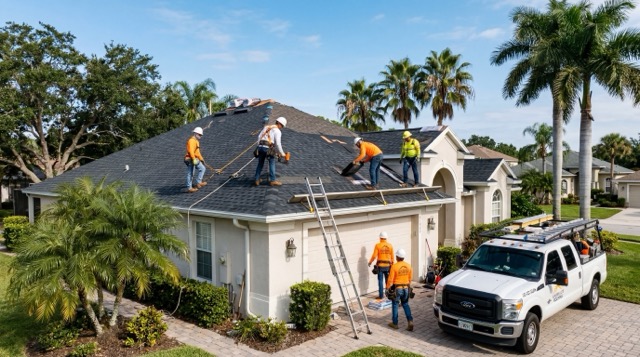
How to Verify Your Florida Roofer Is Licensed and Avoid Storm Chasers
To check if your roofer is licensed in Florida, go to myfloridalicense.com and search by the contractor’s name or license number. Look for an active CCC (Certified Roofing Contractor) license with no disciplinary actions. Florida law requires every roofing contractor to hold this state license, and hiring someone without one puts your home, your investment, and your insurance coverage at risk.
Table of Contents
- Why Does Florida Require Roofing Contractors to Be State Licensed?
- How to Look Up a Roofing Contractor’s License in Florida
- What Are Storm Chasers and How Do They Operate on the Gulf Coast?
- What Are the Warning Signs of a Roofing Scam in Florida?
- What Should You Look for in a Legitimate Gulf Coast Roofing Contractor?
- What SCM Roofing Recommends
- Frequently Asked Questions
- Key Takeaways
Why Does Florida Require Roofing Contractors to Be State Licensed?
Florida Statute 489 requires anyone performing roofing work to hold a state-issued CCC (Certified Roofing Contractor) license. This isn’t a local business tax receipt or a general handyman permit. It’s a specific credential that requires passing a state exam, proving financial responsibility, carrying liability insurance, and maintaining workers’ compensation coverage.
The licensing process exists because roofing work directly affects your home’s structural safety and your ability to insure it. A roof installed without proper permits by an unlicensed contractor creates a chain of problems: the work may not meet building code, the permit may be void, the manufacturer warranty won’t apply, and your insurance carrier may deny future claims.
Unlicensed contracting in Florida is a first-degree misdemeanor. During a declared state of emergency — which happens after every major hurricane — unlicensed contracting becomes a third-degree felony. The state takes this seriously because the worst roofing scams happen when homeowners are most vulnerable.
Permits pulled by unlicensed contractors are void under Florida law. That means even if the work looks fine on the surface, it has no legal standing. When you sell your home, a title search or inspection can reveal the unpermitted work, creating complications that cost thousands to resolve.
How to Look Up a Roofing Contractor’s License in Florida
Verifying a license takes less than two minutes. Here’s the step-by-step process:
Step 1: Go to myfloridalicense.com. This is the Florida Department of Business and Professional Regulation’s (DBPR) official license verification portal.
Step 2: Click “Verify a License” and search by the contractor’s name or license number. If they gave you a license number, search by that — it’s faster and more accurate. Florida roofing contractor license numbers start with CCC.
Step 3: Verify the license status shows “Current, Active.” Anything else — expired, suspended, revoked, or delinquent — means they are not legally authorized to perform roofing work in Florida.
Step 4: Check for disciplinary actions. The portal shows any complaints, fines, or disciplinary history. A clean record is what you want to see. A contractor with multiple complaints or disciplinary actions is a risk.
Step 5: Ask for insurance certificates. A valid license doesn’t guarantee current insurance. Ask the contractor to provide certificates of liability insurance and workers’ compensation coverage. Call the insurance company listed on the certificate to verify it’s active. If a worker is injured on your property and the contractor doesn’t have workers’ comp, you may be liable.
Any legitimate roofing contractor will provide their license number without hesitation. If someone can’t or won’t give you a license number on the spot, that tells you everything you need to know.
What Are Storm Chasers and How Do They Operate on the Gulf Coast?
Storm chasers are out-of-state roofing crews that follow hurricane damage across the Southeast. They show up on the Gulf Coast within days of a storm, go door to door in damaged neighborhoods, and offer to fix your roof at prices that sound too good to pass up.
Here’s how they typically operate:
They arrive in unmarked trucks or trucks with magnetic signs that can be removed. Their license plates are from out of state. They knock on doors in neighborhoods with visible damage, often starting conversations with “I noticed your roof took some damage. We’re working in the neighborhood and can fit you in this week.”
They offer free inspections, then present estimates that are deliberately low to win the job quickly. Some will tell you your roof is covered by insurance and promise to “handle everything” with your carrier. Others push hard for a cash deposit — sometimes 50% or more upfront — before any work begins.
The work itself is often substandard. Shingles installed without proper fastening patterns, flashing done incorrectly or skipped entirely, no building permits pulled, no manufacturer warranty registration. The crew finishes as fast as possible and moves to the next house or the next storm.
By the time problems appear — leaks, lifted shingles, failed inspections — the crew is in another state. The phone number doesn’t answer. The “company” has no local address. Your warranty claim goes nowhere because the manufacturer never authorized the installation.
After Hurricanes Ian and Helene, Gulf Coast communities from Fort Myers to Tampa saw this pattern repeat across thousands of homes. The DBPR and local law enforcement increase enforcement after storms, but they can’t be everywhere at once.
What Are the Warning Signs of a Roofing Scam in Florida?
Beyond storm chasers specifically, here are the red flags that apply year-round:
No written estimate. Every legitimate contractor provides a detailed written estimate before work begins. If someone gives you a verbal quote and wants to start immediately, walk away.
Won’t pull permits. If a contractor says permits aren’t necessary or offers to skip the permit to save you money, they’re either unlicensed or trying to avoid building department scrutiny. In Florida, roofing work requires a permit. Period.
Cash-only demands. Legitimate contractors accept checks, credit cards, and financing. Demanding cash only — especially a large deposit — is a classic scam indicator. Florida law limits contractor deposits to 10% or $1,000, whichever is less, for contracts without financing.
No physical office. Check the contractor’s address. If it’s a PO box, a virtual office, or an out-of-state address, they don’t have roots in the community. A local roofing contractor has a physical location where you can find them if problems arise.
Can’t provide a license number immediately. A licensed contractor knows their CCC number by heart. Hemming, hawing, or promising to “send it later” is a dealbreaker.
Uses sub-subcontractors. Your contractor hires a sub, who hires another sub, who hires the crew that actually does the work. Each layer of separation reduces accountability and quality control.
No manufacturer certifications. Manufacturer certifications like GAF Master Elite require ongoing training, inspections, and adherence to installation standards. A contractor without any manufacturer certifications may not be installing products according to the specifications required for warranty coverage.
Pressures you to sign an AOB agreement. Assignment of Benefits (AOB) agreements transfer your insurance claim rights to the contractor. While Florida’s AOB reform legislation has curbed some abuses, be cautious about signing any document that gives a contractor control over your insurance claim.
What Should You Look for in a Legitimate Gulf Coast Roofing Contractor?
Here’s the checklist for vetting a roofing contractor in Florida:
Active CCC state license. Verified at myfloridalicense.com with no disciplinary actions.
Local office in the service area. A physical address where the business operates — not a PO box or an address in another state. A contractor who lives and works in your community has a reputation to protect.
Liability insurance and workers’ compensation certificates. Current certificates from the insurance carrier, not just a copy of an old certificate. Call the insurer to verify if you want to be thorough.
Manufacturer certifications. GAF Master Elite certification means the contractor is in the top 3% of roofing contractors in North America. They’ve met rigorous standards for installation quality, training, and customer satisfaction. Other manufacturers have similar programs. Certification means the manufacturer stands behind the contractor’s work.
Pulls their own permits. A legitimate contractor handles permitting through the local building department. The permit should be in the contractor’s name — not yours, and not a subcontractor’s. Ask to see the permit before work begins.
Provides written estimates and contracts. A detailed scope of work, material specifications, timeline, payment schedule, and warranty information — all in writing before any work starts.
Strong local reviews. Google reviews, BBB rating, and references from actual customers in your area. Look for patterns in reviews, not just the star rating. Multiple complaints about the same issue (communication, cleanup, timeline) are worth paying attention to.
What SCM Roofing Recommends
After every storm, our phones ring with calls from homeowners who hired the wrong contractor first. They paid a deposit, the work was done poorly or not at all, and now they need someone to fix it. It’s the same story after every hurricane season on the Gulf Coast.
SCM Roofing is locally owned, Florida State Licensed, and has served the Gulf Coast for over 25 years. Our founder, Scott Marone, is a University of Florida Construction Management graduate and holds both a General Contractor and Roofing Contractor state license. We’re not going anywhere because this is our community.
As a GAF Master Elite certified contractor — the top 3% of roofing contractors in North America — we meet the highest standards for installation quality, training, and customer satisfaction. That certification means GAF backs our work with their strongest warranty protection, and it means our crews are trained and retrained on proper installation methods.
SCM Roofing pulls every permit. Every project gets a building department inspection. Every roof is installed to or above Florida Building Code requirements. When you call us five years from now with a question about your roof, the same company answers the phone.
That’s the difference between a local licensed contractor and a storm chaser. One builds your roof. The other builds a problem.
---
Frequently Asked Questions
Q: How do I check if a roofer is licensed in Florida?
A: Go to myfloridalicense.com and search by the contractor’s name or license number. Look for an active CCC (Certified Roofing Contractor) license with a “Current, Active” status and no disciplinary actions. This search takes less than two minutes and is the single most important step before hiring any roofer in Florida.
Q: What happens if I hire an unlicensed roofing contractor in Florida?
A: You lose legal protections, building code compliance, manufacturer warranties, and potentially your insurance coverage. Permits pulled by unlicensed contractors are void under Florida law. If the work fails, you have limited recourse because unlicensed contractors often lack insurance and disappear. You may also be liable for injuries to uninsured workers on your property.
Q: Are storm chasers illegal in Florida?
A: Storm chasers who hold valid Florida CCC licenses are technically legal, though rare. Most storm chasers operating on the Gulf Coast after hurricanes are unlicensed, which is a misdemeanor under Florida Statute 489 — and a felony during a declared state of emergency. Even licensed out-of-state contractors who don’t properly register in Florida are operating illegally.
Q: What does GAF Master Elite certification mean for a roofing contractor?
A: GAF Master Elite is the highest certification level from GAF, North America’s largest roofing manufacturer. Only the top 3% of roofing contractors earn this designation. It requires proven installation expertise, ongoing training, a track record of customer satisfaction, and financial stability. GAF Master Elite contractors can offer GAF’s strongest warranty packages, including coverage that standard contractors cannot.
Q: Should I let a roofing company handle my insurance claim on the Gulf Coast?
A: Be cautious. A reputable contractor will provide a detailed damage assessment and estimate to support your claim, but you should file the claim yourself and maintain control of the process. Avoid signing an Assignment of Benefits (AOB) agreement that transfers your claim rights to the contractor. Work with your insurance carrier directly and use your contractor’s documentation as supporting evidence.
---
Key Takeaways
- Always verify your Florida roofer’s CCC license at myfloridalicense.com before hiring — unlicensed work voids permits, warranties, and potentially your insurance coverage.
- Storm chasers flood the Gulf Coast after every hurricane — watch for out-of-state plates, no local address, pressure to sign immediately, and requests for large cash deposits.
- A legitimate contractor has an active state license, local office, insurance certificates, manufacturer certifications, and pulls their own permits.
- SCM Roofing is locally owned, FL State Licensed, and GAF Master Elite certified — the top 3% of roofing contractors in North America, serving the Gulf Coast for 25+ years.
---
Looking for a licensed, certified roofing contractor on the Gulf Coast? SCM Roofing provides free estimates across Charlotte, Collier, Hillsborough, Lee, Manatee, Pasco, Pinellas, and Sarasota counties. Call us at 855-SCM-ROOF or request an appointment online.