Your 2026 Hurricane Season Roof Prep Checklist for Florida’s Gulf Coast
A pre-season roof inspection and an 8-point checklist can prevent thousands of dollars in damage and dramatically simplify your insurance claims if a storm hits. Early forecasts project 12 to 16 named storms for the 2026 Atlantic hurricane season, with warmer-than-average Gulf waters raising the risk for Florida’s coast. The time to prepare is now — not when a storm is named.
Table of Contents
- When Should Gulf Coast Homeowners Start Preparing Their Roof for Hurricane Season?
- The 8-Point Pre-Hurricane Roof Inspection Checklist
- What DIY Roof Prep Can Homeowners Do vs. What Requires a Professional?
- How to Prepare Your Roof Insurance Before Hurricane Season
- What to Do If a Hurricane Damages Your Roof on the Gulf Coast
- What SCM Roofing Recommends
- Frequently Asked Questions
- Key Takeaways
When Should Gulf Coast Homeowners Start Preparing Their Roof for Hurricane Season?
Hurricane season officially runs June 1 through November 30, but your preparation timeline starts months earlier.
April: Schedule your roof inspection. This is the month to pick up the phone and book a professional roof inspection. Every licensed roofing contractor on the Gulf Coast is booking April and May inspections right now. Waiting until May means competing with thousands of other homeowners who just realized the season is coming.
May: Complete all repairs. Any issues found during your inspection need to be fixed before June 1. That includes loose shingles, deteriorated flashing, gutter problems, and tree trimming. A repair that takes two weeks to schedule in April takes six weeks in May and might not get done before a storm.
June 1: Season starts. By this date, your roof should be inspected, repaired if needed, documented with photos, and your insurance policy should be reviewed. There’s nothing left to do but monitor forecasts.
The worst position is scrambling after a named storm appears in the Gulf. At that point, every roofer from Tampa to Naples is fielding hundreds of calls. Emergency tarping materials sell out. Hardware stores have lines around the building. The homeowners who prepared in April are the ones sleeping soundly.
The 8-Point Pre-Hurricane Roof Inspection Checklist
These eight items cover the critical checkpoints every Gulf Coast homeowner should address before hurricane season:
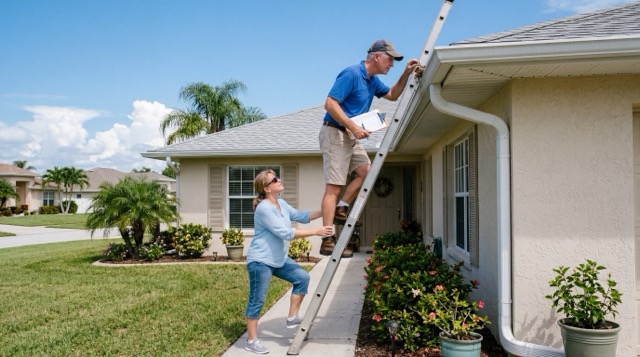
1. Professional roof inspection. Have a licensed roofing contractor walk your roof and inspect every component — covering, flashing, penetrations, ridge caps, edges, valleys, and structural connections. They’ll catch problems you can’t see from the ground.
2. Flashing check at all penetrations. Every pipe vent, exhaust fan, skylight, satellite dish mount, and chimney has flashing around it. Those flashing points are where water gets in during wind-driven rain. Your inspector should check the sealant, the metal condition, and the overlap at each one.
3. Gutter and downspout cleaning. Clogged gutters during a hurricane mean water backs up under your roof edge. That water finds its way into your fascia, soffit, and eventually your attic. Clean gutters and confirm downspouts are directing water away from your foundation.
4. Loose shingle and tile resecuring. Shingles with lifted edges and tiles with broken clips are the first to go in high winds. Once one lifts, the wind gets underneath and peels back more. A few resecured shingles today prevents a stripped roof section during a storm.
5. Tree limb trimming (6-foot clearance). Any branch within 6 feet of your roof is a projectile during hurricane-force winds. Live oaks, which are everywhere from Tampa Bay to Charlotte Harbor, drop heavy limbs that can punch through a roof deck. Trim back now, not during a storm warning.
6. Attic inspection for daylight and leaks. Go into your attic on a sunny day and look up. If you see daylight, water is getting in during rain. Check for staining, mold, and any signs of moisture. These weak points become major failures during a hurricane.
7. Secure all roof-mounted equipment. Satellite dishes, antenna mounts, solar panel brackets, and HVAC equipment on the roof need to be checked for secure attachment. Loose equipment becomes airborne debris that damages your roof and your neighbors’ property.
8. Document everything with dated photos. Walk around your home and photograph every side of your roof, close-ups of the condition, gutters, flashing, and any existing damage. Date-stamp the photos and save them to cloud storage. This documentation is invaluable if you need to file an insurance claim after a storm.
What DIY Roof Prep Can Homeowners Do vs. What Requires a Professional?
Some prep work is safe and practical for homeowners. Other tasks require a licensed professional.
Safe for DIY:
- Gutter cleaning from a stable ladder (not on the roof itself)
- Visual inspection from the ground with binoculars
- Tree limb trimming that’s accessible from the ground
- Photo documentation of roof condition
- Clearing yard debris that could become wind-borne projectiles
- Checking that attic vents are clear and functional
Requires a professional:
- Walking the roof to inspect the surface, especially on tile or steep-pitch roofs
- Flashing repair or replacement at penetrations
- Re-securing loose shingles, tiles, or metal panels
- Attic inspection for structural issues, truss connections, and deck condition
- Any repair work that involves sealant, underlayment, or structural components
The safety rule is simple: if it requires getting on the roof, call a professional. Florida roofs are steep, tile is slippery, and a fall from a single-story home can cause serious injury. The few hundred dollars for a professional inspection is not worth the risk of doing it yourself.
How to Prepare Your Roof Insurance Before Hurricane Season
Your insurance policy is only useful if you understand it before a storm, not while one is bearing down on your house.
Review your policy now. Pull it out and read the coverage details. Know your dwelling coverage limits, your hurricane deductible (which is separate from your standard deductible and usually a percentage of your home’s insured value — typically 2% to 5%), and any exclusions.
Understand your hurricane deductible. On a home insured for $400,000 with a 2% hurricane deductible, you’re responsible for the first $8,000 of hurricane damage. That’s a big number. Know it before a storm hits. Some policies have higher percentages, and the deductible applies per storm event.
Update your wind mitigation inspection. If you’ve had any roof work done since your last wind mitigation inspection, get an updated report. An outdated inspection means you’re missing credits and potentially paying hundreds more per year than necessary. The April 2026 form update makes now a good time to refresh.
Photograph your entire roof and upload to cloud storage. Before damage occurs, document the condition of your roof from every angle. If you file a claim, your insurance carrier will want to know what the roof looked like before the storm. Without pre-storm photos, the adjuster has to rely entirely on their own assessment.
Know your claim filing deadline. Florida law gives homeowners specific timeframes to report claims. Missing the deadline can cost you your entire claim. Check your policy for the reporting window.
What to Do If a Hurricane Damages Your Roof on the Gulf Coast
When a storm hits, the first 48 to 72 hours are critical. Here’s the sequence:
Emergency tarping. If your roof is compromised and rain is coming, a tarp prevents further damage. For safety, call a professional tarping service rather than climbing onto a damaged roof yourself. If you must tarp, use a heavy-duty tarp that extends past the ridge and secure it with 2x4 lumber, not just sandbags that shift in wind.
Document all damage immediately. Photograph and video everything before any cleanup or temporary repairs. Interior damage, exterior damage, water intrusion, debris — all of it. This evidence supports your insurance claim.
Contact your insurance carrier before hiring a contractor. Report the damage to your insurer within the policy’s reporting window. Get a claim number. Then have your contractor provide an independent assessment.
Avoid storm chasers. After every Gulf Coast hurricane, out-of-state crews flood the area going door to door offering emergency repairs. Red flags: no local address, out-of-state license plates, pressure to sign immediately, asking for large cash deposits, and offering to “handle everything with your insurance company.” These crews do substandard work and disappear before warranty claims can be filed.
Call a local licensed contractor. This is why having a relationship with a roofing contractor before the storm matters. SCM Roofing prioritizes existing customers and homeowners in our eight-county service area. We don’t chase storms — we’re already here.
What SCM Roofing Recommends
Every year we see homeowners scrambling in June for repairs they could have handled in April. A cracked flashing that takes 30 minutes to fix in April becomes a $5,000 water damage problem in August when a storm pushes rain through it.
Schedule your roof inspection now. Not May. Not June. Now. Our April calendar across all eight counties — Charlotte, Collier, Hillsborough, Lee, Manatee, Pasco, Pinellas, and Sarasota — fills up fast, and we want every homeowner in our service area heading into hurricane season with a clean bill of health on their roof.
As a GAF Master Elite certified contractor, SCM Roofing doesn’t just inspect — we provide a written assessment with photos and specific recommendations. If repairs are needed, we handle them promptly so you’re ready before June 1.
The 2026 season forecasts point to above-average activity in the Atlantic basin, with warm Gulf waters adding risk for the Florida coast. Tampa Bay’s shallow bay amplifies storm surge. The Sarasota-Charlotte coastline is exposed. Barrier islands from Anna Maria to Sanibel face the highest risk.
Don’t wait for a cone of uncertainty to include your zip code. Prepare now.
---
Frequently Asked Questions
Q: When should I get my roof inspected before hurricane season in Florida?
A: Schedule your inspection in April or early May at the latest. Hurricane season starts June 1, and any repairs found during inspection need time to be completed. By mid-May, most Gulf Coast roofing contractors are fully booked through June.
Q: How much does a pre-hurricane roof inspection cost on the Gulf Coast?
A: A professional roof inspection on Florida’s Gulf Coast typically costs $150 to $350 depending on the size and complexity of your roof. Many contractors, including SCM Roofing, offer free inspections when combined with an estimate for any needed repairs. The cost of an inspection is negligible compared to the damage an undetected problem can cause during a storm.
Q: Can I prep my roof for a hurricane myself or do I need a contractor?
A: You can handle gutter cleaning, ground-level visual inspections, tree trimming, photo documentation, and yard debris cleanup yourself. Any work that requires getting on the roof — walking the surface, repairing flashing, resecuring shingles, or structural assessment — should be done by a licensed contractor. Florida roofs are not safe for untrained people to walk on.
Q: What should I do if my roof is damaged during a hurricane in Florida?
A: First, tarp any openings to prevent further water damage (hire a professional if possible). Document all damage with photos and video immediately. Contact your insurance carrier to file a claim. Then call a local licensed contractor for an independent damage assessment. Avoid storm chasers who go door to door after storms.
Q: Does my homeowners insurance cover hurricane roof damage on the Gulf Coast?
A: Most Florida homeowners policies cover wind damage from hurricanes, but with a separate hurricane deductible that’s typically 2% to 5% of your home’s insured value. On a $400,000 home with a 2% deductible, you pay the first $8,000 out of pocket. Review your policy before hurricane season to understand your deductible and coverage limits.
---
Key Takeaways
- Schedule your roof inspection in April and complete all repairs by the end of May — contractors are fully booked once hurricane forecasts go active.
- Follow the 8-point checklist: professional inspection, flashing check, gutter cleaning, shingle resecuring, tree trimming, attic check, equipment securing, and photo documentation.
- Review your insurance policy before hurricane season, paying special attention to your hurricane deductible and building code upgrade coverage.
- SCM Roofing provides pre-season roof inspections across all eight Gulf Coast counties — call now while April availability remains.
---
Ready to get your roof hurricane-ready? SCM Roofing provides free estimates across Charlotte, Collier, Hillsborough, Lee, Manatee, Pasco, Pinellas, and Sarasota counties. Call us at 855-SCM-ROOF or request an appointment online.