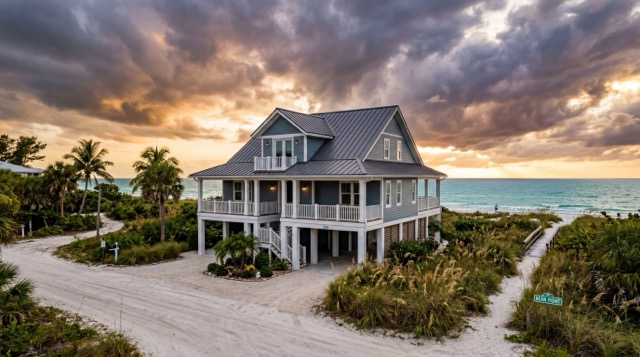
Barrier Island Roofing: How Salt Air and Storms Affect Roofs on Anna Maria Island
Roofs on Anna Maria Island wear out faster than mainland roofs because they face a combination of threats that inland homes never deal with. Salt air corrodes metal components, constant Gulf winds accelerate wear on every surface, and higher design wind speeds mean the Florida Building Code demands more from barrier island construction. For homeowners on Anna Maria, understanding these challenges is the difference between a roof that lasts and one that fails early.
Table of Contents
- Why Do Roofs Fail Faster on Anna Maria Island?
- What Roofing Materials Hold Up Best in Coastal Salt Air?
- How Does Living on a Barrier Island Affect Roof Insurance?
- What Extra Maintenance Do Anna Maria Island Roofs Need?
- How Does the Florida Building Code Treat Barrier Island Homes Differently?
- What SCM Roofing Recommends
- Frequently Asked Questions
- Key Takeaways
Why Do Roofs Fail Faster on Anna Maria Island?
Barrier island roofs degrade 30 to 40% faster than roofs on comparable homes just a few miles inland. That’s not an exaggeration — it’s the reality of living between the Gulf of Mexico and Tampa Bay.
Salt air corrosion is the primary culprit. Airborne salt particles land on every surface of your roof and go to work immediately. Metal components — fasteners, flashing, drip edges, vents, and gutters — are the first to show damage. Standard galvanized steel fasteners that last 20 years in Tampa can start showing rust on Anna Maria Island within 5 to 7 years.
UV intensity is higher on barrier islands because there’s nothing blocking the sun. No tall buildings, minimal tree canopy on most lots, and reflective water on both sides of the island. That UV breaks down asphalt shingle granules faster, degrades sealant strips, and accelerates the aging of rubber boots around pipe penetrations.
Wind exposure is relentless. Anna Maria Island doesn’t have the wind breaks that mainland neighborhoods get from buildings, trees, and terrain. A steady 15 mph breeze off the Gulf that barely registers on the mainland creates constant mechanical stress on shingle edges, tile edges, and flashing.
Sand and debris abrasion adds another layer of wear. Fine sand particles carried by wind act like sandpaper on roof surfaces over time, particularly during storms.
Humidity cycling causes materials to expand and contract daily. Anna Maria’s humidity regularly swings from 50% during midday to 90%+ overnight. That constant cycling loosens fasteners, degrades sealants, and stresses adhesive bonds.
What Roofing Materials Hold Up Best in Coastal Salt Air?
Not all roofing materials are created equal when salt air is in the equation. Here’s how the major options rank for Anna Maria Island:
Standing Seam Metal with Coastal-Rated Coatings — This is the top performer. A standing seam metal roof with Galvalume substrate and a Kynar 500 (PVDF) finish coating resists salt corrosion, reflects UV, and handles high winds with no exposed fasteners. The critical detail: every fastener, clip, and accessory must be stainless steel. One galvanized screw in a coastal metal roof will create a rust streak within a year.
Many of the newer elevated homes on Anna Maria — especially rebuilds after Hurricanes Ian and Helene — are going with standing seam metal for exactly this reason. Lifespan on the island: 30 to 50 years with proper maintenance.
Concrete Tile — Concrete tile is naturally salt-resistant because there’s no metal in the tile itself. It handles UV well and provides excellent impact resistance. The weak points are the underlayment beneath the tiles and the metal flashings, which still need to be coastal-rated. Concrete tile is heavy, which means your structure needs to support it, but that weight also provides hurricane resistance. Lifespan on Anna Maria: 30 to 40 years.
Impact-Rated Architectural Shingles — Modern architectural shingles with algae resistance and Class 4 impact ratings are the most affordable option for barrier island homes. They won’t last as long as metal or tile in the salt air environment, but they’re a solid choice when budget is a factor. The key is choosing shingles with SBS-modified asphalt, which stays more flexible in Florida’s heat cycling. Lifespan on Anna Maria: 15 to 20 years (compared to 20 to 25 years inland).
What to avoid: Standard galvanized steel roofing or any metal roof system without a coastal-rated coating. Galvanized steel near salt water starts showing white rust (zinc oxide) quickly and structural failure follows. If someone quotes you a metal roof on Anna Maria without specifying Galvalume/Kynar or stainless steel fasteners, walk away.
How Does Living on a Barrier Island Affect Roof Insurance?
Insuring a home on Anna Maria Island is harder and more expensive than insuring a comparable home in Bradenton or Lakewood Ranch. That’s the reality of barrier island living.
Fewer insurance carriers are willing to write policies on barrier islands. The hurricane exposure is higher, the flood risk is substantial, and claims history on Anna Maria — particularly after Hurricane Ian in 2022 and Hurricane Helene — has made carriers cautious. Many homeowners on the island end up with Citizens Property Insurance, Florida’s insurer of last resort, because private carriers won’t write the policy.
Flood insurance is virtually mandatory on Anna Maria Island, and it’s separate from your homeowners policy. Most properties fall in FEMA flood zones AE or VE, which carry higher premium requirements.
A code-compliant roof with documented wind mitigation features is the single best thing an Anna Maria Island homeowner can do to keep their home insurable. Hurricane straps, a sealed roof deck, impact-rated covering, and opening protection — when these features are documented on a wind mitigation inspection, they directly reduce your premium and keep carriers willing to write your policy.
The flip side is stark: a non-compliant roof on a barrier island can make your home effectively uninsurable in the private market. In 2026, with carriers returning to Florida but being highly selective, your roof is your ticket to coverage.
What Extra Maintenance Do Anna Maria Island Roofs Need?
Mainland Florida roofs typically need inspection twice a year. Barrier island roofs need three inspections per year minimum — once before hurricane season, once after, and once at midyear.
Here’s the maintenance schedule Anna Maria Island homeowners should follow:
Salt wash-downs every 3 to 4 months. Use fresh water from a garden hose to rinse salt deposits off metal components — flashing, drip edges, vents, and gutters. This simple step dramatically extends the life of metal roofing accessories. Don’t use a pressure washer on shingles or tiles.
Sealant inspections twice a year. Check every sealant joint around penetrations (vents, pipes, skylights, satellite mounts). Salt and UV degrade sealant faster on the island. Budget for resealing penetrations every 3 to 5 years rather than the 7 to 10 years typical on the mainland.
Fastener inspections for corrosion annually. If your roof has any exposed fasteners, check for rust. One corroded fastener can create a leak point and stain surrounding materials. On metal roofs, corroded fasteners should be replaced with stainless steel immediately.
Gutter cleaning every 2 to 3 months. Salt buildup combined with organic debris accelerates gutter corrosion. Aluminum gutters hold up better than steel in coastal environments, but they still need regular cleaning.
The real cost of deferred maintenance on Anna Maria Island is replacement. A roof that could last 25 years with proper maintenance may fail at 15 years without it. That’s a difference of tens of thousands of dollars.
How Does the Florida Building Code Treat Barrier Island Homes Differently?
Anna Maria Island sits in the wind-borne debris region of the Florida Building Code, which triggers the strictest construction requirements in the state.
Higher design wind speeds. Homes on Anna Maria must be built to withstand wind speeds significantly higher than inland Manatee County. The design wind speed determines everything from fastener patterns to connection hardware to material ratings.
Enhanced fastening patterns. Roof decking must be attached with closer nail spacing, and shingles or tiles require enhanced fastening that exceeds the standard code for inland areas. Six-nail shingle patterns are standard on the island.
Sealed roof deck requirements. Barrier island homes require secondary water resistance — a sealed membrane on the roof deck that keeps water out even if the roof covering blows off. This is mandatory, not optional.
Impact-rated materials. All roof coverings, windows, doors, and garage doors on Anna Maria must meet impact-resistance standards or be protected by approved shutters. This includes the roofing material itself.
Anna Maria Island also has its own local regulations beyond the state code. The island’s historic district — particularly in the city of Anna Maria at the north end — has architectural guidelines that affect material choices and roof profiles. Elevated construction standards for new builds and major renovations add another layer of requirements.
What SCM Roofing Recommends
Working on Anna Maria Island is different from working in Tampa or Lakewood Ranch. Every material selection, every fastener choice, and every detail has to account for the coastal environment.
For new roofs and full replacements on Anna Maria, we recommend standing seam metal with Kynar finish and all stainless steel fasteners as the first choice. Concrete tile is an excellent alternative, especially for homeowners who prefer a traditional Florida look. For budget-conscious projects, we use SBS-modified architectural shingles with algae resistance and impact ratings.
Regardless of the covering material, every Anna Maria Island roof SCM Roofing installs gets a sealed roof deck, hurricane-rated connections, and coastal-grade flashing. We don’t use galvanized fasteners on barrier island projects — it’s stainless steel across the board.
As a GAF Master Elite certified contractor, SCM Roofing has the manufacturer training and product access to handle the specific demands of barrier island construction. We’ve worked across Manatee County’s coast from Anna Maria to Longboat Key, and we understand what the salt air does to roofing systems that aren’t built for it.
---
Frequently Asked Questions
Q: How long does a roof last on Anna Maria Island compared to the mainland?
A: Roofs on Anna Maria Island typically last 30 to 40% less time than the same materials on the mainland. An asphalt shingle roof that lasts 20 to 25 years in Bradenton may last only 15 to 18 years on Anna Maria due to salt air, UV exposure, and wind. Standing seam metal and concrete tile close the gap with 30 to 50 year lifespans on the island.
Q: What’s the best roofing material for a barrier island home in Florida?
A: Standing seam metal with a Galvalume substrate and Kynar 500 finish coating is the best performing material for barrier island homes. All fasteners and accessories must be stainless steel. Concrete tile is a strong second choice. Both outlast asphalt shingles by decades in the salt air environment on Anna Maria Island.
Q: How much more does roof insurance cost on Anna Maria Island?
A: Insurance premiums on Anna Maria Island typically run 40 to 60% higher than comparable mainland properties in Manatee County. Fewer private carriers write policies on barrier islands, and flood insurance adds a separate cost. A code-compliant roof with documented wind mitigation features is the most effective way to reduce your premium and maintain access to private carriers.
Q: How often should I have my Anna Maria Island roof inspected?
A: At least three times per year — before hurricane season in May, after hurricane season in December, and at midyear. Salt air, UV, and wind accelerate wear on barrier island roofs, and catching small issues early prevents expensive failures. Professional inspections should be supplemented with quarterly salt wash-downs of all metal components.
Q: Can salt air damage a metal roof on Anna Maria Island?
A: Standard galvanized steel will corrode rapidly in Anna Maria’s salt air environment. However, a properly specified standing seam metal roof with Galvalume substrate, Kynar coating, and stainless steel fasteners resists salt corrosion effectively and can last 30 to 50 years on the island. The difference comes down to material specification — generic metal roofing fails, coastal-rated metal roofing thrives.
---
Key Takeaways
- Barrier island roofs degrade 30 to 40% faster than mainland roofs due to salt air, UV intensity, and constant wind exposure — material selection and maintenance matter more on Anna Maria Island.
- Standing seam metal with Kynar coating and stainless steel fasteners is the top-performing roofing material for coastal barrier island homes in Florida.
- A code-compliant roof with documented wind mitigation features is the single most effective way for Anna Maria Island homeowners to maintain insurance access and reduce premiums.
- SCM Roofing uses only coastal-grade materials and stainless steel fasteners on barrier island projects, backed by GAF Master Elite certification.
---
Need a coastal roofing assessment for your Anna Maria Island home? SCM Roofing provides free estimates across Manatee County. Call us at 855-SCM-ROOF or request an appointment online.