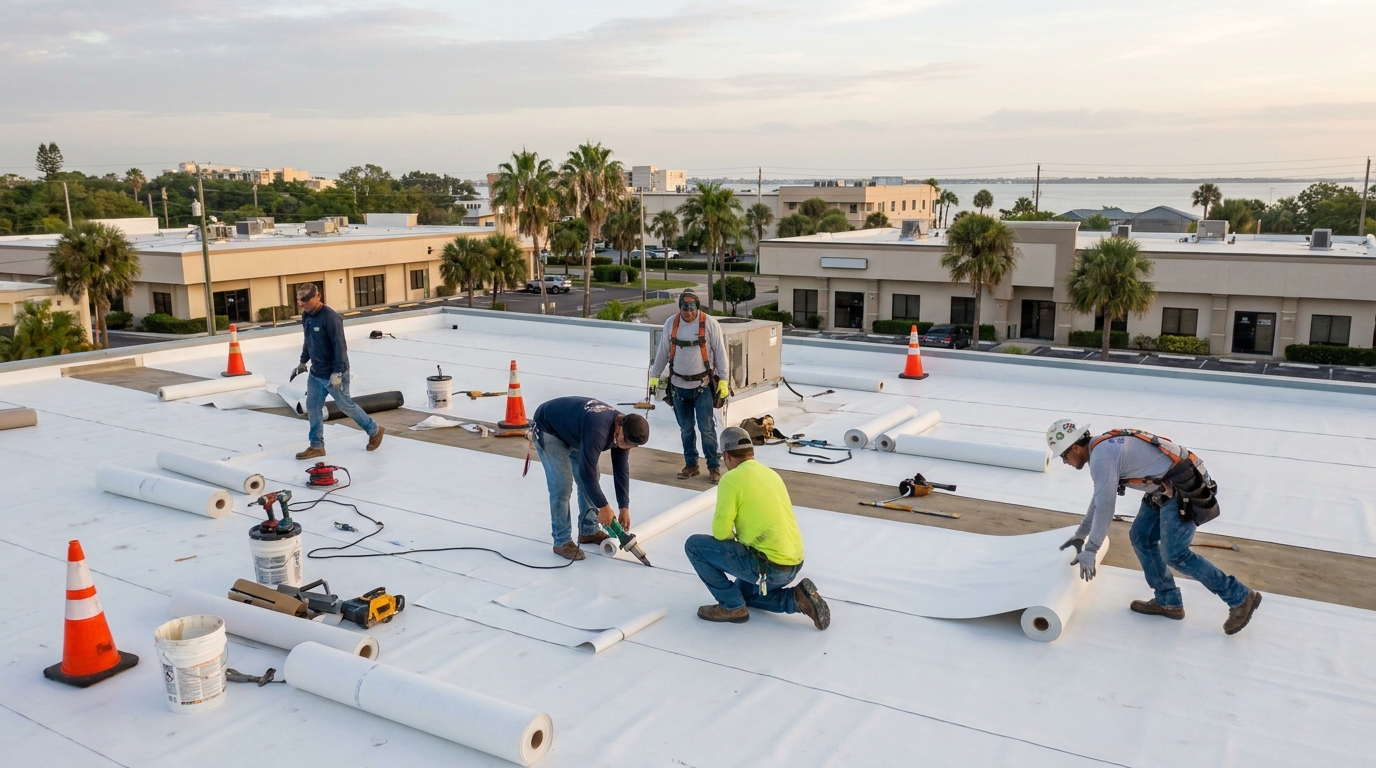
For most St. Petersburg commercial buildings, roof coating runs $4–$8 per square foot installed while full replacement runs $8.50–$17 per square foot for common membranes — roughly half the cost. Coating is the right call when the existing membrane is structurally sound and under about 20 years old; replacement becomes unavoidable once saturation, widespread seam failure, or code-driven insulation upgrades enter the picture. Waiting past that threshold typically converts a $40,000–$80,000 coating job into a $95,000–$170,000 tear-off.
What's the fastest way to decide between coating and replacement in St. Petersburg?
Apply a three-part test: membrane age under 20 years, no trapped moisture on an infrared scan, and fewer than roughly 25% of the field showing seam or flashing failure. If your roof passes all three, coating at $4–$8 per square foot is defensible. If it fails any one, you're looking at full replacement at $8.50–$17 per square foot for TPO, EPDM, or modified bitumen — or $14–$26 for standing-seam metal.
SCM Roofing, LLC uses this same triage on every commercial inspection across Pinellas County, because getting the diagnosis wrong is the single most expensive mistake a property manager can make on a flat roof.
How much does each option actually cost per square foot in 2026?
In the St. Petersburg and Tampa Bay market, coating runs $3–$5 per square foot for a single-coat acrylic or silicone with moderate prep, $4–$8 for a two-coat mid-tier silicone system with a 10–15 year warranty, and $6–$10 for SPF spray foam with a silicone topcoat. Full replacement starts around $6 per square foot for basic TPO or modified bitumen with limited tear-off and climbs from there.
| Option | St. Petersburg Price / sq ft | 10,000 sq ft Project |
|---|---|---|
| Coating — single coat, minimal prep | $3–$5 | $30,000–$50,000 |
| Coating — mid-tier silicone, 2-coat | $4–$8 | $40,000–$80,000 |
| Coating — SPF + silicone topcoat | $6–$10 | $60,000–$100,000 |
| TPO overlay / recover | $7–$12 | $70,000–$120,000 |
| Modified bitumen full replacement | $8.50–$15 | $85,000–$150,000 |
| EPDM full replacement | $9–$16 | $90,000–$160,000 |
| TPO full replacement (tear-off + insulation) | $9.50–$17 | $95,000–$170,000 |
| Standing-seam metal | $14–$26 | $140,000–$260,000 |
Prep and primer add $0.45–$1.20 per square foot to coating projects and swing widely based on condition. St. Petersburg pricing runs toward the upper half of statewide ranges because of high-wind detailing and hurricane-zone uplift requirements.
When is coating the smart move — and when is it a waste of money?
Coating is smart when your membrane is intact but weathering, seams are largely sound, and there's no saturated insulation below. It's a waste when the roof is over 20 years old, when moisture scans show wet substrate, or when you're within a few years of needing to upgrade insulation to meet current Florida Building Code R-values anyway. Coating a compromised roof traps moisture and shortens whatever life the membrane had left.
A useful gut check: if a coating warranty carrier won't underwrite the roof after inspection, that's the market telling you it's a replacement.
What does waiting actually cost a St. Petersburg property owner?
Waiting compounds in three specific ways. First, a coatable roof becomes a replacement roof — jumping the per-square-foot cost from $4–$8 to $9.50–$17 for TPO, a 2x to 3x swing. Second, once water reaches the insulation, tear-off becomes mandatory and the code-required R-value upgrade adds cost that a simple recoat would have deferred for a decade. Third, interior damage — ceiling tiles, drywall, inventory, tenant downtime — routinely exceeds the roof scope itself.
The Gulf Coast climate accelerates every one of these. Afternoon thunderstorms from June through September drive water into any seam breach daily, and named-storm season through November 30 turns a marginal roof into a claim event. A membrane that could have been coated in April often can't be by October.
The stages of delay, in order
- Year 0 — coating window open: $40,000–$80,000 restores a 10,000 sq ft roof for 10–15 years.
- Year 1–2 of visible issues — recover option: TPO overlay at $7–$12 per square foot, no tear-off, but coating is off the table.
- Year 2+ with moisture intrusion — full replacement: $95,000–$170,000 for TPO with tear-off, plus code upgrades.
- After interior damage: replacement cost plus tenant claims, business interruption, and often insurance friction.
When is waiting actually the right call?
Waiting is defensible in a few specific cases: the building is scheduled for demolition or major renovation within 24 months; a tenant lease turnover is imminent and the new tenant's use will change roof requirements; or the current membrane still has meaningful life and you're timing a coating to align with a planned capital budget cycle. In each case, waiting is a strategy, not deferral.
What isn't defensible: waiting because a coating quote felt expensive. The alternative isn't "no cost" — it's a replacement quote 12–24 months later.
How should St. Petersburg property managers budget for either path?
Budget in ranges, not point estimates, and always include a contingency for hurricane-zone detailing. For a typical 10,000 sq ft flat commercial roof in Pinellas County, a realistic coating budget is $40,000–$80,000 including prep, and a realistic full TPO replacement budget is $95,000–$170,000 including tear-off, code-compliant insulation, and permit fees. Metal standing-seam on a complex building can approach $260,000.
Cool-roof reflective coatings and SPF systems may qualify for federal energy-efficiency tax deductions or utility rebates — exact amounts depend on current federal and Florida programs and should be verified per project before you count them in the budget.
What should you look for in a St. Petersburg commercial roofer?
Look for a Florida-licensed contractor who inspects with infrared moisture scanning before quoting, who will walk you through why they're recommending coating, recover, or replacement (not just what), and who can document the manufacturer certifications required to issue the warranty they're selling. Ask for local references on comparable commercial buildings, not residential jobs.
SCM Roofing, LLC serves commercial and residential clients across Pinellas County, with a reputation for communication and transparent quoting that matters especially on six-figure commercial scopes.
Frequently Asked Questions
How long does a silicone roof coating last in St. Petersburg's climate?
A properly installed two-coat silicone system on a sound substrate typically carries a 10–15 year manufacturer warranty, and Gulf Coast UV exposure tends to produce actual service life at the lower end of that range without a recoat. Acrylic systems generally deliver shorter service life than silicone in high-humidity coastal environments. Warranty terms depend on the specific manufacturer and the inspection findings at install.
Can any commercial roof be coated?
No. Coating is only viable when the existing membrane is structurally sound, dry throughout the insulation layer, and generally under 20 years old. Roofs with significant damage, saturated substrate, widespread seam failure, or ponding water that won't drain typically require full replacement. An infrared moisture scan is the standard diagnostic — a contractor who quotes coating without one is guessing.
Does a coating count as a repair or a capital improvement for tax purposes?
Tax treatment varies by the specific scope, the building's ownership structure, and current federal guidance, and it should be confirmed with your CPA rather than your roofer. Reflective cool-roof coatings and SPF systems may also qualify for federal energy-efficiency deductions or Florida utility rebates, but amounts depend on active programs at the time of install.
How does hurricane season affect the decision?
Atlantic hurricane season runs through November 30, and St. Petersburg sits in a high-wind uplift zone that drives up detailing costs on both coating and replacement projects. Practically, the best window for commercial roof work is roughly December through May — cooler, drier weather improves coating cure, and permitting timelines are less compressed than during peak storm-response demand.
What's the difference between a TPO overlay and a full replacement?
A TPO overlay (or "recover") installs a new membrane over the existing roof without tearing it off, running $7–$12 per square foot in St. Petersburg. Full replacement tears the roof down to the deck, upgrades insulation to current code, and installs new membrane at $9.50–$17 per square foot for TPO. Overlay is faster and cheaper but only works when the existing substrate is dry and the deck is sound.
How long does a commercial roof replacement take on a typical building?
Timelines vary by size, membrane type, and weather, but a straightforward 10,000 square foot TPO tear-off and replacement generally runs one to three weeks of active work once permits are issued. Coating projects on a comparable roof usually complete in a few days per coat, with cure time between coats. Both are highly weather-dependent in Florida — rain delays are the norm, not the exception.
The bottom line for St. Petersburg property owners
The decision between coating and replacement is a diagnosis problem, not a preference problem. A sound membrane under 20 years old with no trapped moisture belongs in the coating column at $4–$8 per square foot. A saturated, aged, or seam-failed roof belongs in the replacement column at $8.50–$17 per square foot, and every month of delay narrows the option set.
Property owners and managers in St. Petersburg who want a straight diagnosis — infrared scan, honest recommendation, and a quote that reflects Pinellas County's wind-zone realities — can reach SCM Roofing, LLC at https://scmroofingfl.com to schedule a commercial inspection.