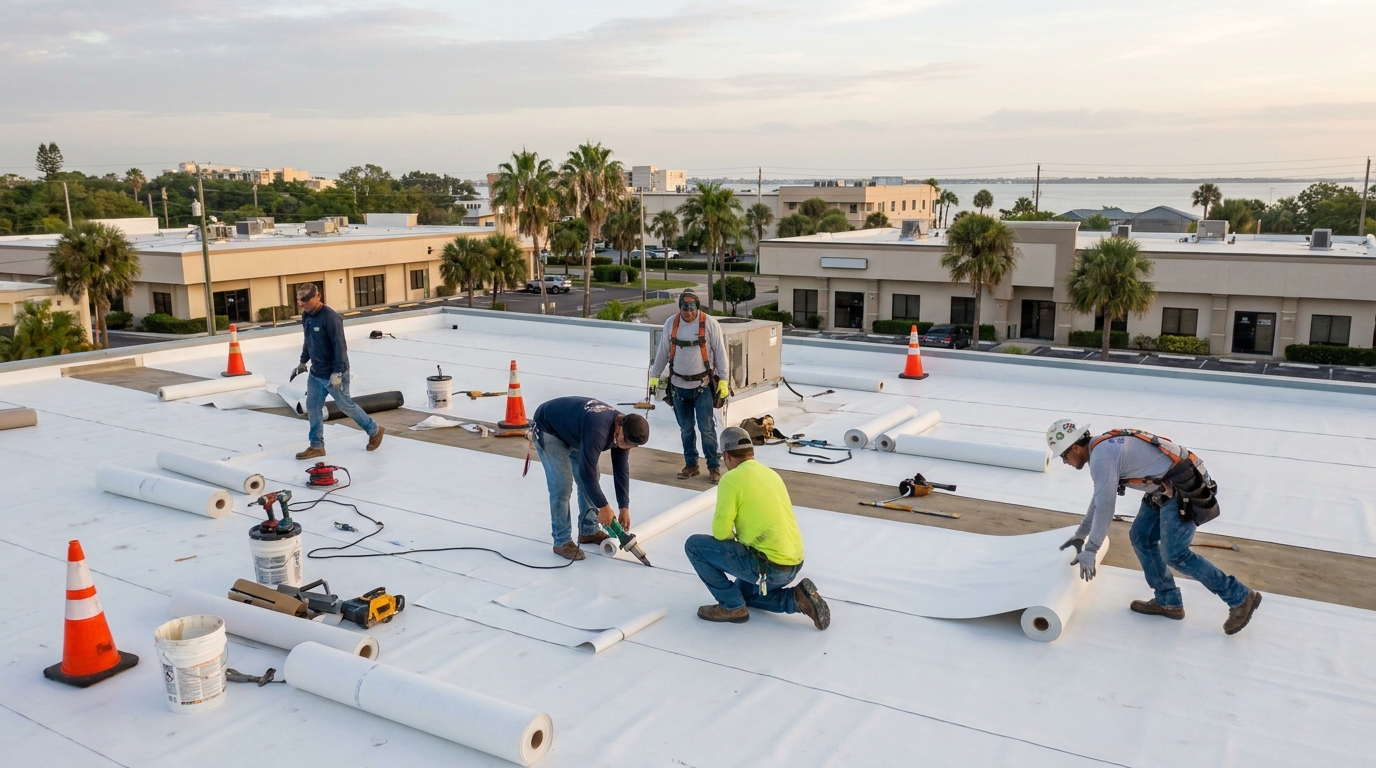
If you own or manage a commercial building in or near Aqualane Shores, you've probably stood on a flat roof in July, felt the heat radiating up through your shoes, and wondered whether your membrane is actually built for this. It's a fair question. Naples sits on the hot, high-sun, hurricane-exposed Gulf Coast, and Aqualane Shores — a low-elevation waterfront enclave just south of Old Naples and a short walk from Naples Bay and Third Street South — puts buildings under a particularly demanding mix of salt air, UV, and intense summer rain.
The two membranes that dominate the conversation for flat commercial roofs here are TPO (thermoplastic polyolefin) and EPDM (ethylene propylene diene terpolymer rubber). Both are proven single-ply systems. But they behave very differently in a climate like ours. Here's how we at SCM Roofing, LLC think about the choice for Aqualane Shores buildings.
The Short Answer for Naples' Climate
For most commercial buildings in Aqualane Shores and the broader Naples market, white TPO usually wins on energy performance and heat management. Its surface reflects roughly 80–90% of solar radiation, which directly reduces cooling load in a climate where air conditioning runs hard from roughly April through October.
EPDM, by contrast, is the longevity champion. Standard black EPDM has a proven service life of 30+ years — and up to 40–50 years in favorable conditions — versus 20–30 years typical for TPO. But standard black EPDM also absorbs about 90% of solar heat, which is the opposite of what most Naples buildings want.
So the real question isn't "which is better." It's "which is better for your building, your budget horizon, and your tolerance for cooling costs."
Solar Reflectivity and Energy Efficiency
This is where the gap is widest in a market like Aqualane Shores. White TPO functions as a "cool roof," reflecting 80–90% of incoming solar radiation and keeping the membrane — and the conditioned space below — measurably cooler. For a boutique office, a small retail strip near Third Street South, or a mixed-use property with significant HVAC load, that reflectivity translates into real operating savings.
Standard black EPDM goes the other direction, absorbing roughly 90% of solar heat. White EPDM exists and narrows the gap, but it's less common and costs more, which erodes EPDM's first-cost advantage.
If your Aqualane Shores property has heavy daytime cooling demand or you're trying to hit an energy target, TPO is the more natural fit.
Seam Integrity in a Wet, Stormy Climate
Naples gets intense afternoon downpours, occasional tropical systems, and stretches of ponding before drains catch up. Seams are where most flat roofs fail, so seam method matters.
- TPO: Hot-air heat-welded seams fuse the sheets into a continuous, monolithic membrane. The seam is essentially as strong as the field of the sheet.
- EPDM: Seams are joined with tapes and adhesives. These have improved enormously since EPDM's introduction in the 1960s, but adhesive-based seams remain more maintenance-sensitive under sustained UV, ponding, and humidity than welded seams.
For waterfront and near-waterfront buildings in Aqualane Shores, where wind-driven rain and storm exposure are facts of life, welded TPO seams have a meaningful advantage.
Longevity: How Long Does a Commercial Roof Last?
This is the question we get more than any other. Honest answer for Naples flat roofs:
- TPO: 20–30 years typical, with some premium systems pushing longer. Early-generation TPO had documented aging issues; current major-brand formulations are more reliable.
- EPDM: 30+ years typical, with 40–50 years possible in favorable conditions. EPDM has the longest field track record of any single-ply membrane.
EPDM wins the longevity comparison on paper. But "favorable conditions" is doing work in that sentence — sustained UV and heat aren't favorable, and black EPDM running hot all summer ages differently than EPDM in a milder climate. In practice, a well-installed TPO on a Naples office building and a well-installed EPDM on a Naples warehouse can both deliver decades of service if maintained.
Installed Cost and Lifecycle Math
Direct installed cost ranges, as reported across the industry:
- TPO: roughly $5.00–$9.00 per square foot installed
- EPDM: roughly $4.00–$10.00 per square foot installed, with basic black membrane material as low as $0.40–$0.80 per square foot before labor and accessories
Naples pricing trends to the higher end of national ranges because of hurricane-rated fastening patterns, code-required insulation, and local labor. Florida Building Code wind requirements for Collier County are not optional — they drive the attachment design, the perimeter and corner enhancements, and ultimately the installed price more than the membrane itself.
Basic black EPDM is usually the lower first-cost option. But in a hot climate, cooling savings from white TPO can offset that gap over the roof's life. We model this for clients case by case — it depends on building use, hours of operation, and HVAC condition.
Flexibility, Penetrations, and Complex Roofs
EPDM has very high elongation — it stretches and recovers without cracking, which makes it forgiving on complex roofs with many penetrations, curbs, and irregular geometries. TPO is also flexible and is reinforced with a scrim that adds puncture resistance, but EPDM's rubber chemistry is genuinely excellent at accommodating building movement and thermal cycling.
If your Aqualane Shores building has a lot of rooftop equipment, skylights, or unusual transitions, that's a point in EPDM's favor.
Warranty
Warranties vary by manufacturer and system, but the general pattern:
- TPO: commonly 10–20 years; premium systems can be longer
- EPDM: commonly 25–30 years
Longer EPDM warranties reflect its longer proven service life. That said, warranty terms depend heavily on installation being performed by a manufacturer-approved contractor — which is the kind of qualification you should ask any bidder to document.
Which One Fits Your Aqualane Shores Building?
TPO is the stronger fit when:
- The building has significant daytime cooling load (retail, hospitality, medical office, mixed-use)
- The roof is visible from upper-story windows or balconies — a common situation in Aqualane Shores, given its proximity to Old Naples' taller buildings and resort properties
- You're prioritizing energy code performance and lower operating costs
- Welded seam reliability matters for your risk tolerance
EPDM is the stronger fit when:
- The building is an industrial, storage, or low-occupancy structure where cooling load is less critical
- You want the longest proven membrane life and the longest manufacturer warranty
- The roof has complex geometry or heavy penetrations
- First cost is the dominant constraint
Naples-Specific Considerations You Shouldn't Skip
A few things that change the conversation in Aqualane Shores specifically:
- Hurricane season. Roof replacements should ideally be planned and completed outside the June–November Atlantic hurricane window, or at least with weather contingencies built into the schedule.
- Wind uplift design. Collier County permitting under the Florida Building Code drives fastener spacing, perimeter enhancement, and insulation attachment. Whichever membrane you choose, the attachment system has to be engineered for the wind zone — this is not a place to value-engineer.
- Salt air and waterfront exposure. Aqualane Shores' canal-front and near-Gulf positioning means metal flashings, fasteners, and edge details should be specified with corrosion in mind.
- Snowbird timing. Many Aqualane Shores buildings see lower occupancy in late summer; if your tenants or operations allow, that window can be a sensible time to schedule work.
FAQ
Is TPO or EPDM better for a flat commercial building in Naples?
For most Naples buildings with meaningful cooling load, white TPO offers better energy performance and welded seam reliability. For low-occupancy industrial or warehouse buildings where cooling is less critical, EPDM's longer service life and warranty can make it the better long-term value.
How long does a commercial roof last in Southwest Florida?
TPO systems typically last 20–30 years and EPDM systems 30+ years, though sustained UV, salt air, and storm exposure in coastal Naples can shorten those ranges if maintenance is neglected. Annual inspections and prompt repair of seams and flashings are the single biggest factors in reaching the top of those ranges.
Can I install a white EPDM instead of black?
Yes. White EPDM is available and narrows the energy gap with TPO, but it costs more than standard black EPDM and is less common, which can affect lead times and contractor familiarity.
Do I need a permit to replace a commercial roof in Naples?
Yes. Commercial reroofing in the City of Naples and unincorporated Collier County requires permitting under the Florida Building Code, and the design must meet local wind-uplift requirements. Your contractor should handle the permitting process.
The Bottom Line
For most commercial buildings in Aqualane Shores, the choice comes down to priorities. White TPO delivers better cooling performance, welded seam integrity, and a cleaner appearance — strong reasons it's our default recommendation for occupied, energy-sensitive properties in Naples. EPDM remains an excellent choice when longevity, simple chemistry, and lower first cost outweigh cooling concerns, particularly for industrial or storage buildings.
Either system can perform beautifully here when it's specified correctly for the wind zone, installed by a qualified crew, and maintained on a sensible schedule. Building owners and property managers in Aqualane Shores who want this evaluated for their specific roof can reach SCM Roofing, LLC at https://scmroofingfl.com for a walkthrough and estimate.