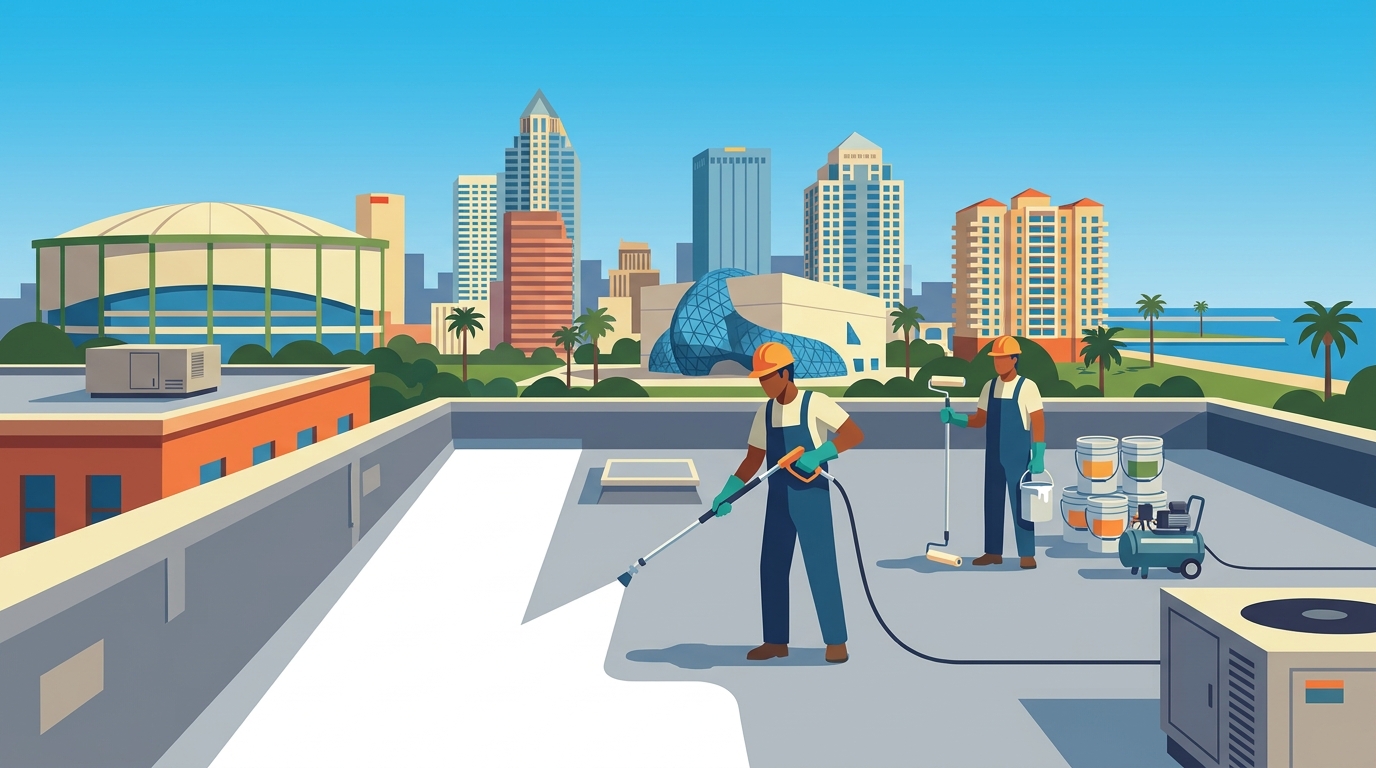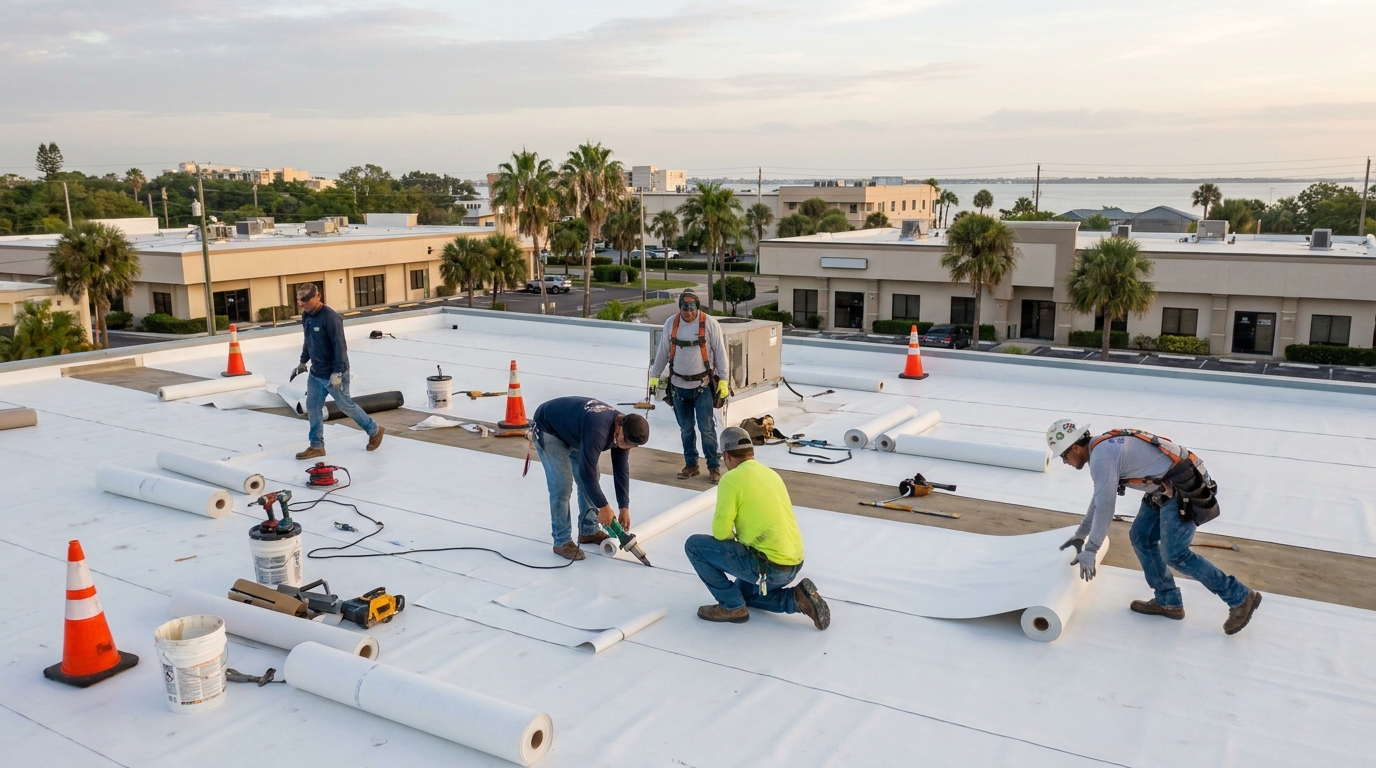
For most commercial buildings in Brandon, FL, TPO is the stronger performer under inland Florida heat and UV load because its white, reflective surface lowers rooftop temperatures and its heat-welded seams create a monolithic waterproof plane. EPDM remains a smart pick when budget control, proven rubber flexibility, and simpler patch repairs matter more than reflectivity — provided the system is detailed correctly for Hillsborough County's sun and summer storms.
That's the short answer. The longer answer depends on your building — a warehouse near the Brandon Regional Hospital corridor puts different demands on a membrane than a strip retail center off Highway 60, and the right membrane is the one matched to your deck, insulation, exposure, and budget. Below, we break down the tradeoffs the way our team at SCM Roofing, LLC walks Brandon property owners through them.
How do TPO and EPDM actually differ as commercial flat roof membranes?
TPO is a thermoplastic polyolefin single-ply membrane, typically white, joined with heat-welded seams. EPDM is an ethylene propylene diene monomer synthetic rubber membrane, usually black, joined with adhesive or tape seams. Both come in 45-, 60-, and 80-mil thicknesses, and both are widely specified across Florida commercial roofs.
The practical difference shows up on the roof surface. TPO reflects sunlight; standard EPDM absorbs it. In Brandon's inland heat — where afternoon rooftop temperatures routinely run well above ambient from May through September — that reflectivity translates directly into cooling load. White EPDM exists, but it's less common and usually carries a premium.
Seams are the other meaningful split. A heat-welded TPO seam fuses two sheets into one continuous membrane. EPDM's adhesive or tape seams are proven but rely on chemistry and workmanship rather than fusion. Both work when installed properly; both fail when they aren't.
Which membrane holds up better under Brandon's UV intensity and heat load?
TPO generally holds up better on Brandon commercial buildings because its white surface reflects solar energy and reduces membrane temperature, which extends the life of both the roof and the HVAC equipment sitting on it. EPDM performs well mechanically, but standard black EPDM runs hotter, and heat accelerates aging in any single-ply system.
Brandon sits inland from Tampa Bay, which changes the exposure profile compared to coastal Florida markets. You get less salt spray, but you also get less breeze off the water — meaning rooftops in areas like Bloomingdale, Valrico-adjacent commercial parks, and the Brandon Town Center corridor bake through long summer afternoons.
UV resistance on both membranes has improved substantially with modern formulations. Still, the reflective advantage of TPO is measurable and consistent, which is why we at SCM Roofing, LLC specify it more often than not on new commercial installations in the Brandon market — particularly on owner-occupied buildings where cooling costs land on the same P&L as the roof.
What does a TPO or EPDM commercial roof cost installed in Brandon, FL?
Based on current Florida pricing data, TPO commonly runs about $5.50–$9.00 per square foot installed, and EPDM about $5.00–$8.00 per square foot installed, with more complete commercial systems in Florida ranging $7–$15 per square foot depending on insulation, attachment method, and site access. Brandon pricing typically tracks Central Florida rather than South Florida.
Material-only pricing is lower — roughly $4.00–$6.00 per square foot for TPO and $3.50–$5.50 per square foot for EPDM — but installed pricing is the number that matters for budgeting. In South Florida, 60-mil white EPDM can move into the $7–$14 per square foot range, which is worth knowing if you're comparing quotes from contractors working across regions.
| Category | TPO | EPDM |
|---|---|---|
| Membrane type | Thermoplastic polyolefin single-ply | EPDM synthetic rubber |
| Common thicknesses | 45, 60, 80 mil | 45, 60, 80 mil (up to 90) |
| Typical color | White, gray, tan | Usually black; white available |
| Seam method | Heat-welded | Adhesive or tape |
| Florida installed cost | ~$5.50–$9.00/sq ft | ~$5.00–$8.00/sq ft |
| Typical lifespan cited | ~15–30 years | ~20–40 years |
| Heat behavior | Reflective, cooler surface | Absorbs heat (black) |
| Repair approach | Hot-air welding required | Adhesive/tape patching |
Real bids in Brandon vary based on tear-off requirements, deck condition, insulation package, wind uplift requirements under Florida Building Code, and whether the system is mechanically fastened, fully adhered, or ballasted. Two buildings across the street from each other can quote thousands of dollars apart for legitimate reasons.
Which thickness and attachment method make sense for Brandon commercial buildings?
For most Brandon commercial roofs, 60-mil is the workhorse thickness and 80-mil is the upgrade when foot traffic, mechanical equipment, or long-term durability justify the cost. Attachment is typically mechanically fastened or fully adhered for TPO; EPDM adds ballasted as a third option. Wind uplift requirements under Florida Building Code often drive the final call.
Hillsborough County enforces the Florida Building Code, which sets wind design requirements that affect fastening patterns, edge metal, and membrane attachment on commercial roofs. Any reroof or new install requires permitting, and inspections apply. That's not a hurdle to avoid — it's a baseline that separates a system that lasts from one that peels at the corners in the first tropical storm.
Repair strategy is worth thinking about upfront. EPDM patches are relatively straightforward — clean, prime, apply tape or adhesive. TPO repairs require hot-air welding equipment and trained hands. If your maintenance plan leans on quick in-house fixes, EPDM has an edge; if you're going to call a licensed commercial contractor either way, that edge shrinks.
Which membrane fits which type of Brandon commercial buyer?
Choose TPO if you own an air-conditioned building in Brandon and care about cooling costs, seam integrity, and energy efficiency — the reflective white surface pays back through lower HVAC load. Choose EPDM if you prioritize lower first cost, proven rubber-membrane longevity, or simpler patch repairs, and heat gain isn't a primary concern for the building's use.
A refrigerated warehouse, medical office, or retail center along Brandon Boulevard almost always benefits from TPO. An unconditioned storage facility, an outbuilding, or a property where the roof isn't visible and cooling isn't a factor may be perfectly served by EPDM at a lower installed cost.
The membrane matters, but the installer matters more. A cheap 60-mil TPO installed poorly will fail before an expensive 45-mil EPDM installed well. SCM Roofing, LLC's 4.9-star rating across 239 Google reviews reflects what Brandon customers consistently point to: clear communication, on-time crews, and clean job sites. One recent reviewer wrote that the crew "worked meticulously together from the start to the finish" — which, on a commercial flat roof, is exactly what determines whether the seams hold ten years in.
Frequently asked questions
Is TPO or EPDM better for Florida's climate?
TPO is generally better suited to Florida's climate for air-conditioned commercial buildings because its white, reflective surface reduces heat gain and cooling load. EPDM performs well mechanically and has strong flexibility and longevity, but standard black EPDM absorbs heat, which is a disadvantage in Brandon's inland summer conditions unless a white EPDM version is specified.
How long does a TPO or EPDM roof last in Brandon, FL?
Published lifespan ranges cite roughly 15–30 years for TPO and 20–40 years for EPDM, depending on membrane thickness, installation quality, and maintenance. In Brandon's UV and heat conditions, thicker membranes (60-mil or 80-mil), proper attachment for Florida Building Code wind requirements, and regular inspections are the biggest drivers of whether a roof reaches the upper end of that range.
What does a commercial flat roof cost per square foot in Brandon?
In the Brandon and Central Florida market, TPO typically runs about $5.50–$9.00 per square foot installed and EPDM about $5.00–$8.00 per square foot installed. Broader Florida commercial systems can range $7–$15 per square foot depending on insulation, attachment method, tear-off requirements, and site access. Actual bids depend on deck condition and code-driven wind uplift specs.
Do I need a permit for a commercial reroof in Brandon, FL?
Yes. Commercial reroofs in Brandon require permitting through Hillsborough County under the Florida Building Code, and inspections apply. Wind uplift design, edge metal, and fastening patterns must meet code. A licensed commercial roofing contractor handles permitting as part of the project, so ask any bidder how they pull and close permits before signing.
What thickness of TPO or EPDM should I specify?
For most Brandon commercial buildings, 60-mil is the standard specification and 80-mil is the upgrade for higher foot traffic, rooftop equipment, or longer expected service life. 45-mil is available and less expensive, but the durability tradeoff usually isn't worth the savings on a Florida commercial roof exposed to intense UV and summer storms.
Can EPDM be installed white to compete with TPO on reflectivity?
Yes, white EPDM exists and delivers meaningful reflectivity, but it is less common than black EPDM and typically carries a premium. In South Florida, 60-mil white EPDM installed can run in the $7–$14 per square foot range. For Brandon commercial buyers who want reflectivity, TPO is usually the more cost-effective path to a white, energy-efficient roof surface.
Getting a straight answer for your building
The TPO-versus-EPDM decision comes down to your building's use, your cooling costs, your budget, and the installer's ability to detail the system correctly for Brandon's heat, UV, and wind code. A generic answer only takes you so far — the right specification for a 12,000-square-foot warehouse near I-75 is different from the right one for a small medical building off Lumsden Road.
Commercial property owners in Brandon, FL who want a straight, itemized comparison for their specific building can reach SCM Roofing, LLC at https://scmroofingfl.com to schedule an inspection and get a written scope for both membrane options side by side.