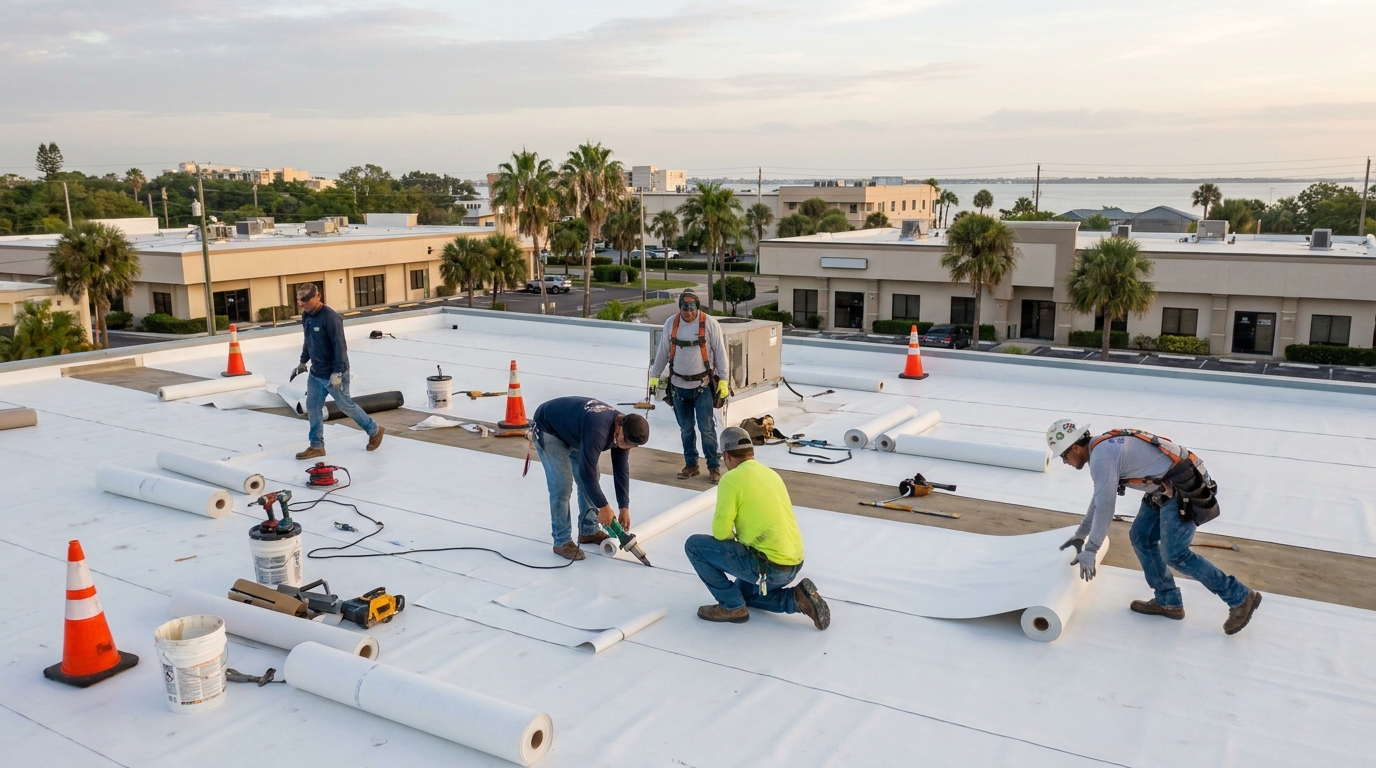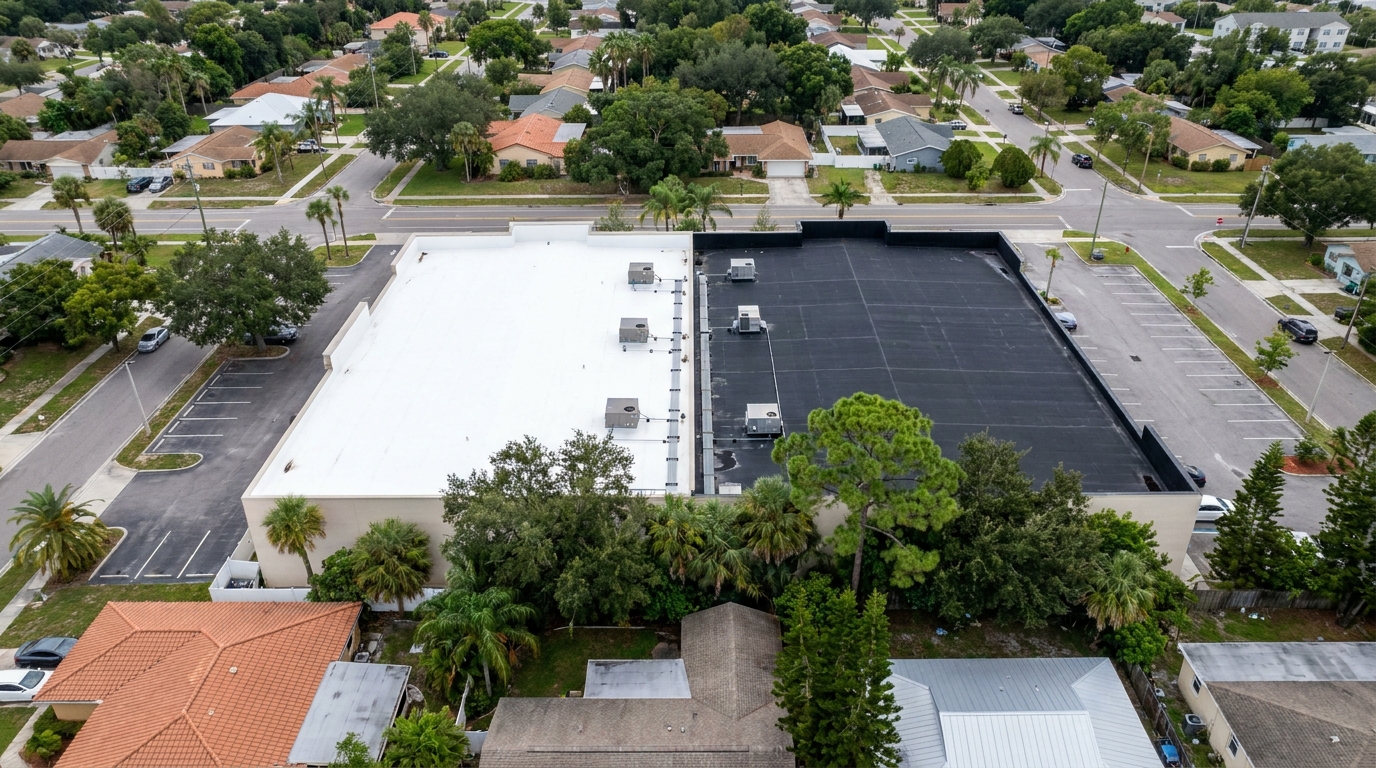
For most Tampa commercial flat roofs, white TPO holds up better than standard black EPDM. Tampa's cooling-dominated climate, intense UV, and hurricane-season wind loads favor a reflective, heat-welded membrane. EPDM still has a role when the lowest upfront price is the deciding factor, but in a hot Gulf Coast market, TPO is the more climate-aligned default.
Below is a Tampa-specific breakdown of how the two single-ply systems actually perform on low-slope roofs from Ybor City warehouses to Westshore office parks — where they win, where they lose, and how to decide.
What's the short answer for Tampa commercial buildings in 2026?
White TPO is the stronger all-around fit for Tampa commercial flat roofs because it reflects solar heat, uses heat-welded seams that handle high-UV Gulf Coast exposure well, and aligns with current Florida cool-roof practice. EPDM is usually the choice only when the lowest installed price outranks cooling performance and reflectivity.
SCM Roofing, LLC works on both membranes across Hillsborough County, and the pattern we see in current Florida-facing guidance matches what plays out on Tampa buildings: TPO tends to be the default recommendation, with EPDM reserved for specific budget-driven or coating-based scenarios.
How do TPO and EPDM compare head-to-head?
TPO is a thermoplastic membrane, typically white and reflective, joined with heat-welded seams. EPDM is a synthetic rubber membrane, typically black, joined with adhesive or tape systems. In Tampa's hot, sunny, storm-prone climate, those two differences — color and seam method — drive most of the real-world performance gap.
| Category | TPO | EPDM |
|---|---|---|
| Material | Thermoplastic single-ply | Synthetic rubber single-ply |
| Standard color | White (reflective) | Black (absorbs heat) |
| Seams | Heat-welded (fused) | Adhesive/tape |
| Installed cost (Florida guidance) | ~$5.50–$12/sq ft; some Tampa ranges $7–$14 | ~$4.50–$11/sq ft; some Tampa ranges $7–$13 |
| Typical service life | ~15–30 years | ~15–25 years (Florida-facing); broader sources cite longer |
| Best climate match | Hot, cooling-dominated | Cooler climates or coated assemblies |
Which membrane handles Tampa's heat and UV better?
White TPO handles Tampa heat and UV better than standard black EPDM. TPO's reflective surface bounces solar energy back off the roof, lowering membrane temperature and cooling loads. Standard black EPDM absorbs that heat, which is a real disadvantage in a market where air conditioning runs most of the year.
For a warehouse near the Port of Tampa or a retail box off Dale Mabry, that reflectivity translates into lower rooftop temperatures during the long stretch from April through October. Florida-oriented sources consistently frame white TPO as the "cool roof" choice and note that black EPDM is less favorable where cooling dominates — a coating or white EPDM variant helps, but standard black rubber gives up ground before the first shingle of summer heat.
How do the seams hold up to Gulf Coast weather?
TPO's heat-welded seams create a fused connection between sheets, which many Florida-facing sources treat as a meaningful performance advantage in hot, high-UV environments. EPDM seams rely on adhesives or seam tape — fully functional when installed correctly, but generally viewed as less robust than a welded seam over decades of Tampa sun and wind cycling.
Seams are usually the first place a flat roof fails. On a Tampa building that will see hurricane-season wind uplift, daily thermal expansion, and summer thunderstorms most afternoons, seam technology matters as much as the membrane itself.
What about hurricane wind loads and standing water?
For Florida hurricane exposure, attachment method and system design matter as much as membrane type. Fully adhered assemblies and high-uplift systems are standard in Tampa's coastal and near-coastal zones, and TPO is commonly specified with strong FM/UL ratings on Florida commercial projects. EPDM can be engineered for the same conditions, but current Tampa-facing guidance leans TPO for storm-prone low-slope work.
Standing water after tropical storms is the other reality of Tampa flat roofs. Both membranes can tolerate occasional ponding when installed correctly with proper slope and drainage, but seam integrity becomes critical — another point where TPO's welded seams have an edge over adhesive-based EPDM assemblies. Any Tampa flat roof, regardless of membrane, needs drains, scuppers, and tapered insulation designed for real Gulf Coast rainfall, not textbook averages.
How much does each system cost installed in Tampa?
Based on current Florida-oriented pricing guidance, TPO installed costs run roughly $5.50–$12 per square foot, with some Tampa contractor ranges landing around $7–$14 depending on thickness and job complexity. EPDM installed costs run roughly $4.50–$11 per square foot, with Tampa ranges around $7–$13. EPDM is usually cheaper upfront, but the gap narrows once insulation, attachment, and detail work are included.
For a mid-size Tampa commercial building, the honest way to compare bids is line by line: membrane thickness (60-mil is a common Tampa baseline), insulation R-value, attachment method, flashing details, and warranty terms. A low EPDM number that skips a fully adhered attachment or drops to a thinner membrane is not actually cheaper — it just moves the cost to the next repair.
How long does a commercial roof last in Tampa?
In Tampa's climate, TPO commercial roofs typically last about 15–30 years and EPDM roofs about 15–25 years, based on Florida-facing sources. Actual life depends heavily on membrane thickness, installation quality, attachment method, and how well the roof is maintained. Poor detailing on either system can cut those numbers in half regardless of the material chosen.
The buildings we see hit the upper end of those ranges in Hillsborough County share a pattern: 60-mil or thicker membrane, quality insulation, proper drainage, and an actual maintenance program — semi-annual inspections, drain clearing before hurricane season, and prompt repair of any storm damage.
Which membrane should you pick for your Tampa building?
Choose TPO if you want the best fit for Tampa heat, better reflectivity, welded seams, and stronger alignment with Florida cool-roof practice. Choose EPDM if the lowest initial installed price is the top priority and you accept lower solar reflectance in a hot climate. For most Tampa commercial low-slope roofs in 2026, 60-mil white TPO is the strongest all-around choice.
SCM Roofing, LLC installs and services both systems across the Tampa Bay area — from South Tampa storefronts to industrial buildings near the airport — and holds a 4.9-star rating across 239 Google reviews, with clients regularly noting communication and installation quality. One recent reviewer described the crew as working "like a well oiled machine," which is the standard any Tampa commercial owner should hold their contractor to when a hurricane forecast starts building in the Gulf.
Frequently asked questions
Is TPO or EPDM better for a Tampa commercial flat roof?
TPO is generally the better fit for a Tampa commercial flat roof. Its reflective white surface handles Tampa's cooling-dominated climate better than standard black EPDM, and its heat-welded seams hold up well against Gulf Coast UV and hurricane-season wind. EPDM remains a valid budget option, but TPO is the more climate-aligned default recommendation in current Florida-facing guidance.
What's the best roofing system for a flat commercial building in Tampa, FL?
For most flat commercial buildings in Tampa, a 60-mil white TPO membrane over quality insulation with a fully adhered or mechanically attached assembly is the strongest all-around choice. It balances heat reflectivity, seam performance, wind uplift resistance, and cost. EPDM, modified bitumen, and coated systems can also work depending on the building's use, budget, and existing roof condition.
How long does a commercial roof last in Tampa?
Commercial roofs in Tampa typically last about 15–30 years for TPO and about 15–25 years for EPDM, based on Florida-facing guidance. Lifespan depends on membrane thickness, quality of installation, drainage design, hurricane exposure, and ongoing maintenance. Roofs with 60-mil or thicker membranes and semi-annual inspections consistently reach the upper end of those ranges.
How much does TPO or EPDM cost per square foot installed in Tampa?
In Tampa, TPO commonly runs about $5.50–$12 per square foot installed, with some current contractor ranges landing at $7–$14 depending on thickness and complexity. EPDM commonly runs about $4.50–$11 per square foot, with some Tampa ranges at $7–$13. EPDM is usually cheaper upfront, but the cost gap narrows once insulation, attachment, and flashing details are included.
Do TPO and EPDM handle hurricane wind loads differently?
Both TPO and EPDM can be engineered for Tampa hurricane wind loads, but attachment method and system design matter as much as membrane type. Fully adhered and high-uplift assemblies with strong FM/UL ratings are standard in Tampa's storm-exposed zones. Current Florida-facing guidance more often specifies TPO for hurricane-prone commercial work, though EPDM assemblies can also meet wind requirements when properly designed.
Where can I find commercial flat roof repair near me in Tampa?
Tampa has a competitive commercial roofing market with many licensed contractors serving Hillsborough County. When choosing one, verify Florida state licensing, insurance, hurricane-code familiarity, warranty terms, and reviews specific to commercial flat roof work. SCM Roofing, LLC offers commercial flat roof repair and replacement across the Tampa Bay area and can be reached at https://scmroofingfl.com for an evaluation.
Bottom line
On a typical Tampa commercial flat roof, white TPO gives you better heat performance, better seam technology, and better alignment with Florida cool-roof expectations. EPDM is a legitimate choice when upfront cost drives the decision — but in a market defined by long summers, high UV, and hurricane season, the reflective, welded system is usually the one that holds up longer.
Tampa commercial property owners who want a professional evaluation of their existing membrane, or a side-by-side proposal comparing TPO and EPDM for a specific building, can reach SCM Roofing, LLC at https://scmroofingfl.com to get started.