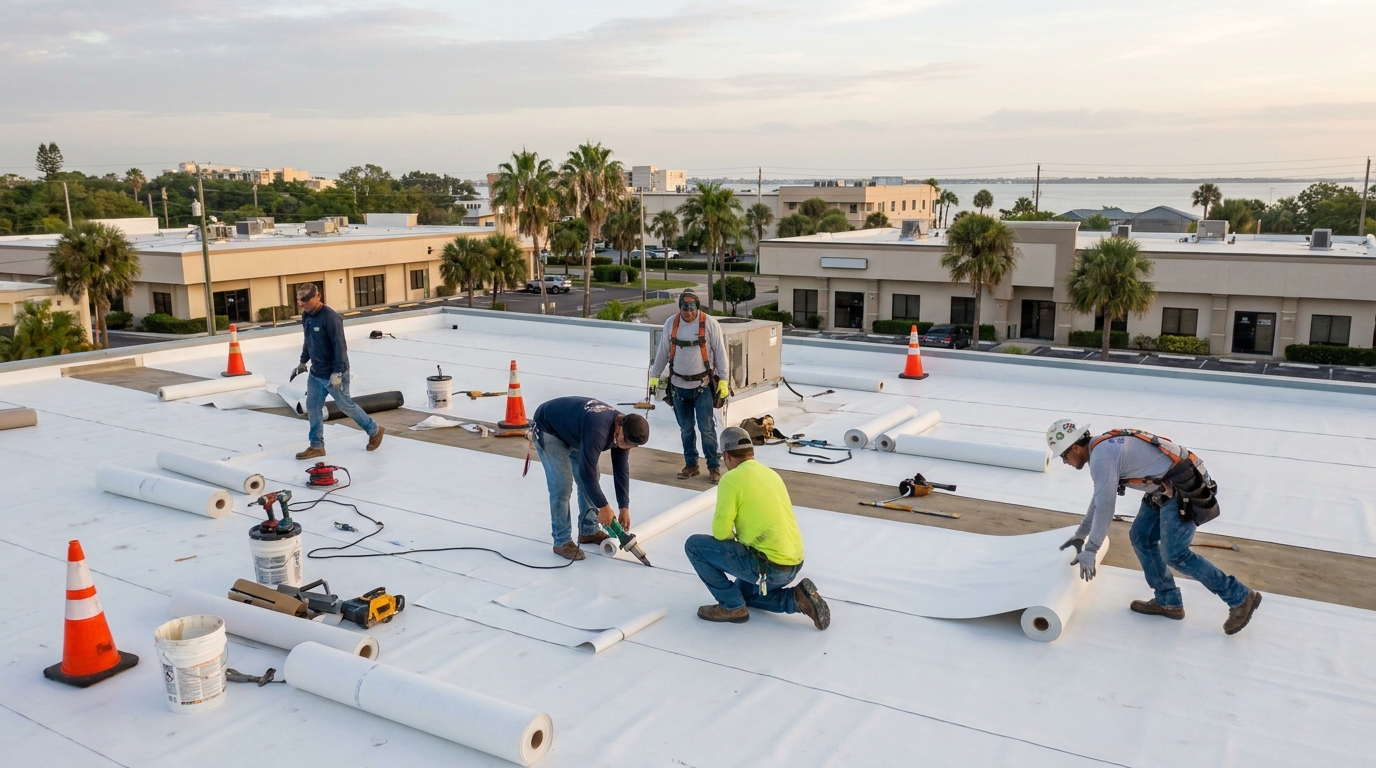
The clearest signs a commercial roof needs replacing in St. Petersburg, FL show up on the roof itself long before water shows up on the ceiling tiles: ponding water that lingers more than 48 hours after rain, blistered or seam-split membrane, corroded flashing at parapets and penetrations, sagging deck areas, and a repair log that keeps getting longer each hurricane season. If two or more of these are present on the same roof, you are past the point where spot repairs are protecting the building — you are subsidizing a system that has already failed.
St. Petersburg's older low-slope commercial stock — the warehouses off 28th Street, the storefronts along Central Avenue, and the mixed-use buildings near the downtown waterfront — takes a beating that inland Florida roofs simply don't see. Salt air off Tampa Bay, near-constant UV, summer humidity, and the annual June-through-November hurricane window compress a membrane's usable life. Knowing what to look for, and when, is what separates a planned replacement from a 2 a.m. tarp call.
What are the earliest warning signs a commercial roof is failing?
The earliest signs are visible on the roof surface, not the ceiling: ponding water that stays more than 48 hours, seam separation on TPO or PVC membranes, blistering or alligatoring on modified bitumen and BUR, rust staining at metal flashings, and granule loss around drains and scuppers. Catching these during a routine commercial roof inspection in St. Petersburg, Florida — ideally twice a year — is what buys you time to plan a replacement instead of reacting to one.
Established Pinellas County contractors see the same pattern repeatedly on buildings well past their last reroof: the membrane still looks intact from the parking lot, but the seams, terminations, and edge metal have quietly degraded to the point where the next tropical system will find every weakness at once.
Why does St. Petersburg's climate accelerate commercial roof failure?
Intense UV radiation, salt air off the Gulf, humidity that rarely dips below 70%, and heavy seasonal rainfall degrade membranes, corrode flashings, and drive moisture into insulation faster than in almost any other U.S. market. Reflective TPO and PVC membranes can reduce rooftop temperatures by up to 80°F and cut cooling costs by up to 30%, according to Department of Energy studies cited in commercial roofing industry reporting — but only while the membrane is intact.
Once seams open or coatings weather off, the same conditions that make Florida a punishing climate for roofs — heat, water, salt — accelerate the failure curve. A TPO roof rated for roughly 12+ years of service life in general industry estimates often reaches that threshold sooner on coastal Pinellas buildings than it would in Orlando or Atlanta.
What visible symptoms mean the roof is past repair?
A commercial roof is past repair when problems are systemic rather than localized: widespread ponding across multiple drains, seam failure in more than one field area, saturated insulation confirmed by an infrared or core sample, sagging deck sections, and a repair history where each patch is followed by a new leak within one or two rainy seasons. At that point, continuing to patch costs more over 24 months than a planned replacement would.
Ponding water that won't drain
Florida code and manufacturer warranties both treat water standing longer than 48 hours as a defect. On St. Petersburg buildings with rooftop HVAC, condensate lines, and clogged internal drains, ponding is often the first symptom that the deck has deflected or the tapered insulation has compressed. Ponding accelerates UV damage in the wet area and voids most membrane warranties.
Flashing and edge metal corrosion
Salt air attacks fasteners, counter-flashing, and edge metal long before it kills the field membrane. If you see rust bleed down parapet walls or lifted edge metal after a storm, the wind-uplift assembly that Pinellas County code requires is already compromised.
Interior staining, musty odor, and rising energy bills
By the time water reaches drywall or ceiling tile, the insulation above it has usually been wet for months. A noticeably rising cooling bill on the same equipment is often the first interior clue that saturated insulation has lost its R-value.
Repair or replace? How to decide in 2026
Replace when the roof is within a few years of its expected service life, when leaks are appearing in multiple locations, when more than roughly 25% of the field shows membrane damage, or when insulation moisture scans come back positive over large areas. Repair when damage is isolated, the membrane is under 10 years old, and the underlying insulation and deck test dry. The economics almost always favor replacement once repair frequency exceeds twice a year.
| System | Typical Installed Cost (per sq. ft.) | General Service Life | Best Use Case in St. Petersburg |
|---|---|---|---|
| Silicone/acrylic restoration coating | $4.00 – $8.00 | Extends existing roof 8–15 yrs | Sound membrane, minor weathering |
| SPF spray foam with topcoat | $6.50 – $12.00 | 15–20 yrs with recoats | Irregular decks, ponding correction |
| TPO overlay/recover | $7.00 – $12.00 | ~12+ yrs | Dry existing insulation, tight budget |
| TPO full replacement (tear-off + insulation) | $9.50 – $17.00 | ~12+ yrs | Wet insulation, code upgrades |
| EPDM full replacement | $9.00 – $16.00 | 20–25 yrs | Low-traffic industrial roofs |
| Modified bitumen full replacement | $8.50 – $15.00 | 15–20 yrs | High-foot-traffic, HVAC-heavy roofs |
| PVC full replacement | Within TPO range | ~20–30 yrs | Chemical exposure, restaurants |
| Standing seam / PBR metal | $14.00 – $26.00 | 40+ yrs | Long-hold assets, wind exposure |
For a 10,000 sq. ft. commercial roof in Florida, broad installed replacement costs typically run $50,000 to $140,000 depending on system, tear-off scope, insulation, and code upgrades required by Pinellas County permitting.
What does a proper commercial roof inspection in St. Petersburg include?
A proper commercial inspection documents membrane condition, seam integrity, flashing and edge metal, drain and scupper function, penetration seals, insulation moisture (via infrared or core samples), and wind-uplift assembly compliance with current Pinellas County code. The inspector produces photographs, a written condition report, and a repair-versus-replace recommendation suitable for insurance documentation and, if needed, a real estate transaction file.
Two inspections per year is the practical cadence for St. Petersburg commercial buildings: one in spring before hurricane season, one in late fall after the storm window closes. This is the only schedule that reliably catches storm-related damage before winter cold fronts drive water through compromised flashings.
When is emergency commercial roof leak repair the right call?
Emergency response is warranted whenever active water intrusion threatens inventory, electrical systems, tenants, or occupancy — most commonly during or immediately after a tropical system, a heavy summer thunderstorm, or a failed HVAC penetration. The correct sequence is: contain the interior damage, get a qualified commercial roofer on site to dry-in the affected area (typically shrink-wrap or peel-and-stick membrane over the failure point), then schedule a full assessment within days rather than months.
Searching "emergency commercial roof leak repair near me St Petersburg" at 11 p.m. during a storm is not the moment to vet a contractor. That vetting — license verification (Florida CCC licensing), insurance, manufacturer certifications, references — belongs on the calm-weather side of the year.
FAQ
How do I know if my commercial roof needs replacing versus another repair?
You need replacement when leaks recur in multiple locations, when moisture scans show widespread wet insulation, when more than roughly a quarter of the membrane shows visible damage, or when the roof is within a few years of its expected service life. Isolated damage on a younger membrane with dry insulation is a repair. A qualified inspector should give you both options in writing with cost projections for each.
How much does commercial roof replacement cost in St. Petersburg, FL?
Broad installed costs in Florida run roughly $5.00 to $14.00 per square foot, or about $50,000 to $140,000 for a 10,000 sq. ft. roof. TPO full replacement typically falls in the $9.50–$17.00 range per square foot; metal standing seam runs $14.00–$26.00. Actual bids vary with tear-off scope, insulation requirements, deck repairs, and wind-uplift code upgrades required in coastal Pinellas County.
Do I need a permit to replace a commercial roof in Pinellas County?
Yes. Commercial reroofs in Pinellas County require permits and formal inspections tracked through county field-report systems, which explicitly include roofing items such as reroof metal. Skipping the permit process creates liability for insurance claims, future real estate transactions, and code enforcement. A licensed commercial roofer pulls the permit and coordinates required inspections as part of the project.
How long does a TPO roof actually last on a St. Petersburg building?
General industry estimates cited by commercial roofing sources put TPO service life at roughly 12 years or more, PVC at 20–30 years, and metal at 40+ years. On St. Petersburg buildings exposed to salt air, intense UV, and hurricane-force winds, real-world TPO performance often lands at the lower end of that range unless installation quality and biannual maintenance are exceptional.
Can I just recoat my roof instead of replacing it?
Silicone or acrylic restoration coatings at $4.00–$8.00 per square foot can extend a sound roof's life, but only if the underlying membrane is intact, the insulation is dry, and there is no seam or deck failure. Coating a roof with wet insulation traps moisture and accelerates deck rot. An infrared scan or core samples should confirm the substrate is dry before any coating decision.
How quickly should I act on interior water stains?
Within days, not weeks. By the time water reaches ceiling tile or drywall, the insulation above it has usually been saturated for weeks or months, and the R-value loss is already showing up in cooling costs. Ignoring an interior stain through a Florida summer typically turns a $4,000 flashing repair into a full section reroof after the insulation delaminates and the deck begins to corrode or rot.
Bottom line for St. Petersburg building owners
Failing commercial roofs almost always broadcast their condition months before the first interior leak. Ponding, seam separation, flashing corrosion, rising cooling costs, and a growing repair log are the honest signals; a ceiling stain is the expensive one. A twice-yearly inspection cadence — spring and late fall — catches most of these on the calm-weather side of the calendar, when you have leverage to plan rather than react. Building owners in St. Petersburg who want a documented condition assessment, repair-versus-replace analysis, or a code-compliant replacement scope should contact a licensed local commercial roofing contractor to get started.