If your commercial building's roof is leaking after a heavy Tampa rain, the right sequence is: contain the water intrusion inside, document everything, call a licensed Florida commercial roofing contractor for emergency tarping, and only then schedule the permanent repair with permits. In Tampa, that means a contractor with an active state roofing credential who can dispatch 24/7 and work with your insurer's documentation requirements.
Below is the step-by-step protocol commercial property managers in Hillsborough County should follow, what each stage realistically costs, and the regulatory details that trip up owners who try to shortcut the process.
Who should you call first when a commercial roof is leaking after heavy rain in Tampa?
Call a Florida state-licensed commercial roofing contractor that offers 24/7 emergency dispatch — not a general handyman, not a water-restoration-only firm, and not your insurer first. The roofer stops the active intrusion with emergency tarping or membrane patching; the insurance claim and interior drying come next, once the roof is stabilized and photographed.
In Tampa, SCM Roofing, LLC offers 24/7 emergency roofing service and handles commercial systems including TPO, EPDM, PVC, mod-bit, BUR, and standing seam metal — the systems most common on flat and low-slope commercial buildings in the area. The company's Florida state contractor license number is CCC1331132, which you can verify through the Florida Department of Business and Professional Regulation before any crew sets foot on your roof.
Verifying the license matters because Florida Statute Chapter 489 requires anyone performing commercial roof work to hold an active state-certified or locally registered roofing credential. Hiring an unlicensed crew during a storm surge — when demand spikes and out-of-area operators appear — can void your insurance claim entirely.
What should you do in the first hour after discovering the leak?
In the first hour, protect people and property inside, then document the damage before anything is moved. Move inventory, electronics, and files away from active drips; place buckets and plastic sheeting; shut off power to affected circuits if water is near fixtures or panels; and photograph every wet area, ceiling stain, and pooled location with timestamps.
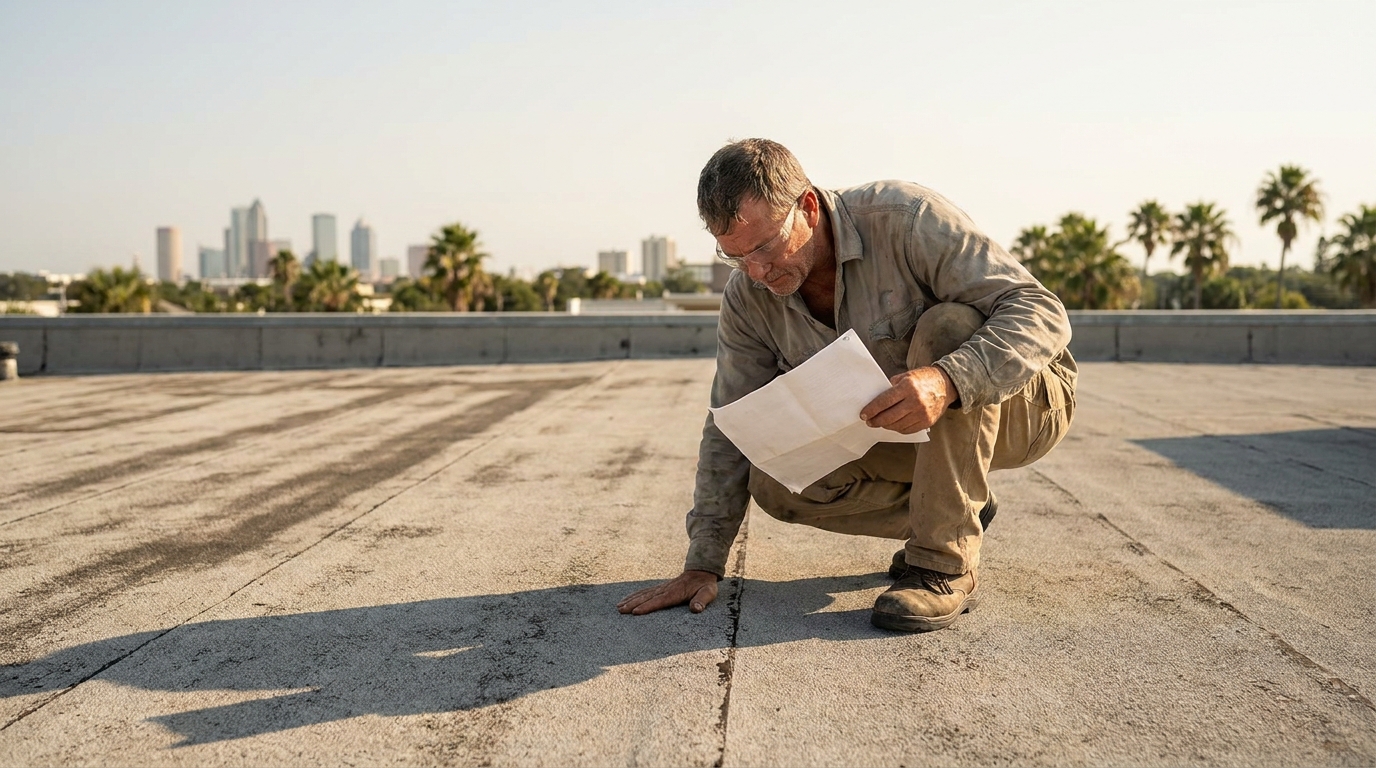
Documentation is not optional. Under Florida insurance law, carriers can — and frequently do — deny commercial roof leak claims on the basis that damage was caused by long-term wear and tear rather than a sudden weather event, a pattern well documented in Florida roof claim litigation as of mid-2026. Timestamped photos taken during or immediately after the rain event are the strongest evidence that the intrusion is storm-related, not maintenance-related.
While you document, call for emergency tarping. Do not send a maintenance tech onto a wet commercial roof — the combination of slick TPO or modified bitumen, standing water, and compromised decking is how people get seriously hurt.
What does emergency commercial roof response cost in Tampa?
Published Tampa-area emergency roof pricing is drawn largely from residential reference guides and should be treated as a floor, not a ceiling, for commercial work.
Commercial jobs almost always sit at the upper end or well above these figures because of roof area, access equipment (lifts, fall protection), membrane type, and the extent of saturated insulation that has to come out. Expect a reputable contractor to give you a stabilization estimate separate from the permanent repair estimate.
| Service | Published Tampa range | What drives the cost higher on commercial |
|---|---|---|
| Emergency tarping | $150–$350 | Roof area, parapet height, lift access |
| After-hours dispatch surcharge | $250–$600 | Nights, weekends, active storm conditions |
| Common emergency leak repair | $400–$1,500 | Membrane type (TPO/EPDM/PVC), flashing complexity |
| Major repair, multiple leaks or deck damage | $2,500–$6,000 | Wet insulation removal, deck replacement, permit scope |
All four ranges are drawn from residential roofing reference guides and are not a commercial price schedule. Request a written scope and estimate for your specific building.
Does temporary tarping require a permit in Tampa or Hillsborough County?
Temporary emergency stabilization — tarping and board-up — is generally treated differently from permanent structural repairs, which do require permits and inspections from the applicable local building authority. The jurisdictional catch in Tampa is that a property with a "Tampa" mailing address may actually sit in unincorporated Hillsborough County, which uses a separate permitting authority from the City of Tampa.
Confirm the correct building department by exact property address before anyone pulls a permit for the permanent repair. Permanent repairs and replacements must also meet applicable building code requirements for wind uplift, membrane securement, fastener, and edge metal — non-compliant work is a direct route to claim denial and a failed inspection down the road.
Commercial roofs in this region face serious wind loading from Gulf storms and must meet building code requirements for wind uplift resistance and membrane securement.
What are Tampa's most common commercial leak points after heavy rain?
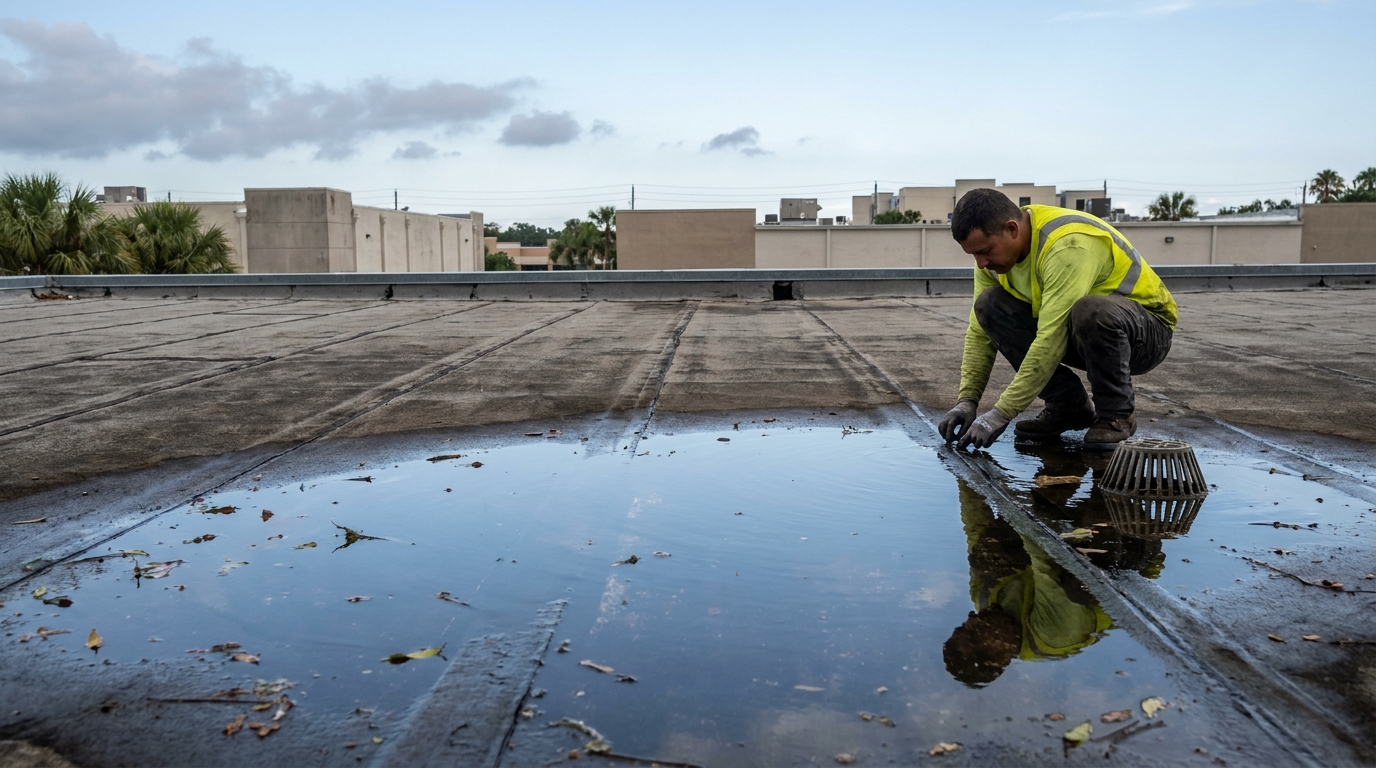
Flat and low-slope commercial roofs in Tampa leak most often at seams, flashings, drains, parapet terminations, and penetrations around HVAC curbs — not through the field of the membrane. Heavy rain exposes these weak points because volume overwhelms a drain that was marginal or ponds water against a flashing that was already fatigued by Tampa's year-round UV and humidity exposure.
Buildings across different parts of the city see different wind-driven rain patterns, which changes where water actually enters. A leak showing up over a conference room may originate at a scupper thirty feet away — tracing that path is where experienced commercial crews earn their keep.
SCM Roofing's commercial scope covers the membrane families that dominate Tampa's commercial stock: TPO, EPDM, PVC, modified bitumen, built-up roofing, and standing seam metal. Matching the repair material to the existing system is non-negotiable for warranty and code compliance.
How do you choose the right emergency commercial roofer in Tampa?
Pick a contractor who answers the phone 24/7, holds an active Florida roofing license you can verify, uses employee crews rather than day-of subcontractors, and documents the work with photos and a written report your insurer will accept. The Tampa market has dozens of established commercial contractors — the differentiators during a storm surge are responsiveness, licensing, and documentation quality, not price.
SCM Roofing, LLC's crews are employees rather than recently hired subcontractors, and the company's roof inspections include a structural assessment, roofing material condition review, past workmanship review, and an attic or interior check, delivered with photo documentation and a written report with prioritized repair recommendations. That documentation package is exactly what Florida insurance carriers ask for when evaluating a sudden-event claim.
SCM Roofing is also GAF Master Elite certified — a distinction held by roughly 2–3% of roofing contractors nationwide — and has 25+ years of experience in the roofing industry across the Gulf Coast.
Frequently asked questions
Should I call my insurance company before or after the roofer?
Call the roofer first for emergency stabilization, then your insurer. Florida insurance carriers require you to mitigate further damage, and an unmitigated leak that keeps running for days gives the carrier grounds to reduce your payout. Get the tarp on, the photos taken, and the written stabilization scope in hand — then open the claim with that documentation ready.
Can my maintenance team put a tarp on the roof themselves?
Not recommended on a wet commercial roof. TPO, EPDM, and modified bitumen become extremely slick when wet, standing water hides compromised decking, and OSHA fall protection requirements apply to commercial roof work. A tarp installed incorrectly can also lift in wind and worsen the damage. Use a licensed roofer with proper fall protection and tarping materials rated for the exposure.
What if the leak started during a named tropical system?
Document the storm date and the leak timing carefully — this strengthens a sudden-event claim and weakens any wear-and-tear denial. Expect delayed response times during named storms, because crews across Tampa, Hillsborough, Pinellas, and surrounding counties are dispatched simultaneously. A contractor already in your area with employee crews will reach you faster than one routing from out of market.
How quickly can a permanent repair happen after tarping?
Permanent repair timing depends on insurance approval, permit issuance from the correct jurisdiction, material availability, and weather. During active wet season or post-storm periods, material supply and crew availability can both be constrained, extending timelines. A tarp is designed to hold for weeks, not months — plan the permanent repair as soon as your adjuster signs off.
Will insurance cover a commercial roof leak from heavy rain?
Coverage depends on your policy and the carrier's assessment of cause. Florida insurers commonly deny roof leak claims by attributing damage to wear and tear rather than a sudden weather event. The strongest position is a documented sudden event (dated storm, timestamped intrusion photos), a recent inspection on file showing the roof was in serviceable condition, and a licensed contractor's written assessment tying the damage to the event.
Do I need to shut down the affected part of the building?
Shut down any area with active water near electrical panels, outlets, or lighting until an electrician clears it. Beyond that, you can usually keep the rest of the building operating if you contain the drip zones and ventilate for drying. Prolonged moisture in insulation and drywall will drive mold growth quickly, so dry-out should start the same day as tarping.
Getting it handled
A commercial roof leak after heavy Tampa rain is a sequenced problem: contain, document, stabilize, claim, repair — in that order, with the right licensed contractor driving the stabilization and repair phases. Shortcutting any step, especially the licensing check and the documentation, is what turns a covered claim into a denied one.
Property managers in Tampa who want this handled professionally can reach SCM Roofing, LLC at (855) 726-7663 or https://scmroofingfl.com to arrange emergency response, a documented inspection, and a code-compliant permanent repair plan.