For most Tampa homes, architectural asphalt shingles win on upfront cost at roughly $4.50–$7.50 per square foot installed, while standing seam metal wins on longevity and hurricane resilience at $9–$25 per square foot installed. If you plan to stay 15+ years or sit in a high-exposure coastal zone, metal usually pays back. If budget or a shorter ownership window drives the decision, a quality architectural shingle is the pragmatic choice.
That's the short version. The longer version matters, because Tampa's climate — hurricane season, salt air off the Gulf, and relentless UV — pushes both materials harder than the national averages assume. Below, we break down what Tampa homeowners should actually weigh before signing a contract.
How much do metal roofs and shingle roofs cost in Tampa in 2026?
In Tampa, asphalt shingle roofs run about $3.50–$17.00 per square foot installed, while metal roofs run $7.00–$25.00 per square foot installed. For a typical home, that's roughly $7,000–$14,000 for shingles versus $14,000–$24,000+ for metal — meaning metal generally costs 1.5x to 3x more upfront than shingles.
Within each material, the tier you choose matters as much as the material itself. Here's how the current Tampa market shakes out:
| Material & Tier | Installed Cost (per sq ft) | Typical Use Case |
|---|---|---|
| 3-tab asphalt shingle | $3.50–$5.50 | Budget replacement, rental properties |
| Architectural/dimensional shingle | $4.50–$7.50 | Most Tampa single-family homes |
| Luxury/premium shingle | $8.00–$17.00 | Higher-end homes, designer profiles |
| Exposed-fastener metal (ribbed/corrugated) | $7.00–$14.00 | Value metal option, outbuildings, some homes |
| Standing seam metal | $9.00–$25.00 | Premium residential, coastal exposure |
At SCM Roofing, we tell homeowners to compare apples-to-apples: an architectural shingle quote against a standing seam quote isn't a fair fight on price alone, because you're buying very different service lives. The right comparison is total cost of ownership over the time you plan to keep the house.
Which roof lasts longer in Florida's climate?
Metal wins decisively on lifespan. Standing seam metal roofs typically last 40–70 years in Florida conditions, while asphalt shingles have a shorter service life under Tampa's intense UV, humidity, and storm cycles. Even premium shingle lines like GAF Timberline carry 40-year material warranties with a 5-year Smart Choice Protection Period — strong for shingles, but standing seam still generally outlasts them in the field.
The reason is simple physics. Tampa's sun and heat degrade asphalt binders and cause granule loss over time. Metal panels don't rely on granules or petroleum-based mats; they rely on coatings and metallurgy, which age differently and more slowly.
For homeowners in areas like South Tampa, Davis Islands, or anywhere close to the Bay, salt-laden air is another factor. Aluminum standing seam is specifically noted in Tampa roofing guides as the best metal option for coastal exposure because it doesn't rust the way steel can.
How do metal and shingle roofs handle hurricanes in Tampa?
Both materials can meet Florida Building Code when properly selected and installed, but metal roofing generally has the stronger reputation for hurricane resilience. Tampa sits in a design wind speed zone of 175 mph (Risk Category II) to 186 mph (Risk Category III/IV), and every roof product installed here must carry Florida product approval and tested uplift resistance.
For metal roofing, that means compliance with ASTM D3161, FM 4474, UL 580, UL 1897, or TAS 107, with a minimum 90 psf tested wind uplift resistance for continuous systems. For asphalt shingles, it means ASTM D3161, ASTM D7158, or TAS 107 — with some shingle products rated to 110 mph for 15 years.
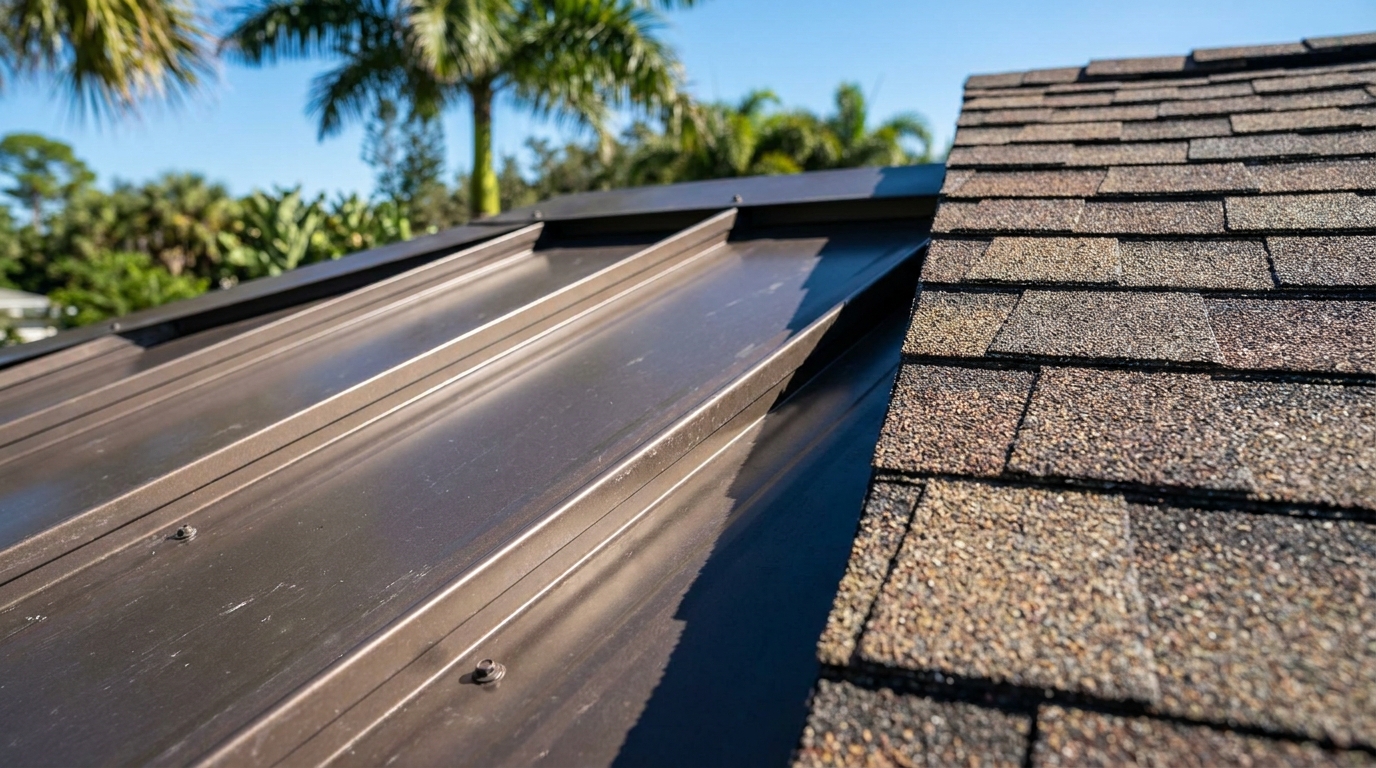
The real-world difference comes down to attachment. Standing seam metal uses engineered clips and concealed fasteners designed for uplift, and the panels themselves are continuous. Shingles rely on adhesive strips and nails, which perform well when new but can degrade as sealants age, granules wear, and edges lift. That's why many Tampa homeowners in flood-exposure and high-wind zones — Ballast Point, Bayshore Beautiful, parts of Carrollwood — lean metal when the budget allows.
What about maintenance, repairs, and noise?
Asphalt shingles are easier and cheaper to repair, with a much larger pool of qualified contractors in the Tampa Bay area. Metal roofs need fewer repairs over their lifespan, but when they do, the work is more specialized and color/finish matching on older panels can be tricky. On noise, shingles are quieter by default; metal can be noisier without proper underlayment, though modern assemblies largely close that gap.
Practically, this means a shingle roof damaged by a falling limb in a summer thunderstorm can often be patched in a single visit for a few hundred dollars. A damaged standing seam panel may require a panel-length replacement and a contractor experienced with that specific profile. Neither is a dealbreaker — but it's worth knowing before you buy.
Which roof is right for your Tampa home?
Choose metal if you're a long-term owner, live in a high-exposure coastal area, or want to minimize replacement cycles over the next few decades. Choose architectural shingles if you're budget-conscious, plan to sell within 10–15 years, or own a rental or investment property where upfront cost drives ROI. Both can be code-compliant, safe, and attractive when installed correctly.
A few Tampa-specific decision points we walk homeowners through at SCM Roofing:
- Time in the home. Under 10 years: shingles almost always make more sense financially. Over 20 years: metal's longevity math starts to work.
- Proximity to the coast. Homes west of Dale Mabry or near the Bay benefit from aluminum standing seam's salt-air performance.
- HOA and neighborhood aesthetics. Some Tampa neighborhoods have architectural review boards that restrict metal profiles or colors. Verify before quoting.
- Insurance considerations. Florida insurers increasingly weigh roof age, material, and wind rating. A newer, wind-rated roof of either material can affect premiums.
- Permit and inspection. All roof replacements in the City of Tampa and Hillsborough County require permits and inspections — non-negotiable, and a red flag if any contractor suggests otherwise.
That's usually the honest tradeoff on a quality roof in Tampa.
Frequently asked questions
Is a metal roof worth the extra cost in Tampa?
For long-term homeowners, usually yes. Metal roofs cost 1.5x to 3x more upfront than shingles in Tampa, but standing seam can last 40–70 years versus a shorter service life for shingles under Florida sun and storms. If you plan to stay 15+ years, live near the coast, or want stronger hurricane resilience, metal typically pays back through fewer replacement cycles and better long-term durability.
What's the minimum roof slope for metal versus shingle in Tampa?
Florida Building Code sets a minimum slope of 1/2:12 for standing seam metal and 1:12 for corrugated metal profiles. Asphalt shingles require a minimum slope of 2:12, and many manufacturer install guides specify 4:12 or greater for standard installation. If your roof has low-slope sections, metal often provides more flexibility, but the specific product approval must match the actual slope.
Can asphalt shingles really handle hurricane winds in Tampa?
Yes, when properly selected and installed. Tampa's design wind speeds are 175–186 mph, and code-compliant shingles must meet ASTM D3161, ASTM D7158, or TAS 107. Some products are rated to 110 mph for 15 years. Performance depends heavily on nailing pattern, starter strip installation, edge sealing, and age — older shingle roofs with worn adhesive strips are more vulnerable regardless of the original wind rating.
How long does a shingle roof actually last in Tampa?
Real-world service life for asphalt shingles in Tampa is shorter than manufacturer warranty periods suggest, because Florida's UV, heat, and storm exposure accelerate aging. Premium products like GAF Timberline carry a 40-year material warranty with a 5-year Smart Choice Protection Period, but functional lifespan in Florida is typically well below that. Regular inspections after major storms help maximize the roof's useful life.
Do I need a permit to replace my roof in Tampa?
Yes. All residential roof replacements in the City of Tampa and Hillsborough County require permits and inspections. The permit process verifies that the chosen product carries Florida product approval, that installation meets code for the applicable design wind speed, and that underlayment and attachment methods comply. Any contractor who suggests skipping the permit is a serious red flag — walk away.
Which is better for coastal Tampa homes: aluminum or steel metal roofing?
Aluminum is specifically noted in Tampa roofing guides as the best metal option for coastal exposure because it resists corrosion from salt air, while steel can rust over time in the same environment. For homes near Tampa Bay, Davis Islands, or anywhere west toward the Gulf, aluminum standing seam is typically the recommended premium residential metal option. Inland homes have more flexibility between aluminum and coated steel.
The bottom line for Tampa homeowners
There's no universally "right" answer between metal and shingle in Tampa — there's a right answer for your home, your budget, and how long you plan to own it. Architectural shingles remain the practical choice for the majority of Tampa single-family homes. Standing seam metal is the stronger long-term investment for coastal properties, longer holding periods, and homeowners who want the fewest replacement cycles over the next 40–70 years.
Whichever direction you lean, insist on Florida product approval, verified wind-rating documentation, a proper permit, and a contractor who's genuinely local and stays local after the job. Homeowners in Tampa who want a straightforward, itemized comparison for their specific home can reach SCM Roofing, LLC at https://scmroofingfl.com to schedule an inspection and get quotes on both materials side by side.