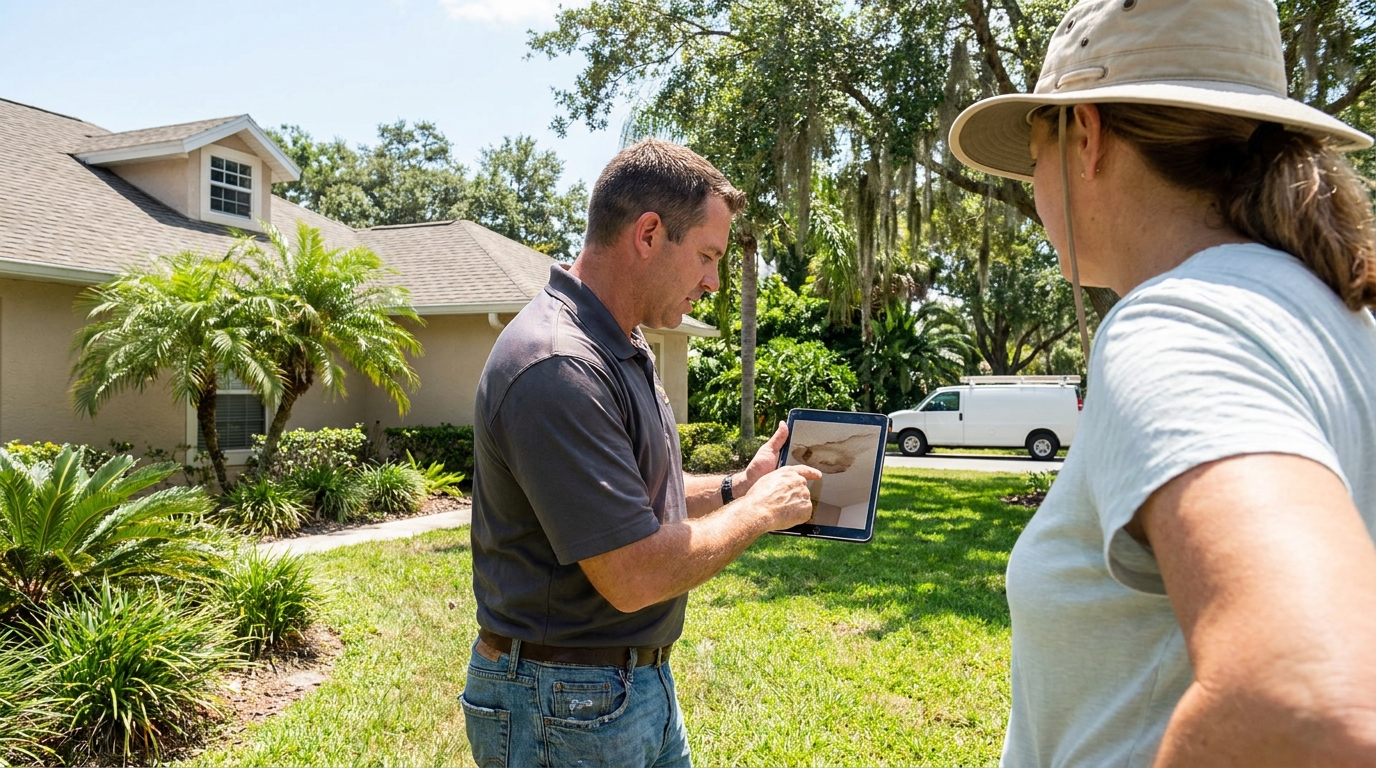
You noticed a faint brown ring on the ceiling above the guest bedroom. Maybe the attic smells a little musty after last week's storm. Or the soffit paint is bubbling in a way it wasn't six months ago. These are the quiet signals New Port Richey homeowners learn to recognize — and the ones too often ignored until a ceiling caves in.
Roof leaks in this part of Florida rarely announce themselves with a dramatic drip into a kitchen pot. Between the Gulf humidity, wind-driven rain off the coast, and the slow stress of summer thunderstorms rolling across Pasco County, water usually finds its way in long before you see it. The trick is knowing where to look — and when to call in a professional inspection.
This guide walks you through the leak detection methods that actually work for homes in New Port Richey, what hidden leak signs to take seriously, and how diagnostic experts pinpoint damage you can't see from the ground.
Why Roof Leaks Hide So Well in New Port Richey Homes
The local climate works against you. With average humidity hovering above 70% for most of the year and a rainy season that runs roughly June through September, moisture has constant opportunity to migrate into roofing assemblies. Add the regular threat of tropical systems coming off the Gulf, and even small breaches can compound quickly.
Most New Port Richey homes use asphalt shingle, tile, or metal roofing — each with its own failure patterns. Older neighborhoods near Jasmin Lakes and around the Cotee River have housing stock dating to the 1970s and 80s, where original underlayment has often outlived its service life. Newer builds out toward Trinity tend to have tile roofs where cracked or slipped tiles create concealed entry points above intact underlayment, masking damage for months.
The result: water often enters at one location, travels along rafters or decking, and shows up several feet away. By the time you see a stain, the actual breach may be in a completely different part of the roof.
Early Warning Signs of Hidden Water Damage
Before you ever climb a ladder, your home tells you when something's wrong. These are the indicators worth investigating immediately.
Interior Signs
- Ceiling discoloration — yellow, brown, or copper-colored rings, even faint ones
- Bubbling or peeling paint on ceilings or upper walls
- Sagging drywall, especially around light fixtures or HVAC vents
- Musty odors in closets, attics, or upstairs rooms after rain
- Visible mold on baseboards, crown molding, or HVAC returns
- Unexplained spikes in humidity readings indoors
Exterior and Attic Signs
- Granules from asphalt shingles collecting in gutters or at downspout outlets
- Cracked, slipped, or missing tiles
- Lifted, curled, or buckled shingles
- Damaged or rusted flashing around chimneys, skylights, and vent pipes
- Daylight visible through the roof deck when standing in the attic
- Wet or stained insulation, even if dry on top
- Dark streaks on rafters or decking — a sign of past or active moisture
One pattern we see often in New Port Richey: homeowners notice a stain, the rain stops, the stain dries, and they assume the problem resolved itself. It didn't. The leak path is still there, waiting for the next storm.
Professional Roof Leak Detection Methods
Once a leak is suspected, professional diagnostics move far beyond a visual once-over from the driveway. Here's what a thorough roof leak inspection typically involves.
1. Comprehensive Visual Inspection
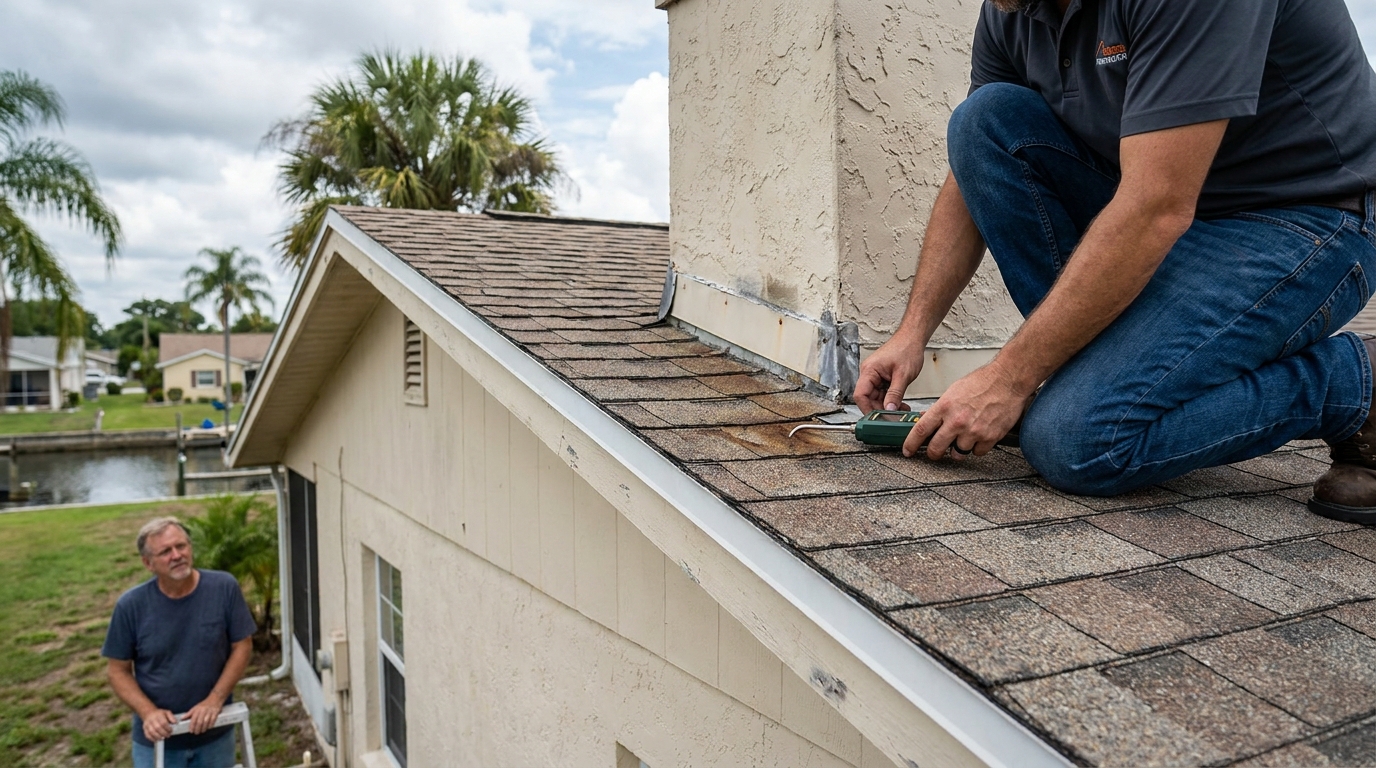
The foundation of any diagnosis. A trained inspector walks the roof systematically, checking field shingles or tiles, ridge caps, valleys, penetrations, flashing, and edge details. They're looking for the small failures — a lifted nail, a hairline crack in a boot, a flashing seam that's pulled away half an inch — that water exploits.
2. Attic and Underside Examination
Often more revealing than the rooftop itself. Inspectors look for moisture trails on rafters, staining on the underside of decking, compressed or discolored insulation, and rust on nail tips (a sign of repeated condensation or active leakage).
3. Infrared Thermal Imaging
Thermal cameras detect temperature differences that indicate trapped moisture inside roofing assemblies. Wet insulation and saturated decking hold and release heat differently than dry material, making hidden water damage visible on a thermal scan — often well before it would show up to the naked eye.
4. Moisture Meter Readings
Handheld moisture meters give quantitative readings on decking, drywall, and framing. This helps distinguish active leaks from old damage that's already dried out, which matters when you're deciding whether to repair, replace, or simply monitor.
5. Controlled Water Testing
When the entry point is elusive, inspectors will deliberately apply water to specific roof zones in sequence — flashing first, then field, then penetrations — while a second technician watches inside. It's tedious but effective for tracking down intermittent leaks that only appear in heavy rain or wind-driven conditions.
Florida Building Code and Permitting Considerations
Pasco County follows the Florida Building Code, which sets specific requirements for roof repairs and replacements — including provisions like the 25% rule, which can require full re-roofing when repairs exceed a quarter of the roof area within a 12-month period. Permits are required for most repair work beyond minor patching, and inspections may be needed depending on the scope.
This matters for leak repair because what looks like a small fix can trigger broader compliance obligations once a contractor opens the roof and finds extensive underlayment damage. A reputable inspection should flag these considerations upfront, not surprise you mid-project.
What to Do When You Suspect a Leak
- Document the evidence. Photograph stains, take note of when they appeared, and track whether they grow after rain.
- Check the attic safely. Bring a flashlight, look for moisture on rafters and decking, and note any musty smell or visible mold.
- Don't power-wash or probe the suspected area from the roof — this can drive water deeper and worsen damage.
- Schedule a professional inspection before the next significant rain event. In New Port Richey, that window is often shorter than you think.
- Review your homeowners insurance policy. Sudden damage from a storm is typically covered; long-term neglect usually isn't, which makes early detection financially important.
FAQs About Roof Leak Detection in New Port Richey
How quickly can a small roof leak cause structural damage?
In Florida's climate, faster than most homeowners expect. Saturated decking can begin to rot within weeks, and mold growth can start in as little as 48 hours after sustained moisture exposure. Hidden leaks discovered after a single rainy season often involve thousands of dollars in framing and drywall repair.
Can I detect a roof leak without going on the roof?Sometimes. Attic inspections, ceiling and wall observations, and thermal imaging from inside can identify many leaks without rooftop access. But pinpointing the exact entry point almost always requires getting on the roof safely — which is why professional inspection is usually the right call.How often should New Port Richey homeowners have their roof inspected?
At minimum once a year, ideally before hurricane season begins in June, and again after any major storm. Homes with roofs older than 15 years benefit from semi-annual inspections to catch deterioration early.
Does homeowners insurance cover hidden roof leaks?
It depends on cause and timing. Sudden, accidental damage from a covered event is usually included. Gradual damage from wear, poor maintenance, or undetected long-term leaks often isn't. Documentation from a professional inspection strengthens any claim you may need to file.
Getting Professional Help
Hidden water damage is one of those problems where time genuinely changes the cost. A leak caught at the flashing stage might be a few hundred dollars. The same leak caught after a season of rot in the decking can run into the thousands.
SCM Roofing, LLC has built its reputation in the New Port Richey area on the kind of careful diagnostic work this article describes — thorough inspections, clear documentation, and honest recommendations about whether a repair or replacement is the right path. The company holds GAF Master Elite certification and consistently earns high marks from local homeowners for communication and workmanship, with a 4.9★ average across 239 Google reviews.
Homeowners in New Port Richey who want a hidden leak diagnosed properly can reach SCM Roofing, LLC at https://scmroofingfl.com for a free inspection and estimate. Catching water damage early is almost always cheaper than catching it late — and a professional eye on the roof is the most reliable way to know what you're actually dealing with.