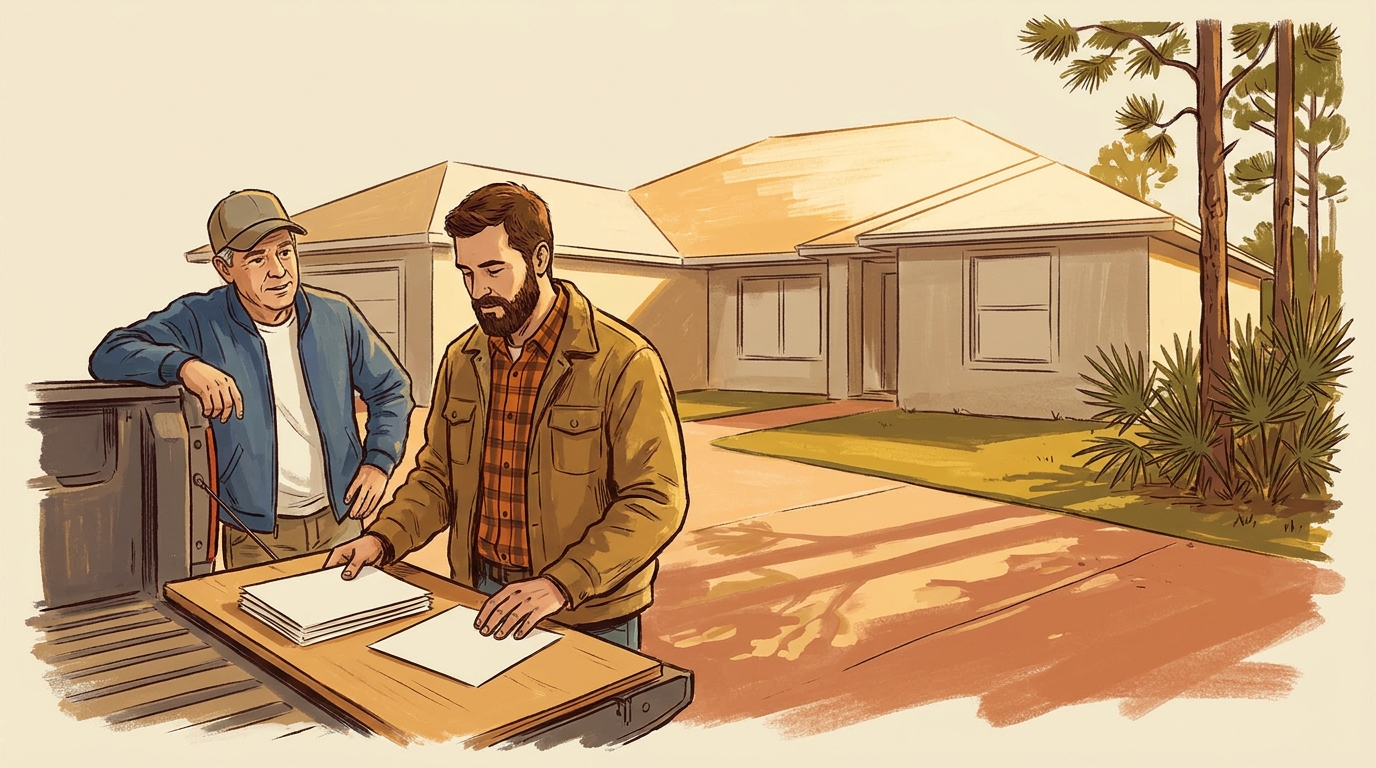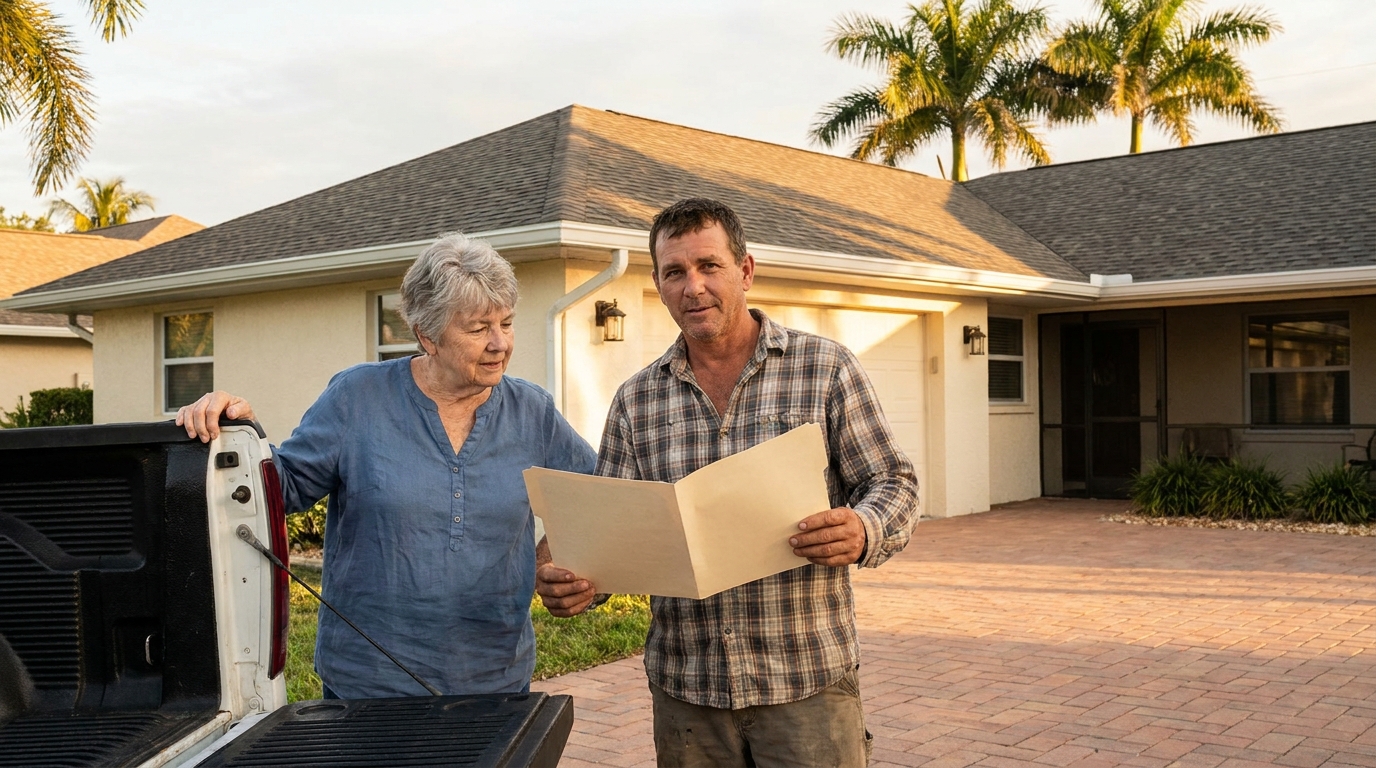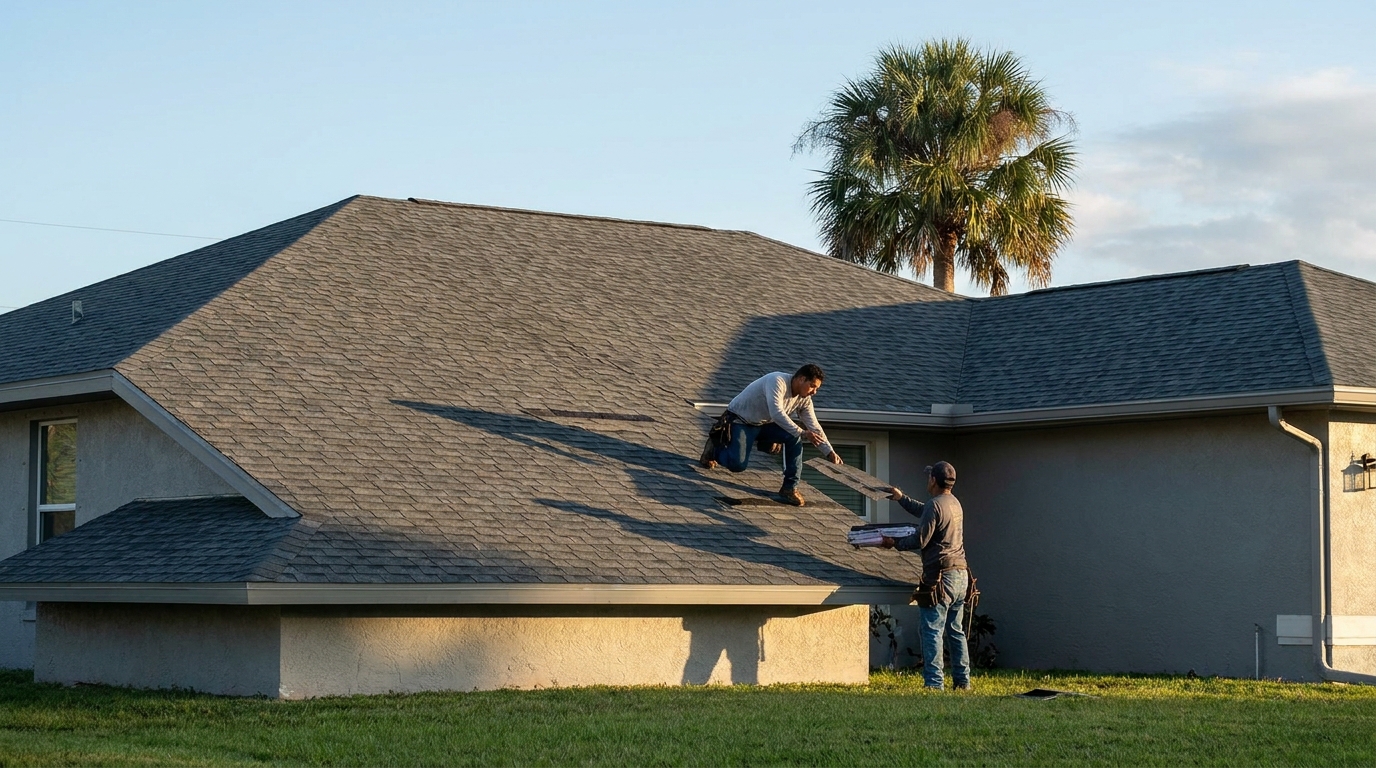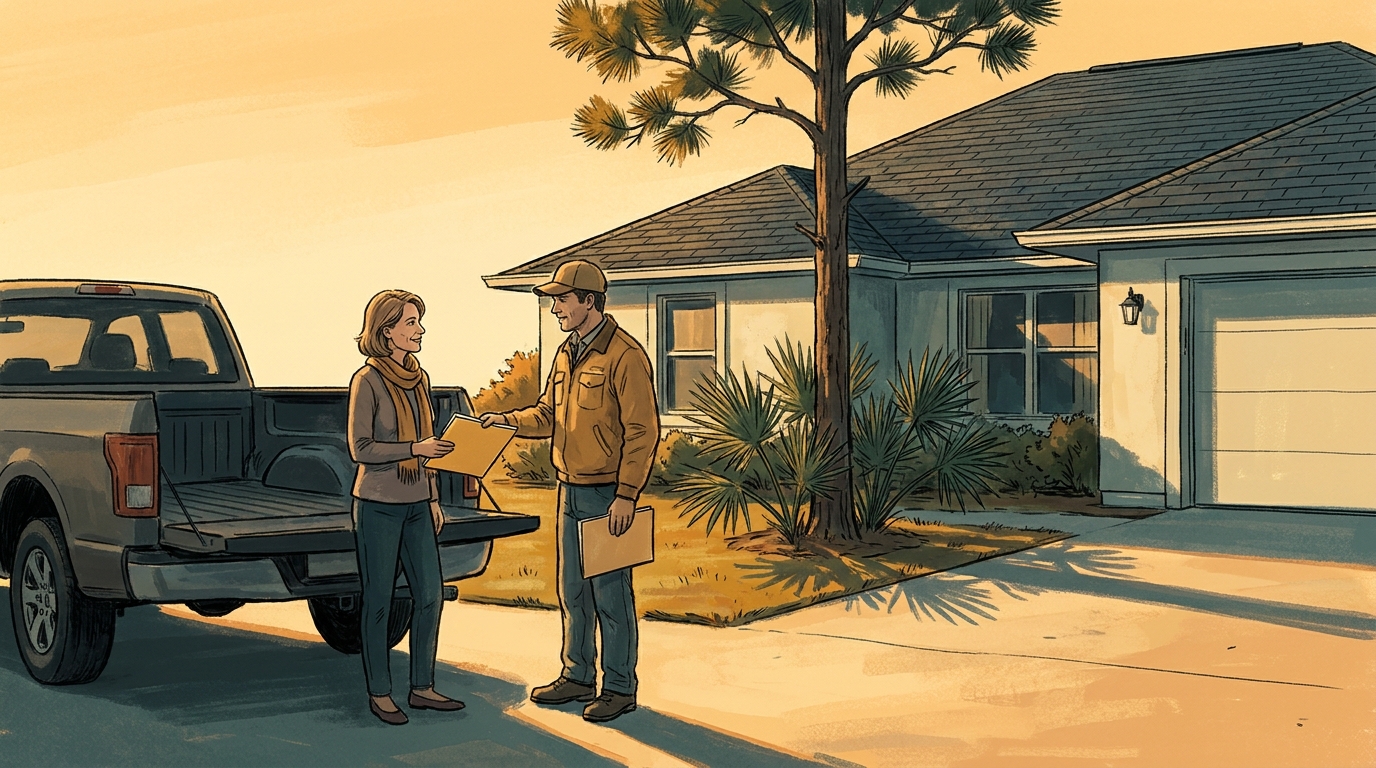
A full roof replacement in Port Charlotte moves through seven stages: documenting the problem, choosing materials and scope, pulling a permit, tearing off the old roof and inspecting the deck, installing the new assembly, passing inspections, and collecting closeout documents. Charlotte County requires a permit for roof work beyond 100 square feet or work involving trusses or rafters, and projects with contracts above $5,000 need a signed and recorded Notice of Commencement before the first inspection. Plan on three to six weeks from first call to Certificate of Completion when weather and the permit queue cooperate.
What triggers a roof replacement in Port Charlotte?
Replacement is driven by age, storm damage, or widespread failure of the covering or deck. In coastal Charlotte County, hurricane exposure accelerates wear on shingles, tile fasteners, and underlayment — and insurers increasingly require replacement rather than patching once damage crosses a threshold. If you see granule loss on shingles, cracked or displaced tiles, repeated leaks after storms, or sagging between rafters, you are likely past repair territory.
SCM Roofing, LLC handles leak repair, storm damage repair, and emergency service, and will tell you honestly when a repair is still viable versus when a full tear-off is the better investment. For homes in waterfront neighborhoods near tidal canals and open bays, saltwater air and the summer afternoon storms that roll across the harbor make underlayment condition — not just the surface material — the deciding factor.
Which building code governs your 2026 Port Charlotte roof?
The code edition that governs your project is set by the date your permit application is submitted. Florida's 9th Edition (2026) Building Code is scheduled to take effect December 31, 2026, so most Port Charlotte roofs permitted through late 2026 will fall under the current edition, while permits filed from the effective date forward will fall under the new one. Confirm the governing edition with Charlotte County before signing a contract.
Florida Building Code Section 105.1 requires the owner or an authorized agent to obtain the required permit before regulated construction or repair begins. A reputable contractor pulls the permit in their own name; walking away from a job because the homeowner refuses to permit it is a sign of a contractor worth hiring.
Do you need a permit to replace your roof in Charlotte County?
Yes — nearly always. Charlotte County's published guidance exempts only roof repairs under 100 square feet (one roofing square) that do not involve trusses or rafters; anything larger, and any work touching structural members, requires a permit. A full replacement always clears that threshold.
If your roofing contract exceeds $5,000, a signed and recorded Notice of Commencement must be submitted before the first inspection is scheduled. Port Charlotte addresses may fall under unincorporated Charlotte County or a municipality, so confirm which building department has jurisdiction before the application goes in — the wrong department means a restart.
How does the replacement process actually unfold?
A typical Port Charlotte replacement runs seven stages across three to six weeks: inspection and scope, material selection, permit submittal, tear-off and deck inspection, dry-in and installation, county inspections, and closeout. Tear-off through final inspection on a single-family home usually takes two to five working days on the roof itself; the rest is paperwork and queue time.
| Stage | What happens | Typical duration |
|---|---|---|
| 1. Inspection & scope | Measure roof, assess deck, document damage, write proposal | 1–3 days |
| 2. Material selection | Choose shingle, tile, or metal; confirm underlayment and flashing | 1–7 days |
| 3. Permit & NOC | Submit application to Charlotte County; record Notice of Commencement if contract exceeds $5,000 | 1–3 weeks |
| 4. Tear-off & deck | Remove old covering to the deck, replace rotted sheathing | 1–2 days |
| 5. Dry-in & install | Underlayment, flashing, new covering, ridge and vents | 1–4 days |
| 6. Inspections | In-progress and final inspections by Charlotte County | 2–7 days |
| 7. Closeout | Certificate of Completion, warranties, final invoice | 1–2 weeks |
Florida rules on reroofing over existing materials and secondary water barrier requirements vary by building type, so ask which specific provisions apply to your home. SCM Roofing, LLC does not roof over existing layers; it removes all old material down to the deck before installing a new system, which is also what gives the inspector a clean look at the sheathing.
What materials should Port Charlotte homeowners choose?
The three mainstream choices on Gulf Coast homes are asphalt shingle, concrete or clay tile, and metal. Shingle is the lowest first cost and fastest to install; tile is the traditional Florida look with long service life; metal — especially standing seam — performs well in wind and reflects heat, which matters through a Port Charlotte summer.
SCM Roofing, LLC installs shingle roofing in 3-tab, architectural, and luxury/designer profiles; metal in standing seam, metal shingle, stone-coated steel, and corrugated/exposed-fastener styles; and concrete and clay tile with underlayment replacement. That matters because many Port Charlotte tile roofs fail at the underlayment long before the tile itself, and the right fix is usually a tile lift-and-relay with new underlayment, not a full tear-off of the tiles.
How do you vet a roofing contractor in Port Charlotte?
Verify license, verify insurance, and compare written proposals on the same scope. A roofing contractor should provide proof of liability and workers' compensation insurance — including the name and phone number of their insurance agent so you can verify coverage directly rather than trusting a certificate PDF. Florida contractor licenses are searchable by number; SCM Roofing, LLC's Florida state contractor license number is CCC1331132.
Evaluate written proposals on the same ten dimensions: material and product, removal and disposal, underlayment and flashing, deck-repair pricing, ventilation details, cleanup, schedule, payment terms, warranty terms, and who obtains the permit and schedules inspections. Owner Scott Marone graduated from the University of Florida's Construction Management program and holds both a Florida State General Contractor's license and a Roofing Contractor's license — the kind of credential stack that reduces the chance of a bad surprise at inspection. SCM Roofing, LLC also holds GAF Master Elite Certified status, a distinction earned by only about 2–3% of roofing contractors nationwide, and brings 25+ years of experience in the roofing industry.
Had a great experience with SCM roofing. Needed a roof put on for the sale of my parents house that was closing in 3 weeks. Robbie got a quote to me quickly, ensured the permits were pulled, the replacement was done and the inspection happened with time to spare. I loved how Robbie sent me copies of their insurance as well as their license before i asked. No other roofer did that and his quote was very competitive. Jose and his crew were wonderful. They were timely and efficient. It was an easy experience at each stage and I'm pleased with the results of the installation. Thanks so much Robbie.
What inspections and closeout documents should you expect?
Charlotte County requires a Roof Re-Roof Inspection Affidavit to be available at the job site, and the Notice of Commencement must be submitted before the first inspection is scheduled when the contract exceeds $5,000. After required inspections are completed and approved, the county's permitting section finalizes the process and issues a Certificate of Occupancy or Certificate of Completion as appropriate.
At closeout, keep the signed permit, inspection approvals, the Certificate of Completion, manufacturer material warranty, contractor workmanship warranty, and a final paid invoice. These are the documents an insurer or a future buyer will ask for, and they are nearly impossible to reconstruct years later.
Frequently asked questions
How long does a roof replacement take in Port Charlotte?
From signed contract to Certificate of Completion, plan on three to six weeks when weather and the permit queue cooperate. The on-roof work itself — tear-off, dry-in, and installation — is typically two to five working days on a single-family home. Permit submittal, Notice of Commencement recording, and county inspections account for most of the remaining time.
Do I need a permit to replace my roof in Charlotte County?
Yes. Charlotte County only exempts roof repairs under 100 square feet (one roofing square) that do not involve trusses or rafters; full replacements always require a permit. Florida Building Code Section 105.1 also requires the owner or an authorized agent to obtain the permit before regulated construction or repair work begins, so the permit must be in hand before the first nail.
What is a Notice of Commencement and when is it required?
A Notice of Commencement is a recorded document identifying the property, owner, and contractor for a construction project. In Charlotte County, residential roof projects with contracts above $5,000 require a signed and recorded Notice of Commencement submitted before the first inspection is scheduled. Your contractor typically prepares it, but the owner signs and records it with the appropriate county office.
Will the new Florida Building Code affect my 2026 roof project?
It depends on your permit application date. Florida's 9th Edition (2026) Building Code is scheduled to take effect December 31, 2026, so projects permitted before the effective date fall under the current edition and projects permitted on or after fall under the new one. Confirm the governing edition with Charlotte County before signing a contract if your timing is near the changeover.
Can a contractor roof over my existing shingles in Florida?
Florida's rules on reroofing over existing materials and secondary water barrier requirements vary with building type and project circumstances, and your contractor should tell you which provisions apply to your specific home. As a practical matter, many Port Charlotte contractors — including SCM Roofing, LLC — do not roof over existing layers and instead remove all old material down to the deck, which also allows a proper deck inspection.
What should a written roofing proposal include?
Compare proposals on roof material and product, removal and disposal, underlayment and flashing, deck-repair pricing, ventilation details, cleanup, schedule, payment terms, warranty terms, and who obtains the permit and schedules inspections. Also verify proof of liability and workers' compensation insurance, including the name and phone number of the insurance agent so you can confirm coverage is active before work starts.
What documents should I keep after the job is finished?
Keep the signed permit, the recorded Notice of Commencement if one was required, Charlotte County's inspection approvals, the Roof Re-Roof Inspection Affidavit, the Certificate of Occupancy or Certificate of Completion, the manufacturer material warranty, the contractor workmanship warranty, and the final paid invoice. These documents will be requested by insurers at renewal and by buyers when the home is sold.
Getting started in Port Charlotte
Roof replacement in Port Charlotte is a regulated project, not a weekend job: the permit, the Notice of Commencement when the contract exceeds $5,000, the inspection affidavit on site, and the Certificate of Completion are all non-negotiable. The homeowners who come out of it happiest start by confirming jurisdiction, verifying contractor license and insurance, and locking the scope in writing before any shingle is torn off. Readers in Port Charlotte who want this handled professionally can reach SCM Roofing, LLC at (855) 726-7663 or https://scmroofingfl.com to get started.