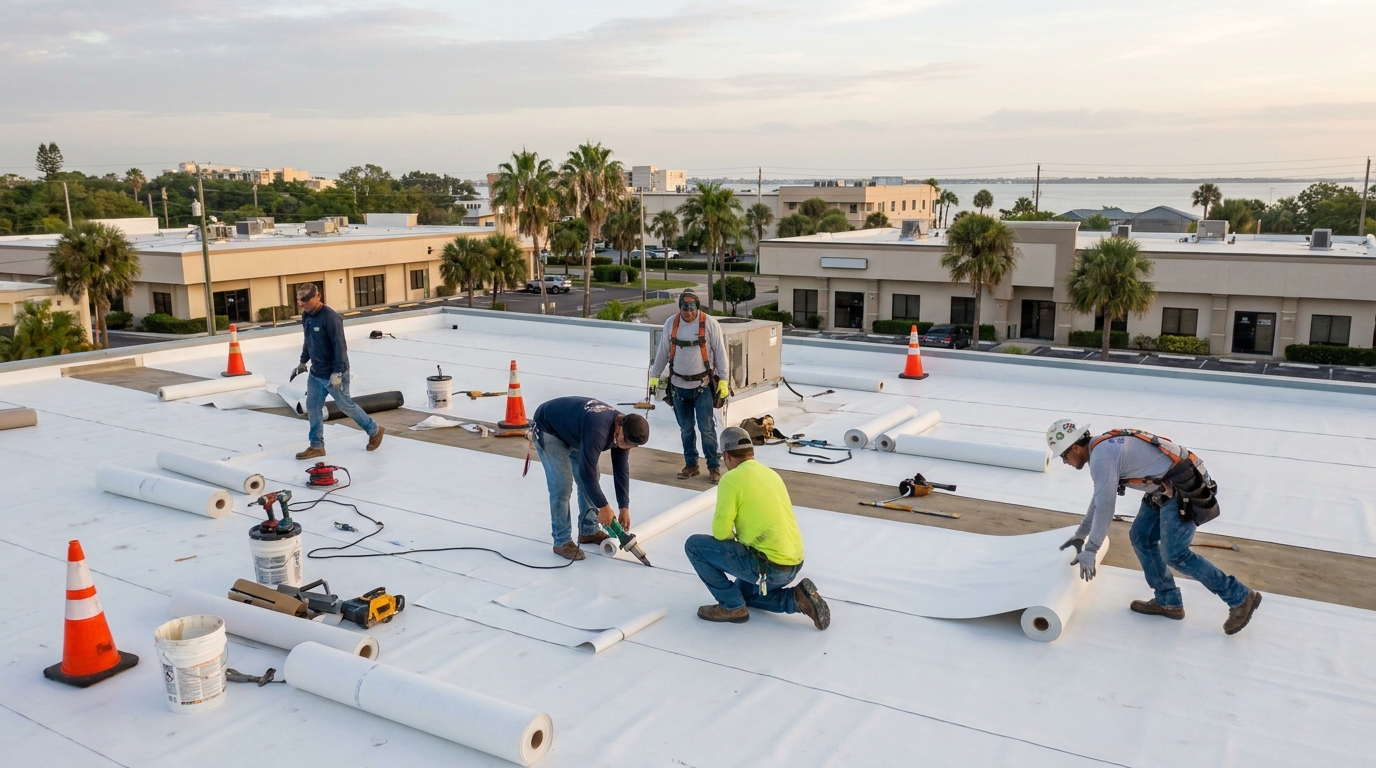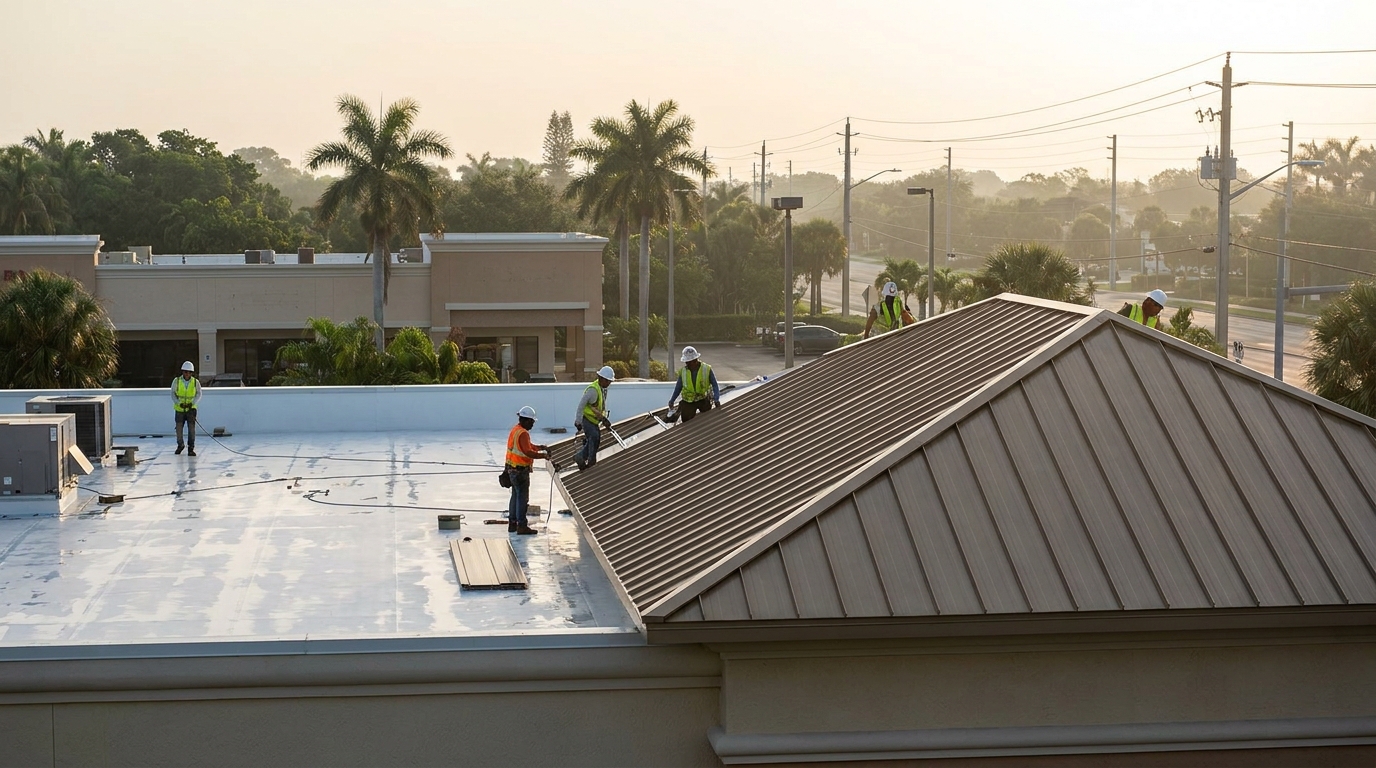
If you own a commercial building in Naples, the roof replacement decision usually comes down to two systems: TPO single-ply membrane or standing seam metal. Both can be engineered to meet Florida's hurricane-driven wind uplift codes. Both are common on Gulf Coast commercial properties. But they solve different problems — and picking the wrong one can cost you tens of thousands over a building's lifecycle.
This is a head-to-head comparison written for Naples property owners weighing a real replacement decision. No fluff, no listicle padding — just the tradeoffs that matter along the Paradise Coast.
The Short Answer
TPO is the lower-cost, faster-installed choice for flat and low-slope buildings — the warehouses off Airport-Pulling Road, the strip centers along Pine Ridge, the office boxes near the Naples Airport. Expect $5–$14 per square foot installed, a 20–30 year lifespan, and up to ~88% UV reflectivity that meaningfully lowers cooling costs.
Metal standing seam costs roughly twice as much upfront — typically $8–$22 per square foot installed in the Naples market — but delivers a 40–70+ year service life, Class 4 hail resistance, and superior debris performance in hurricane conditions. It requires a sloped roof (usually 3:12 minimum, though some standing seam systems are rated to 0.5:12).
If your building is flat, TPO is almost always the practical answer. If your building has slope and you plan to hold it 20+ years, metal often wins on lifecycle cost.
Installed Cost in the Naples Market
Naples coastal pricing tends to skew toward the higher end of national ranges because of hurricane code requirements, insurance-driven engineering, and elevated labor rates in Collier County.
For TPO, budget $5–$8 per square foot for simpler assemblies and $10–$14 per square foot for Florida code-compliant systems with proper insulation and hurricane uplift detailing. Material alone runs roughly $2.50–$4.50 per square foot.
For standing seam metal, expect $8–$14 per square foot for baseline commercial assemblies and $14–$22 per square foot for premium coastal specs with enhanced coatings and engineering. Florida contractor data typically works out to $800–$1,400 per square (100 sq ft).
Commercial roof replacement cost in Naples is driven as much by insulation, deck condition, parapet detailing, and permitting as by the membrane or panel itself. Get itemized quotes.
Lifespan and Long-Term Value
TPO membranes typically last 20–30 years, and sometimes only 15–20 years in harsher exposure or with the lighter 45 mil product. Metal standing seam runs 40–70+ years, with many manufacturers advertising a 50-year service life.
That gap matters. A Naples building held for 40 years may need two full TPO replacements versus zero replacements on a well-installed metal roof. When you model total cost of ownership — replacements, tear-off disposal, business disruption, maintenance — metal often pulls ahead for long-hold owners even though the upfront number is higher.
For a 10–15 year hold period, TPO's ROI is hard to beat. For generational ownership of an Old Naples storefront or a Fifth Avenue South mixed-use property, metal usually makes more financial sense.
Hurricane and Wind Performance
This is where Naples owners need to pay attention. Collier County sits in one of the most stringent wind zones in the country, and the Florida Building Code enforces it aggressively through the permit process.
Both systems can be engineered to meet code. Premium TPO systems (such as GAF EverGuard Extreme with RhinoBond attachment) can reach 180 mph uplift ratings. Standing seam metal typically achieves 140–180 mph uplift, with Florida-optimized assemblies also reaching 180 mph and carrying UL 580 Class 90 ratings.
The real difference shows up under debris impact. Standing seam metal's interlocking panels resist puncture from wind-driven objects — the palm fronds, roof gravel, and airborne signage that turn a Category 3 into a claim event. TPO can be punctured by sharp debris, and edge and seam failures are the most common membrane loss mode after major storms. Both hold Class A fire ratings; metal typically carries the higher Class 4 hail rating (UL 2218).
For storm-critical facilities — medical offices near NCH Baker Hospital, essential retail, data-sensitive tenants — metal offers a wider margin of safety.
Energy Efficiency Under the Naples Sun
White TPO delivers up to ~88% UV reflectivity and is Energy Star and LEED qualified. Owners typically see 15–20% cooling cost reduction versus darker roofs — a real number when your building is running air conditioning nine months out of the year.
Reflective-coated metal reaches up to ~70% solar reflectivity and performs especially well in ventilated assemblies. It's efficient, but for pure reflective cooling performance on a flat commercial box, white TPO usually wins.
Best Roofing System for a Flat Commercial Building in Naples
If your building is flat or low-slope — anything down to about 0.25:12 — TPO is the practical answer. Standing seam metal generally requires a 3:12 minimum for lapped panels (some systems go to 0.5:12), and retrofitting slope onto a flat structure is rarely worth the cost.
The vast majority of Naples' commercial building stock — the warehouses in the North Naples industrial corridor, big-box retail along Tamiami Trail, medical offices, and light industrial around the airport — is flat-roofed. TPO dominates this segment for good reason.
Metal shines on sloped applications: high-visibility retail, church and school buildings, mixed-use with architectural intent, and storm-hardened facilities where the roof is a design feature rather than a utility surface.
Maintenance and Warranty
TPO warranties run 10–20+ years typically, with 25–30 year coverage available on 60+ mil membranes installed by approved contractors and enrolled in periodic maintenance programs. Seams, flashings, and penetrations need inspection — especially after hurricane season.
Metal carries lower ongoing maintenance because of fewer failure points and no seams to weld. Manufacturer warranties commonly align with 30–50+ year service life expectations, though exact terms vary by gauge, coating, and system.
Neither system is truly install-and-forget in a coastal environment. Salt air, UV, and storm cycling take a toll on any roof in Southwest Florida.
How to Choose a Commercial Roofing Contractor in Naples
Roof system choice matters less than installation quality. A poorly detailed metal roof will leak; a poorly welded TPO seam will fail. When evaluating contractors, prioritize:
- Florida licensing and Collier County permit history — verify the certified roofing contractor license and confirm they pull permits routinely.
- Manufacturer certifications — GAF, MBCI, and other manufacturers only extend full system warranties through approved installers.
- Coastal hurricane experience — ask specifically about wind uplift engineering, edge detailing, and post-storm inspection protocols.
- Transparent, itemized proposals — insulation, fastening pattern, tear-off, disposal, and warranty terms should all be spelled out.
- Local presence — a Naples-based contractor who'll return for warranty service beats an out-of-market bidder.
Experienced local contractors such as SCM Roofing, LLC work across both systems, which matters — you want an evaluation from someone who isn't defaulting to whatever they install most.
Frequently Asked Questions
Which lasts longer in Naples' climate — TPO or metal?
Metal. Expect 40–70+ years from standing seam versus 20–30 years from TPO. Salt air and UV exposure in Southwest Florida push both systems toward the lower end of their ranges.
How much does commercial roof replacement cost in Naples?
TPO typically runs $5–$14 per square foot installed; standing seam metal $8–$22 per square foot. Naples pricing skews high due to hurricane code requirements and coastal labor rates.
Can metal roofing go on a flat commercial building?
Generally no — standing seam requires slope, typically 3:12 minimum, though some systems are rated to 0.5:12. For truly flat roofs, TPO is the practical choice.
Does insurance care which system I install?
Often yes. Carriers writing coastal Collier County policies frequently favor metal or premium high-uplift TPO assemblies. Ask your carrier before finalizing your spec.
The Bottom Line for Naples Owners
For flat-roof commercial buildings and shorter hold periods, TPO delivers the strongest cost-to-performance ratio. For sloped roofs, long-term ownership, and storm-critical facilities, standing seam metal earns its premium.
Commercial property owners in Naples who want an honest side-by-side evaluation — one that accounts for your specific building geometry, hold period, and insurance situation — can reach SCM Roofing, LLC at https://scmroofingfl.com for a free estimate. Doing the analysis before hurricane season gives you time to permit and install without the pressure of an active leak or a storm on the map.