Flat Roof Systems for Florida Businesses: TPO, Modified Bitumen, and EPDM Compared
There’s no single best flat roof system for every commercial building in Florida, but TPO dominates new installations for good reason. It handles the heat, reflects UV, resists ponding water, and meets Florida’s cool roof requirements out of the box. That said, modified bitumen and EPDM each have situations where they’re the right call. Here’s how the three stack up for Gulf Coast business owners.
Table of Contents
- Why Does Florida’s Climate Make Commercial Roofing Different?
- How Do TPO, Modified Bitumen, and EPDM Compare for Florida Businesses?
- Which Commercial Roof System Handles Florida Storms Best?
- What About Energy Efficiency and Florida’s Cool Roof Requirements?
- How Do You Know When Your Commercial Roof Needs Replacement vs. Repair?
- What SCM Roofing Recommends
- Frequently Asked Questions
- Key Takeaways
Why Does Florida’s Climate Make Commercial Roofing Different?
Florida’s climate punishes commercial flat roofs in ways that northern building owners never deal with. Understanding these stressors is the first step to choosing the right system.
UV intensity is extreme. Florida’s Gulf Coast gets more annual UV exposure than almost anywhere else in the continental U.S. That radiation breaks down roofing membranes, degrades adhesives, and accelerates aging. A roof system that performs well in Ohio may fail years early in Tampa or Fort Myers.
Thermal shock is the hidden killer. During summer afternoon thunderstorms, a roof surface baking at 160°F can drop 60 degrees in 30 minutes when a storm rolls through. That rapid expansion and contraction stresses seams, loosens fasteners, and cracks rigid materials. It happens almost daily from June through September on the Gulf Coast.
Ponding water is unavoidable on flat commercial roofs during Florida’s rainy season. Some systems handle standing water better than others. A membrane that allows water to sit for 48+ hours without degradation is worth more in Florida than anywhere else.
Hurricane wind uplift is a serious threat on large, flat surfaces. Commercial roofs present massive surface areas for wind to grab. The Florida Building Code requires specific wind uplift ratings for commercial structures, and the attachment method — mechanically fastened, fully adhered, or ballasted — directly affects performance.
Salt air affects coastal commercial properties from Clearwater to Naples. Metal edge details, fasteners, and accessories need to be rated for the environment.
How Do TPO, Modified Bitumen, and EPDM Compare for Florida Businesses?
Here’s a direct comparison of the three most common flat roof systems for Gulf Coast commercial buildings:
TPO (Thermoplastic Polyolefin)
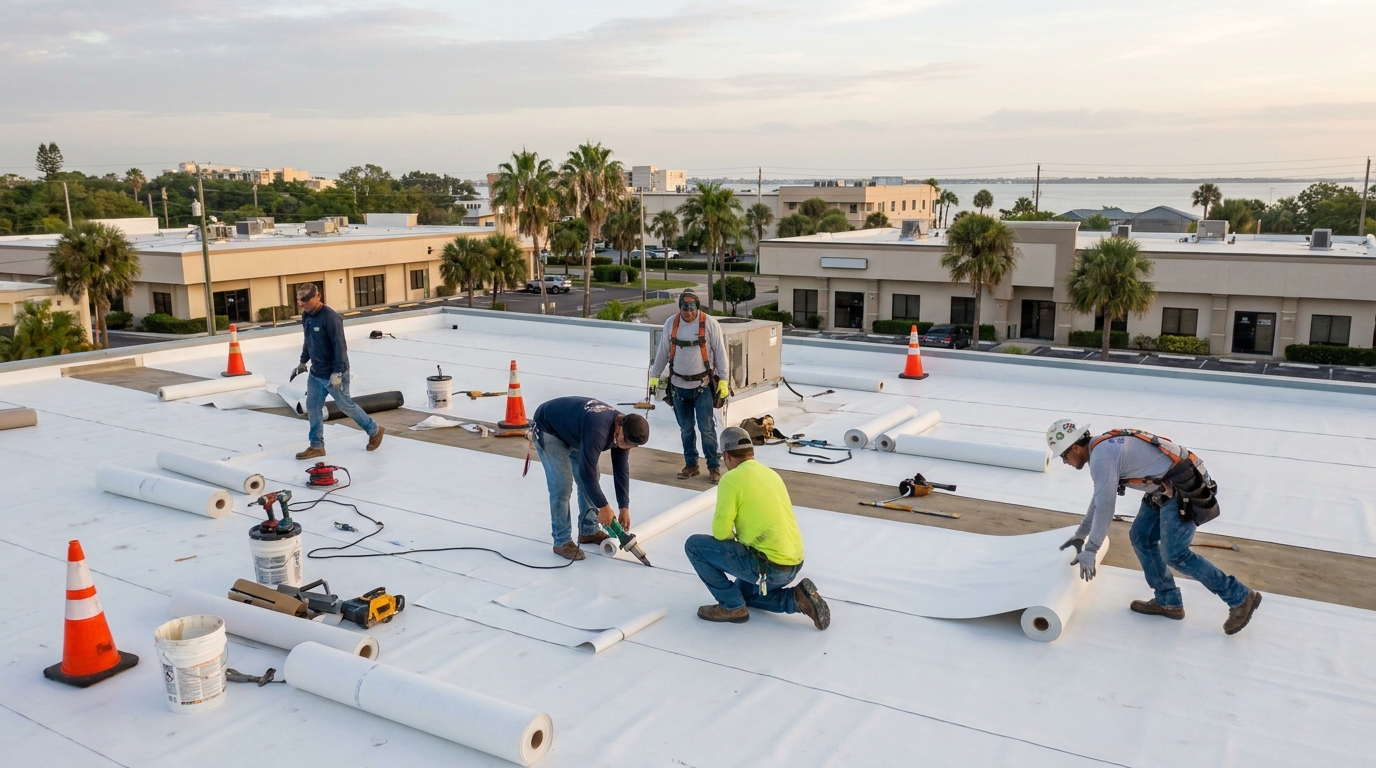
TPO is a single-ply membrane that comes in white, gray, or tan — though white is the standard choice in Florida for its reflective properties. Seams are heat-welded, creating a bond that’s actually stronger than the membrane itself. Lifespan in Florida: 20 to 30 years for quality installations. Cost: $5 to $10 per square foot installed. TPO handles ponding water well, reflects up to 80% of solar radiation, and meets Florida’s cool roof requirements without additional coatings. It’s the most specified commercial roofing membrane in Florida right now.
Modified Bitumen
Modified bitumen is a multi-layered system that’s essentially an engineered evolution of the old built-up roof (BUR). It’s thick — 240 mils compared to TPO’s 60 mils — and that redundancy provides excellent puncture and impact resistance. Lifespan in Florida: 15 to 20 years. Cost: $4 to $8 per square foot installed. Mod-bit is tough and handles foot traffic better than any single-ply membrane, making it ideal for buildings with frequent rooftop maintenance access. The downside: its dark surface absorbs heat, increasing cooling costs unless you add a reflective coating.
EPDM (Ethylene Propylene Diene Monomer)
EPDM is a synthetic rubber membrane that’s been around for decades. It’s known for durability and flexibility, with a lifespan of 20 to 25 years in most climates. In Florida, it’s less common than TPO because it’s typically black, which absorbs heat and conflicts with cool roof requirements. White EPDM exists but costs more and still doesn’t reflect as well as white TPO. Cost: $4 to $8 per square foot installed. EPDM seams are adhesive-bonded rather than heat-welded, which makes them more vulnerable to failure in Florida’s thermal cycling environment.
Which Commercial Roof System Handles Florida Storms Best?
Wind uplift resistance on a large flat commercial roof is not about the membrane alone — it’s about how the system is attached to the building.
Mechanically fastened TPO uses screws and plates that anchor the membrane to the roof deck. This is the most common and cost-effective method, and it performs well in most Gulf Coast wind zones. For higher wind speed areas — coastal Pinellas, Manatee, and Lee counties — closer fastener spacing provides the uplift resistance the code requires.
Fully adhered systems bond the membrane directly to the substrate with adhesive across the entire surface. This creates more uniform wind resistance with no point loads, and it’s often specified for buildings in the highest wind zones. Fully adhered TPO or modified bitumen provides the strongest wind performance for Florida commercial roofs.
Modified bitumen’s thickness gives it an advantage against impact from flying debris — a real concern during Gulf Coast hurricanes. Its 240-mil profile is four times thicker than TPO, which means small debris that might puncture a single-ply membrane won’t penetrate mod-bit.
The Florida Building Code requires commercial roofing systems to carry FM Global or UL wind uplift ratings appropriate for the building’s location. Your contractor should specify the attachment method and verify the system meets code requirements for your specific property.
What About Energy Efficiency and Florida’s Cool Roof Requirements?
Florida’s Energy Code requires commercial buildings to meet specific roof reflectivity standards. A cool roof — one that reflects solar radiation rather than absorbing it — directly reduces the building’s cooling load and energy costs.
White TPO is the most straightforward way to meet these requirements. A quality white TPO membrane reflects 80% or more of solar radiation, keeping roof surface temperatures significantly cooler than dark-colored alternatives. For a large commercial building on the Gulf Coast, the difference in cooling costs between a white reflective roof and a dark roof can be $50 to $100 per month per 2,000 square feet.
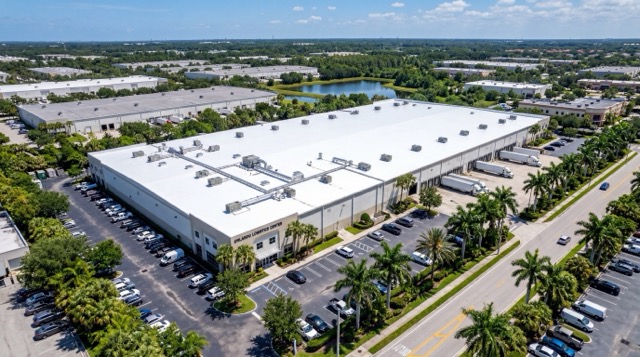
Over a 20-year roof lifespan, that adds up to $12,000 to $24,000 in energy savings on a 2,000-square-foot commercial space. For larger buildings — warehouses, distribution centers, retail plazas — the savings scale proportionally.
Modified bitumen can meet cool roof requirements with a reflective coating applied over the surface. This adds cost and requires recoating every 5 to 10 years. EPDM in white can technically meet the standard, but it’s rarely specified in Florida for this purpose because white TPO does the job at lower cost.
The energy code also specifies R-value requirements for commercial roof insulation. Your roofing system should include rigid insulation boards (typically polyiso) between the deck and the membrane to meet current standards.
How Do You Know When Your Commercial Roof Needs Replacement vs. Repair?
Commercial flat roofs should be inspected at least twice a year in Florida — once before hurricane season and once after. Between scheduled inspections, watch for these signs:
Ponding water that lasts more than 48 hours after rain indicates drainage problems. Some ponding is normal, but persistent standing water accelerates membrane degradation and adds structural load.
Membrane bubbling or blistering means moisture is trapped between layers or beneath the membrane. Small blisters can be repaired, but widespread blistering usually means the system is failing.
Seam failures are the most common point of entry for water on single-ply roofs. If heat-welded TPO seams are opening or adhesive EPDM seams are lifting, the roof’s integrity is compromised.
Flashing deterioration at walls, curbs, HVAC penetrations, and edges is a leading cause of commercial roof leaks. Flashing takes the most abuse and is often the first component to fail.
Interior leaks or staining mean water is already getting through. By the time you see ceiling stains inside your building, the problem has likely been developing for weeks or months.
The general rule: if repair costs exceed 30% of replacement cost, or if your roof has had more than three significant repairs in two years, it’s time to replace rather than patch.
What SCM Roofing Recommends
For most Gulf Coast business owners, we’re recommending TPO for new commercial roof installations. White TPO checks every box Florida demands — UV resistance, cool roof compliance, ponding water tolerance, and code-rated wind uplift. It’s the most cost-effective system that performs at the highest level in our climate.
That said, modified bitumen still has its place. For buildings with heavy rooftop equipment, frequent foot traffic, or in situations where impact resistance is a priority, mod-bit’s thickness and durability earn the investment. We see this on restaurants, manufacturing facilities, and buildings with extensive HVAC systems on the roof.
SCM Roofing handles commercial roofing projects across all eight counties we serve — from strip malls in Fort Myers to warehouses in Tampa to mixed-use buildings in Sarasota. As a GAF Master Elite certified contractor, our commercial roofing work is backed by the same manufacturer warranties and quality standards as our residential projects.
We perform commercial roof inspections, maintenance programs, repair work, and full replacements. For business owners who want to get ahead of problems, we offer inspection programs that catch issues before they become emergencies.
---
Frequently Asked Questions
Q: How much does a commercial flat roof replacement cost in Florida?
A: A full commercial flat roof replacement on the Gulf Coast typically costs $5 to $12 per square foot installed, depending on the system (TPO, modified bitumen, or EPDM), roof complexity, and access. For a 10,000-square-foot commercial building, expect $50,000 to $120,000 for a complete TPO system including insulation, membrane, and flashings.
Q: What is the best flat roof material for a Florida warehouse?
A: White TPO is the best choice for most Florida warehouses. It reflects solar radiation (reducing cooling costs on large open spaces), handles ponding water well, meets cool roof energy code requirements, and provides 20 to 30 years of service. For warehouses with heavy rooftop equipment or fork traffic near skylights, modified bitumen’s impact resistance may justify the additional cooling cost.
Q: How long does a TPO commercial roof last in Florida’s heat?
A: A quality TPO roof installed by a certified contractor in Florida typically lasts 20 to 30 years. The key factors are membrane thickness (60 mil minimum for Florida commercial projects), proper attachment method, and regular maintenance. Heat-welded seams on TPO actually strengthen over time, making it well-suited for Florida’s climate.
Q: Does my Florida business need a cool roof to meet energy code?
A: Yes. Florida’s Energy Code requires commercial buildings to meet specific roof reflectivity and emissivity standards. White TPO meets these requirements inherently. Modified bitumen and EPDM can meet the standard with reflective coatings, but those coatings add cost and require periodic reapplication. Check with your contractor about current requirements for your building’s location.
Q: How often should a commercial flat roof be inspected on the Gulf Coast?
A: At minimum, twice a year — once before hurricane season (April/May) and once after (November/December). High-traffic roofs, older systems, and coastal properties benefit from quarterly inspections. Regular inspection programs catch small issues before they become expensive emergencies and help maintain manufacturer warranty requirements.
---
Key Takeaways
- White TPO is the leading commercial flat roof system in Florida, offering the best combination of reflectivity, durability, ponding water resistance, and cost-effectiveness for Gulf Coast businesses.
- Modified bitumen excels where impact resistance and foot traffic durability matter most, while EPDM is less commonly specified in Florida due to heat absorption concerns.
- Florida’s climate creates unique stressors — thermal shock, UV intensity, and hurricane wind uplift — that eliminate some systems and favor others compared to northern markets.
- SCM Roofing provides commercial roofing services across all eight Gulf Coast counties, with GAF Master Elite certification backing every project.
---
Need a commercial roof assessment for your Gulf Coast business? SCM Roofing provides free estimates across Charlotte, Collier, Hillsborough, Lee, Manatee, Pasco, Pinellas, and Sarasota counties. Call us at 855-SCM-ROOF or request an appointment online.