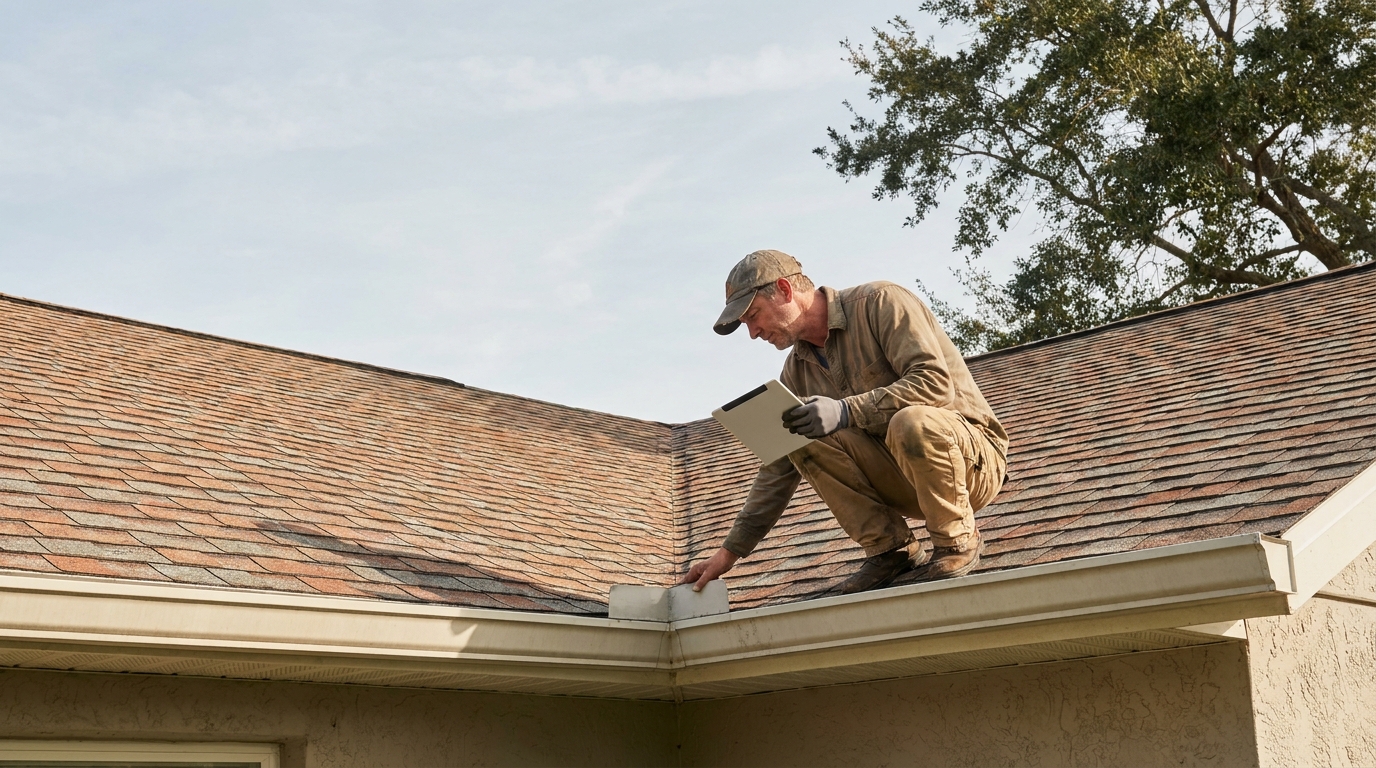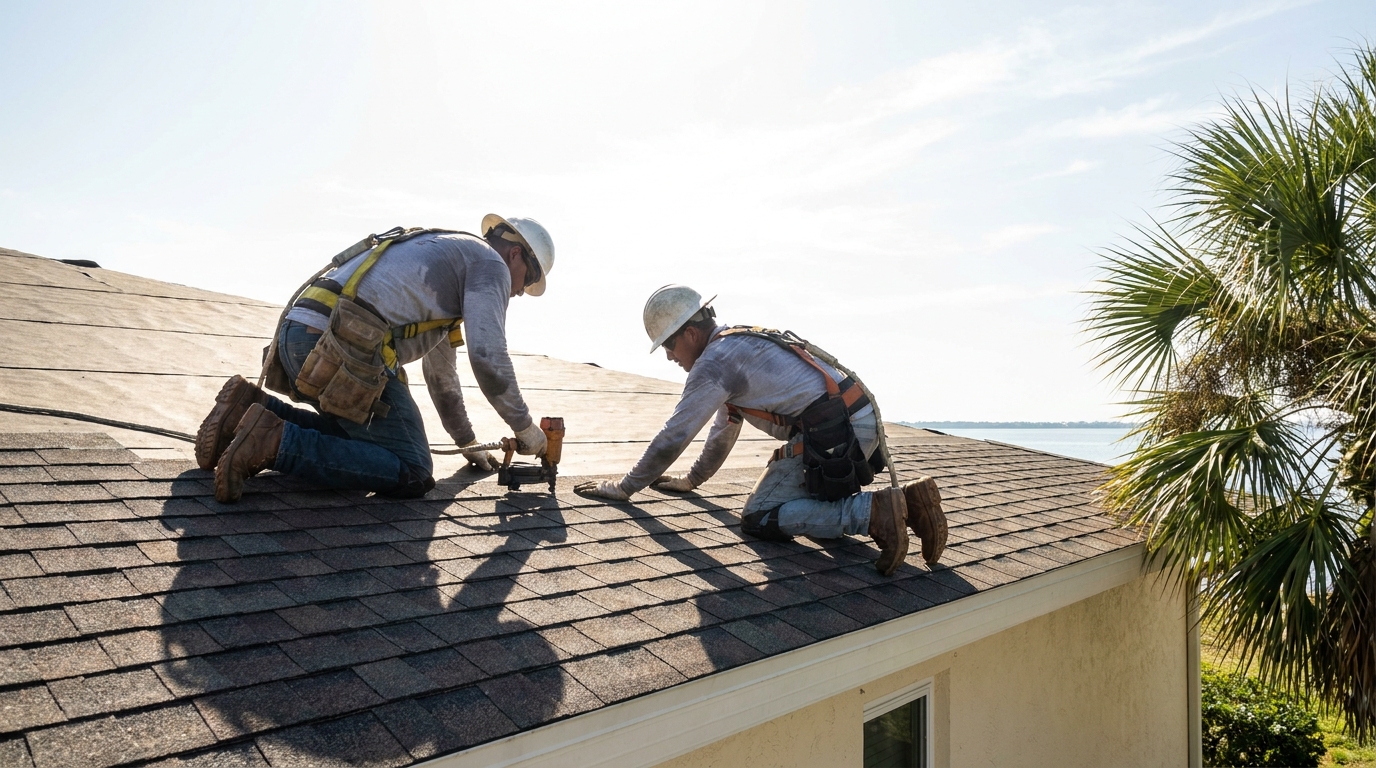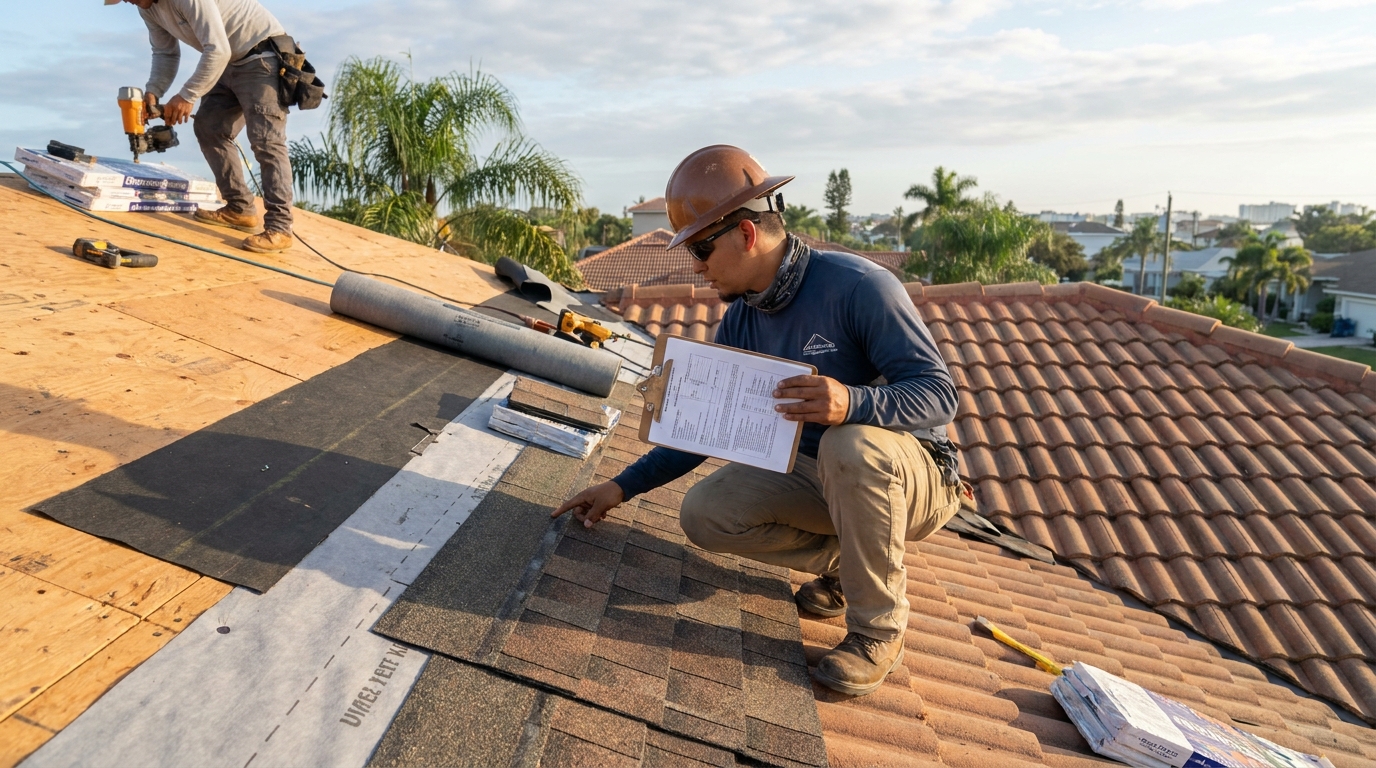
A roofing estimate in Clearwater, FL should be a detailed, line-itemed document — not a one-page total with a signature line. At minimum, it must name the exact materials (brand, product line, color), quantify labor and tear-off, list underlayment and flashing, spell out the permit filed with the City of Clearwater or Pinellas County, and identify the warranties on both the product and the workmanship. If any of that is missing, the estimate isn't ready to sign.
Below is a working homeowner's guide to every section you should see, what each line actually means, and the omissions that should stop you cold — written for the reality of Gulf Coast roofs that live through hurricane season, summer humidity, and the occasional windborne debris event.
What should a roofing quote include in Clearwater, FL?
A complete Clearwater roofing quote should include: contractor license and insurance details, a full scope of work (tear-off, deck inspection, underlayment, flashing, ventilation, new roof covering, cleanup), specific material brands and product names, quantities, labor, permit and inspection fees, disposal, warranty terms, payment schedule, and start/completion windows. Anything vaguer than that is a placeholder, not a bid.
Contractor identification and licensing
Florida requires roofing contractors to hold a state license issued by the Department of Business and Professional Regulation (DBPR). The estimate should list the company's legal name, physical address, phone, DBPR license number (typically prefixed CCC), and general liability plus workers' compensation carriers. SCM Roofing, LLC includes these on every proposal we send in Pinellas County — it's the first thing you should verify at MyFloridaLicense.com before reading any further.
Scope of work
The scope should read like a recipe, not a menu. Expect language covering tear-off down to the deck, inspection and replacement of rotted sheathing (usually priced per sheet of plywood), synthetic or felt underlayment, drip edge, valley metal, step and counter flashing, pipe boots, ridge and off-ridge ventilation, and the new roof covering itself. Vague phrases like "install new roof" are a red flag.
What line items should appear on a Clearwater roofing contract?
Every Clearwater roofing contract should itemize: materials by brand and quantity, labor, tear-off and disposal, decking replacement rate, underlayment type, flashing and metal work, ventilation, permit fees, cleanup and magnetic nail sweep, warranty terms, and a payment schedule tied to milestones. Coastal-specific items — secondary water barrier, hurricane clips or re-nailing to Florida Building Code — should also be called out explicitly on the line-item list.
Materials — brand, product line, color
"Architectural shingles" is not a material spec. The estimate should name the manufacturer (GAF, Owens Corning, CertainTeed), the specific product line (for example, GAF Timberline HDZ), the color, and the wind rating. For flat sections common on Clearwater additions and lanais, TPO or modified bitumen should be named by manufacturer and mil thickness.
Underlayment and secondary water barrier
Florida Building Code requires a sealed roof deck (secondary water barrier) on re-roofs when more than 25% of the roof is replaced in the High-Velocity Hurricane Zone counties, and Pinellas County enforces sealed-deck and enhanced attachment requirements on re-roofs as well. Your estimate should specify either self-adhered underlayment or taped deck seams with a synthetic overlay — not just "15# felt."
Flashing, ventilation, and accessories
New flashing at every penetration, wall intersection, and valley should be included by default. Reusing old flashing is a common cost-cutter that shortens roof life. Ventilation (ridge vent, off-ridge vents, or powered vents) should be quantified in linear feet or unit count. Pipe boots, drip edge gauge, and starter strip brand should all appear as their own lines.
Permits and inspections
A permit through the City of Clearwater Building Division (or Pinellas County for unincorporated areas) is required for any re-roof. The contractor pulls it in their name — never yours. If an estimate says "homeowner to pull permit," walk away. Permit fees, inspection fees, and Notice of Commencement recording should be listed, even if bundled.
How should payment terms and warranties be written?
Payment terms on a Clearwater roofing estimate should follow Florida's construction lien framework: a modest deposit (10–33%), progress payments tied to material delivery and tear-off, and final payment only after the county or city passes the final inspection. Warranties should be split cleanly into manufacturer coverage (materials, often 25–50 years or lifetime limited) and contractor workmanship (typically 2–10 years), each stated in writing with the exact term.
Deposit and payment schedule
Under Florida law, a contractor who accepts more than 10% of the contract price as a deposit must apply for permits and start work within 30 days (with some conditions). A demand for 50% up front, or full payment before the roof is inspected, is not standard practice on the Gulf Coast and should raise concern.
Warranty language
Look for the manufacturer warranty by name (GAF System Plus, Golden Pledge, etc.) and confirm the contractor is certified to register it. Only certified installers — GAF Master Elite contractors, for example — can register enhanced warranties. SCM Roofing, LLC carries GAF Master Elite certification, a designation held by a limited share of roofing contractors nationwide, which is what makes those upgraded warranties available to homeowners in Clearwater.
Sample line-item breakdown
| Line item | What to look for | Red flag |
|---|---|---|
| Tear-off | Number of layers, disposal included | "Overlay existing roof" on a second layer |
| Decking | Per-sheet replacement rate (e.g., $75–$120/sheet) | No rate listed, or open-ended charge |
| Underlayment | Brand, synthetic or self-adhered, sealed deck | "15# felt only" on a re-roof |
| Shingles/TPO | Manufacturer, product line, color, wind rating | Generic "architectural shingle" |
| Flashing | New at all penetrations and walls | "Reuse existing flashing" |
| Ventilation | Type and quantity specified | Not mentioned |
| Permit | Pulled by contractor, fee listed | "Homeowner pulls permit" |
| Warranty | Manufacturer + workmanship, in years | "Standard warranty applies" |
What are the biggest red flags on a Clearwater roofing estimate?
The biggest red flags on a Clearwater roofing estimate are: no license or insurance numbers, a demand for large upfront payment, vague material descriptions, missing permit language, no written warranty terms, and pressure to sign the same day. Storm-chaser operations that appear after named tropical systems often produce estimates missing three or more of these items — a pattern Pinellas County homeowners should recognize on sight.
The "we'll handle the insurance claim" pitch
In Florida, a contractor negotiating the terms of an insurance claim on your behalf without a public adjuster license is prohibited under state statute. An estimate that promises to "waive your deductible" or "get the whole roof paid for by insurance" is describing conduct that can expose both you and the contractor to liability.
Bids that are dramatically low
On roughly the same scope, competitive Clearwater bids usually land within 10–20% of each other. A bid that comes in 40% under everyone else is almost always missing something — most often the sealed deck, new flashing, or the permit. As one recent SCM Roofing customer put it, the contract "was not one-sided" and the company "were not the lowest," which is the honest tradeoff of a fully scoped bid.
When should you get estimates in Clearwater?
The best window to solicit roofing estimates in Clearwater is late fall through early spring — after hurricane season winds down on November 30 and before the summer rainy season and heat make scheduling tight. Contractors have more availability, material lead times are shorter, and you avoid competing with post-storm demand. Homeowners in neighborhoods like Belleair, Countryside, and Island Estates typically see the widest bid spread during peak demand months.
Frequently asked questions
How many roofing estimates should I get in Clearwater?
Three written estimates is the standard for a Clearwater re-roof. That's enough to identify pricing outliers on both ends without dragging out your decision. Make sure all three bids specify the same scope — same underlayment type, same shingle line, same ventilation plan — otherwise you're comparing different roofs. If one bid is materially lower, ask specifically what's missing rather than assuming it's a bargain.
Is a verbal roofing quote binding in Florida?
No. Florida requires residential construction contracts over $2,500 to be in writing, and any roof replacement will exceed that threshold. A verbal quote has no legal weight, cannot be enforced, and typically won't be honored once work begins. Always insist on a written, signed estimate with itemized scope, price, and payment terms before any deposit changes hands or any material is ordered.
Who pulls the permit for a roof replacement in Clearwater?
The licensed roofing contractor pulls the permit — through the City of Clearwater Building Division for properties inside city limits, or Pinellas County for unincorporated areas. If a contractor asks the homeowner to pull the permit, it usually means they are not properly licensed for the work, or they want to shift liability. This is one of the clearest disqualifiers on an estimate.
What does a sealed roof deck mean on a Clearwater estimate?
A sealed roof deck is a secondary water barrier created by taping the seams of the roof sheathing or applying a self-adhered underlayment across the whole deck. Florida Building Code requires it on qualifying re-roofs, and it dramatically reduces water intrusion if shingles are lost in a hurricane. Your estimate should specify the method (taped seams vs. peel-and-stick) as its own line item.
How long should a roofing estimate be valid?
Most Clearwater roofing estimates are valid for 30 days. Asphalt shingle, metal, and TPO pricing all shift with manufacturer changes and fuel costs, so an estimate held longer than a month may need to be re-priced. If a contractor honors an older estimate without adjustment, get that in writing. Never sign an estimate that has no expiration date — that's a document designed to be changed.
What should the warranty section actually say?
The warranty section should name two separate warranties: the manufacturer's product warranty (by name and year term) and the contractor's workmanship warranty (in years, with what it covers). Both should be written into the estimate itself, not referenced as "standard." Ask whether the contractor is certified to register the enhanced manufacturer warranty — many upgraded coverages require certified-installer status to activate.
The bottom line for Clearwater homeowners
A good roofing estimate is a document you can read cover to cover and know exactly what you're buying, what you're paying for, and what happens if something goes wrong. When a Clearwater estimate spells out materials by brand, quantifies decking and flashing, lists the permit, and defines both warranties in writing, you have a bid worth comparing. When it doesn't, you have a sales pitch.
Homeowners in Clearwater who want a fully itemized, code-compliant proposal reviewed line by line can reach SCM Roofing, LLC at https://scmroofingfl.com. The 4.9-star average across 239 Google reviews is a reasonable place to start your own due diligence.