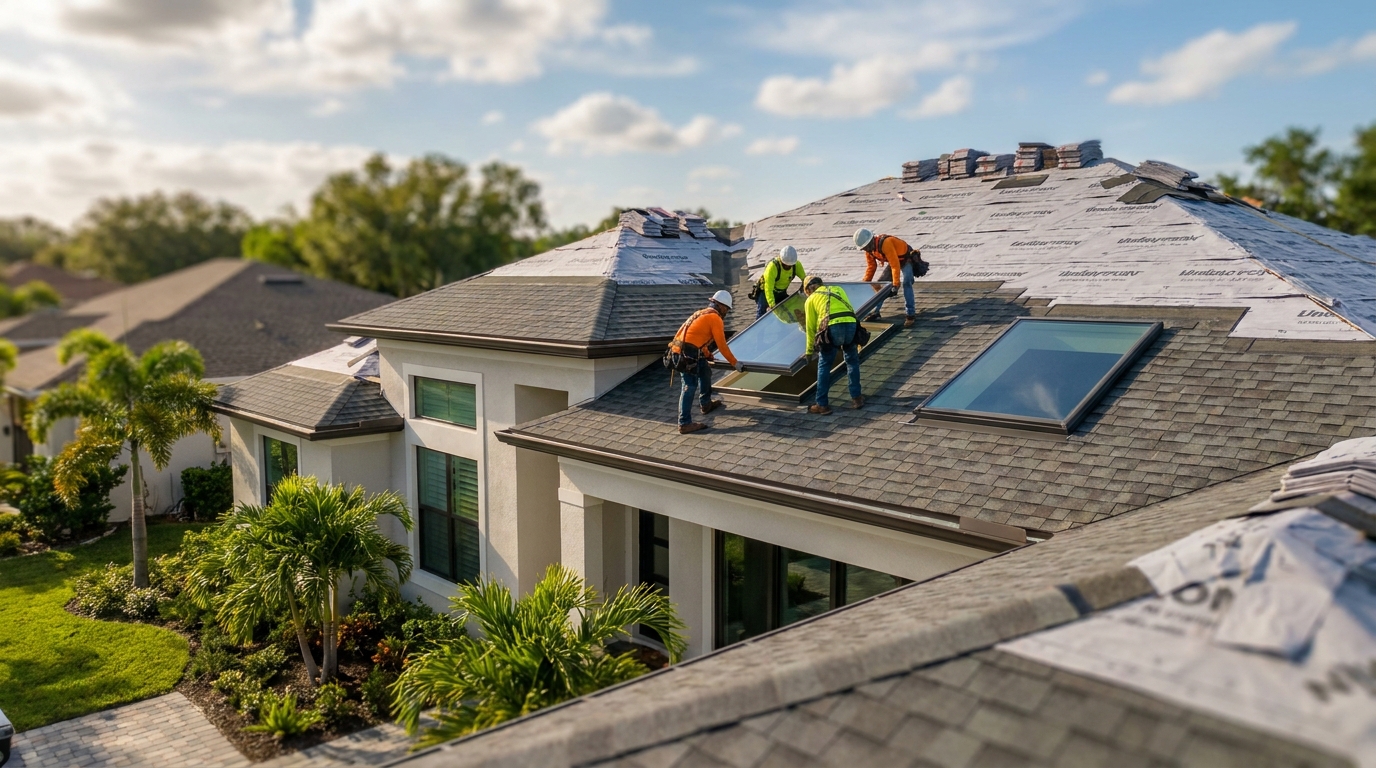
You're already replacing your roof. The decking is exposed, the crew is on-site, and the permit is pulled. If you've ever thought about adding natural light to a dim hallway, kitchen, or primary bath, this is the moment when a skylight goes in cleanly, affordably, and with the fewest leak risks down the road.
Adding a skylight during a full roof replacement is fundamentally different from cutting one in later. The flashing integrates with brand-new underlayment. The shingles wrap fresh around the curb. There's no patchwork, no mismatched materials, no second mobilization fee. For Tampa homeowners weighing the upgrade, here's what actually matters — and how to get it right the first time.
Why Roof Skylight Installation Belongs in the Replacement Window
Skylights fail at the flashing, not the glass. That's the single most important fact to anchor every decision around. When a skylight leaks five years after install, the cause is almost always a flashing detail that was rushed, reused, or poorly tied into the surrounding roof system.
During a tear-off, your roofer has a clean substrate to work with. The skylight curb gets set into fresh decking, the manufacturer's flashing kit gets layered correctly with new ice-and-water shield and underlayment, and the shingles get woven around it as part of the original install rhythm. Done this way, a skylight is essentially as watertight as the rest of the roof.
Tampa's climate makes this especially important. Between summer thunderstorms, wind-driven rain off the Gulf, and the punishing UV load that breaks down sealants, a skylight that wasn't integrated properly will announce itself within a few rainy seasons. Doing the work mid-replacement eliminates the most common failure mode before it starts.
Choosing the Right Skylight for a Tampa Roof
Not all skylights belong on a Florida roof. The two broad categories are fixed (non-opening) and venting (operable, often solar-powered). Both come in deck-mounted and curb-mounted configurations.
Deck-mounted vs. curb-mounted
Deck-mounted skylights sit lower to the roof plane and have a sleeker profile. They're a strong choice for asphalt shingle roofs, which dominate neighborhoods from South Tampa to Carrollwood. Curb-mounted units sit on a built-up wooden frame and are more common on flat or low-slope roofs — useful for some of the modern builds you'll see closer to the Westshore corridor.
Glass specifications that matter in Florida
For Tampa specifically, you want:
- Impact-rated laminated glass that meets Florida's wind-borne debris requirements
- Low-E coatings to cut solar heat gain — non-negotiable in a climate where AC runs nine months a year
- Argon-filled double glazing for thermal performance
- A Florida Product Approval or Miami-Dade Notice of Acceptance number you can verify
Hillsborough County enforces the Florida Building Code, and any skylight installed here needs documented approval for the wind zone. A reputable roofer will pull these specs before ordering — not after.
How Skylight Flashing and Roof Integration Actually Work
This is where the value of timing becomes obvious. Skylight flashing isn't a single piece — it's a kit of layered components that have to be installed in a specific sequence with the roof underlayment and shingles.
The flashing sequence
- Underlayment lap: Self-adhered membrane wraps the rough opening before the skylight is set.
- Sill flashing: Goes on first at the bottom edge, on top of the shingle course below.
- Step flashing: Side pieces interleave with each shingle course up the sides of the curb.
- Head flashing: Caps the top, tucked under the shingle course above so water sheds over, never into, the assembly.
- Counter-flashing or cladding: Manufacturer-supplied metal that locks the whole system together.
When this sequence happens during a full replacement, every layer is new and every transition is clean. When it happens as a retrofit, the roofer is cutting into existing shingles, breaking adhesive bonds, and trying to weave new flashing into aged materials. The retrofit can be done well — but the margin for error is much smaller, and the warranty implications are different.
Permits, Code, and What Tampa Requires
Roof replacements in Tampa require a permit through the City of Tampa Construction Services Division (or Hillsborough County Development Services for unincorporated areas). Adding a skylight is part of that permitted scope when it's done during the replacement — your contractor handles the paperwork, the inspection, and the product approval documentation.
Doing it as a separate project later means a separate permit, a separate inspection, and often a separate trip charge. Bundling the skylight into the original permit is one of the quiet cost savings most homeowners don't think about.
If your home is in a wind-borne debris region — which covers essentially all of the Tampa Bay area — the skylight unit itself must carry a Florida Product Approval. Inspectors will check.
Cost Considerations During a Replacement
The marginal cost of adding a skylight during a roof replacement is meaningfully lower than retrofitting one later. You're already paying for tear-off, underlayment, flashing labor, shingle work, cleanup, and permit administration. Adding a skylight uses incremental hours of that same labor instead of triggering a new mobilization.
Where homeowners get into trouble is choosing the cheapest skylight unit available. A bargain skylight on a quality roof is the weak link that defines the system's lifespan. Match the skylight's expected service life to the roof's — if you're installing a 30-year architectural shingle, the skylight should be rated to perform that long with proper flashing.
Questions to Ask Before You Add a Skylight
- Is the skylight unit Florida Product Approved for this wind zone?
- Will you use the manufacturer's complete flashing kit, or substitute components?
- How does the skylight warranty interact with the roofing system warranty?
- Are you GAF Master Elite Certified or equivalent, so the workmanship warranty actually carries weight?
- Will the skylight be deck-mounted or curb-mounted, and why for my specific roof?
- Is the install included on the same permit as the replacement?
That last question matters more than it sounds. A roofer who treats the skylight as a casual add-on rather than a fully engineered detail is the roofer whose work shows up as a leak in three years.
FAQ: Skylight Installation During Roof Replacement
Can a skylight be added to any roof?
Most pitched and low-slope roofs can accommodate a skylight, but rafter spacing, attic obstructions, and interior framing all affect placement. A site assessment before tear-off confirms feasibility.
How long does adding a skylight extend the roofing project?
For a single skylight on a standard residential replacement, typically a few hours to half a day of additional labor — not a separate project timeline.
Will a skylight raise my insurance premium in Tampa?
Insurance treatment varies by carrier. Impact-rated glass that meets wind mitigation standards generally does not penalize a policy and may actually qualify for credits as part of a wind mitigation inspection. Confirm with your specific insurer.
Do skylights leak?
Properly installed skylights with intact flashing and current sealants do not leak. Leaks come from installation shortcuts, aged sealants past their service life, or flashing damage from storm debris.
Can I add a skylight after the roof is done?
Yes, but it costs more, the warranty integration is messier, and the leak risk over the life of the roof is higher. The replacement window is the natural moment.
What skylight brands are Florida Product Approved for Tampa installations?
Multiple manufacturers carry Florida Product Approval numbers valid for the Tampa Bay wind zone. Your roofer should provide the specific approval number for the unit being installed before you sign off on the order. A GAF Master Elite Certified contractor such as SCM Roofing, LLC verifies this documentation as part of the pre-order process — not as an afterthought during inspection.
Does adding a skylight affect my roofing system warranty?
It can, if the skylight is not installed by a certified contractor or if non-manufacturer flashing components are substituted. When the skylight is integrated during the replacement by the same crew using the manufacturer's complete flashing kit, most roofing system warranties cover the skylight penetration as part of the overall installation. Always confirm warranty scope in writing before work begins.
Making the Decision
If you've been thinking about a skylight for a year or two, and you're already replacing the roof, the math almost always favors doing it now. The flashing is integrated correctly, the permit covers it, the labor is incremental, and the workmanship warranty applies to the whole system rather than to a retrofit cut-in.
Homeowners who have worked with SCM Roofing, LLC describe the experience in terms that speak to exactly this kind of careful, coordinated work. One customer wrote that the installation crew "worked meticulously together from the start to the finish," and another noted that the team treated the project "as if it was their own." SCM Roofing, LLC holds a 4.9-star rating from 239 Google reviews as of April 2026 — reflecting consistent praise for communication, materials quality, and professional installation.
Tampa homeowners planning a roof replacement and weighing skylights as part of the project can reach SCM Roofing, LLC at https://scmroofingfl.com or by calling (855) 726-7663 for a free estimate. The team is GAF Master Elite Certified, works throughout the Tampa Bay area, and can walk you through skylight options, Florida product approvals, and how the integration fits into your replacement scope before any decisions are locked in.
"