If you own a flat or low-slope commercial building in Naples, the membrane question comes up sooner or later. TPO or EPDM? Both are proven single-ply systems. Both can protect your investment for decades. But in Southwest Florida's heat, sun, and hurricane exposure, the two behave very differently — and the wrong call can cost you in cooling bills, premature repairs, or a full early replacement.
Here's how the two systems actually stack up for commercial buildings in Naples, and how to decide which one belongs on your roof.
The Short Answer for Naples Commercial Buildings
For most Naples commercial properties, TPO is the better default. The white, highly reflective membrane helps reduce cooling loads in Florida's intense heat, and heat-welded seams handle wind-driven rain better when storms roll in off the Gulf. That said, the complete assembly — deck, attachment, insulation, cover board, perimeter details, and drainage — matters at least as much as the membrane itself.
EPDM still earns its place. If you own the asset for the very long haul, value the decades-long track record of rubber roofing, and prefer simpler patch repairs, EPDM is a legitimate choice — just expect higher cooling loads if you choose the standard black membrane, and be sure to compare bids on the same scope before drawing a conclusion on price.
What TPO and EPDM Actually Are
TPO (Thermoplastic Polyolefin)
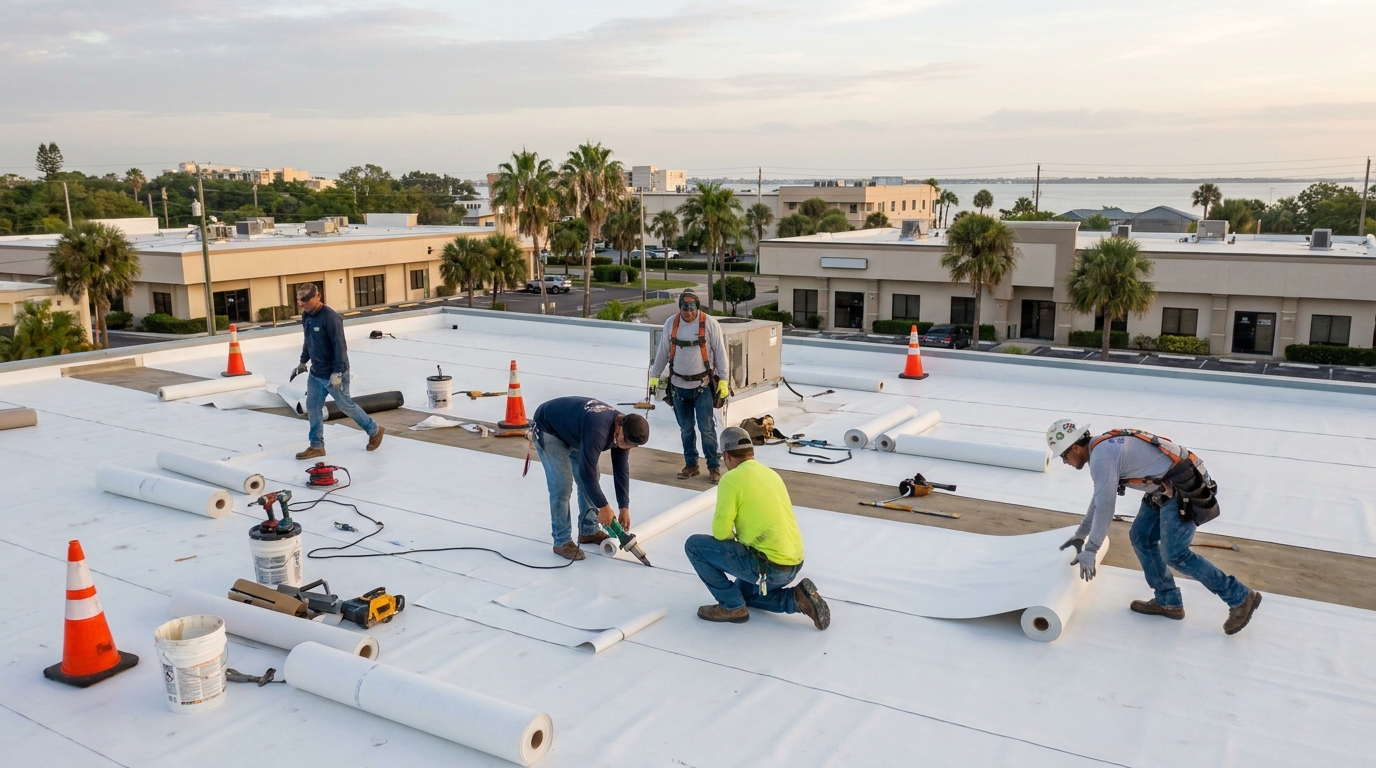
TPO is a single-ply thermoplastic membrane. Seams are joined with hot-air welders, producing a continuous, watertight bond. Common thicknesses run 45, 60, and 80 mil — with thicker sheets typically pairing with longer warranties, subject to the manufacturer's approved assembly requirements. Carlisle's TPO product line, for example, includes membranes up to 80 mil with warranties up to 30 years when all assembly conditions are met.
EPDM (Ethylene Propylene Diene Monomer)
EPDM is a synthetic rubber membrane that has been in the roofing market for over 50 years, according to manufacturer documentation. It ships in large sheets — fewer seams overall — and those seams are joined with manufacturer-approved adhesives or seam tapes. Standard EPDM is black; white EPDM is available but less common. Typical thicknesses include 45 and 60 mil, with some product lines offering a 90-mil option in specific system contexts.
How Each System Performs in Naples' Climate
Heat and Energy Costs
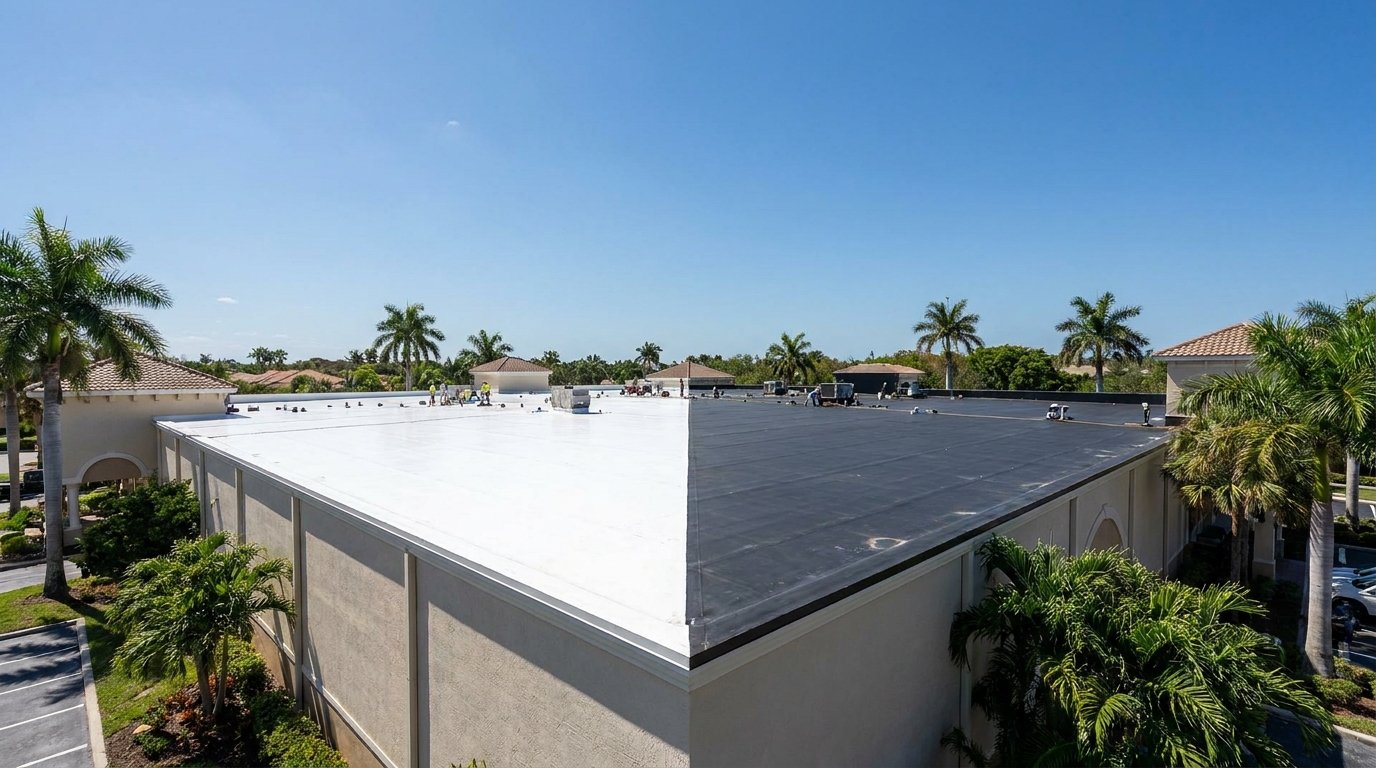
This is where Naples-specific reality bites. Southwest Florida is a cooling-dominated climate for most of the calendar year, and rooftops absorb the brunt of it. Black EPDM absorbs significantly more solar heat than a white membrane, which translates directly into higher AC runtime for buildings from Old Naples to the Pine Ridge corridor.
White TPO flips that equation. A reflective surface keeps the membrane cooler and reduces the solar load transferred into the building. That said, actual energy savings depend on insulation, HVAC efficiency, building use, and roof exposure — a reflective membrane alone does not guarantee a specific reduction in utility costs. For retail centers, medical offices, and multifamily buildings off Pine Ridge Road or Tamiami Trail, reflectivity is still a meaningful factor worth discussing with your contractor and designer.
UV, Storms, and Seam Strength
TPO is formulated with UV absorbers and is widely used in high-sun markets. Its heat-welded seams also resist the kind of wind-driven rain that defines hurricane season from June through November. In a hurricane-prone area, however, do not select a membrane based on its material name alone — require the proposal to identify the project-specific assembly, edge and perimeter details, applicable code approvals, and the wind rating being offered.
EPDM holds its own on weather resistance and stays flexible across temperature swings, but its seams rely on tape and adhesives rather than heat welding. Both systems require compatible materials, trained installation, and prompt repair of damage. In a market where every roof must satisfy Florida Building Code wind provisions and Collier County permitting, seam performance and detail quality are not small considerations.
Punctures and Foot Traffic
If your roof carries HVAC service techs, solar work, or regular equipment access, TPO's reinforced membrane and welded seams generally hold up well against punctures and tears. Stepping up to a thicker EPDM membrane narrows the gap considerably, which is one reason specifying thickness — not just material type — matters when comparing bids.
How Long Does a Commercial Roof Last in Naples, FL?
Lifespan is the question every owner asks, and the honest answer depends on the system, the install, and the maintenance.
- TPO: Industry documentation from manufacturers cites warranty terms up to 30 years for approved assemblies. Real-world lifespan depends on membrane thickness, attachment, drainage, and maintenance.
- EPDM: A long-established material; manufacturer literature describes over 50 years of use in the low-slope roofing market. Longevity varies with thickness, color, attachment method, and maintenance history.
Naples accelerates wear on any membrane. Salt air along the Gulf, intense UV, afternoon thunderstorms, and hurricane stress all affect membrane performance. Roofs that get inspected twice a year — ideally before hurricane season and again after — consistently outlast roofs that get ignored until something leaks. SCM Roofing, LLC recommends exactly that inspection schedule for Florida commercial properties.
Commercial Roof Replacement Cost in Naples, Florida
Pricing for commercial flat roofing varies with membrane thickness, insulation package, deck condition, attachment method, tear-off scope, and roof complexity. Published Florida cost guides give broad ranges as planning context, but those figures are not verified local quotes and can differ significantly depending on what each bid actually includes.
What drives cost on a Naples commercial reroof: membrane thickness (45, 60, or 80 mil for TPO; 45, 60, or 90 mil in some EPDM systems); whether the scope includes tear-off and disposal; the insulation and cover board specified; wet deck or substrate repairs; perimeter and penetration detailing; and the warranty tier — standard labor-and-material versus enhanced or no-dollar-limit coverage. Premium assemblies push cost toward the top of any range, but for a building you plan to hold for 25 or more years, the investment in a fully documented, code-compliant assembly usually makes financial sense.
For a current, line-item estimate on your specific building in Naples, contact SCM Roofing, LLC at (855) 726-7663 or visit scmroofingfl.com. Free inspections and estimates are available with no obligation.
Which System Is the Best Roofing System for a Flat Commercial Building in Naples?
Choose TPO if you…
- Own a retail, office, medical, or multifamily building with heavy AC loads
- Want a reflective white membrane suited to Southwest Florida's sun
- Plan to own the building for a defined period and care about ROI on energy and maintenance
- Need strong storm-season seam performance under Collier County wind requirements
- Have rooftop equipment and regular service traffic
Choose EPDM if you…
- Hold the property as a long-term asset and prioritize the material's established track record
- Prefer simpler patch repairs without specialized heat-welding equipment
- Have a complex roof with significant thermal movement or unusual geometry
- Are willing to specify white EPDM to reduce Florida's heat penalty
Naples-Specific Considerations Most Owners Overlook
Two factors shape every commercial reroof in Collier County:
Hurricane season timing. Permitting, material lead times, and crew availability tighten dramatically once tropical activity ramps up. Owners who start the conversation in late winter or early spring typically have their roof completed before storm season. Waiting until late summer rarely ends well.
Code and permitting. Commercial reroofs in Naples fall under the Florida Building Code with high-velocity wind provisions, and they require permitting through Collier County or the City of Naples depending on the parcel. Membrane attachment, insulation R-value, and edge metal details all have to be specified to those standards — not pulled from a generic manufacturer spec sheet. SCM Roofing, LLC handles permitting and works within these requirements on every commercial project it takes on in Collier County.
FAQs
Is TPO or EPDM better for Florida's heat?
For most Naples commercial buildings, white TPO is the more practical choice in a cooling-dominated climate. A reflective white surface reduces the solar load transferred into the building in a way standard black EPDM cannot match. White EPDM is available and does provide reflectivity, but it is less common and typically costs more. Actual energy results depend on the full assembly, insulation, and HVAC conditions — ask bidders to address this for your specific building.
How long does a commercial TPO roof last in Naples, FL?
Manufacturer warranty documentation cites terms up to 30 years for approved TPO assemblies — Carlisle's product line, for example, lists 25- and 30-year options for qualifying 80-mil systems. Real-world lifespan depends on membrane thickness, attachment, drainage quality, maintenance, and storm exposure. Regular inspections, ideally twice per year, are the single most reliable way to maximize service life on any Naples commercial roof.
Why is EPDM sometimes more expensive than TPO in Naples?
Where EPDM prices higher, it is generally because local demand is lower, the bench of specialized installers is thinner, and material lead times can be longer. That said, the available pricing evidence does not establish that EPDM is always more expensive in Naples — costs depend heavily on the specified system, scope, and which bids you are comparing. Get at least three written proposals on the same assembly before drawing a conclusion.
Can EPDM be installed white instead of black?
Yes. White EPDM is available and provides a reflective surface comparable to white TPO. It is less common than black EPDM and typically carries a higher cost. For most Naples commercial buildings, white TPO delivers similar reflectivity and is generally easier to source locally. If you prefer EPDM for other reasons, specify white in the bid rather than assuming color.
What's the most important spec to compare on bids?
Membrane manufacturer, product name, thickness, color, and reinforcement; attachment method; insulation type, R-value, and whether tapered insulation is included; cover board; tear-off and disposal scope; drain, scupper, penetration, and edge-metal details; applicable code approvals and wind requirements; and warranty type, term, exclusions, and workmanship coverage. Bids that do not itemize these are not truly comparable — and the difference between a base and a premium assembly can be substantial.
Does membrane thickness actually matter, or is it just an upsell?
Thickness matters. A thicker membrane — for example, 60 or 80 mil TPO versus 45 mil — generally offers greater resistance to punctures, foot traffic, and weathering, and is often required to qualify for longer manufacturer warranty terms. Carlisle's published warranty specifications, for instance, tie 25- and 30-year coverage to 80-mil assemblies that meet all other system requirements. That said, thickness alone does not guarantee performance; attachment, detailing, and installation quality are equally important.
How do I know if a Naples roofing contractor is qualified to install commercial single-ply systems?
Ask for the contractor's Florida state roofing license number, verify it is current, and confirm the installer is approved by the membrane manufacturer whose product is being specified — manufacturer approval is often required to access the strongest warranty tiers. SCM Roofing, LLC holds Florida state contractor license CCC1331132 and has more than 25 years of experience in the roofing industry across Florida's Gulf Coast, including commercial TPO, EPDM, PVC, and other flat-roof systems.
The Bottom Line
For most flat-roof commercial buildings in Naples, white TPO is the practical default — a reflective surface suited to Florida's cooling demands and heat-welded seams built for storm season. EPDM remains the right answer for long-hold owners who prioritize the material's established track record, flexible attachment options, and straightforward repairs, and who are willing to specify color, thickness, and seam system carefully.
The bigger variable is the install. The same membrane can perform brilliantly or fail early depending on substrate prep, fastening, flashings, and detail work — none of which show up in a generic price-per-square-foot quote. SCM Roofing, LLC, rated 4.9 stars across 239 Google reviews as of April 2026, works with commercial property owners across Naples and Collier County — providing free inspections and written estimates that spell out membrane, insulation, fastening, warranty, and scope on a line-item basis. Reach the team at scmroofingfl.com or call (855) 726-7663.