A commercial roof warranty in St Petersburg, FL is a conditional promise with defined limits — not blanket protection against every leak or storm loss. You get two separate instruments: a manufacturer warranty that covers product or material defects, and a contractor workmanship warranty that covers installation errors. Both carry exclusions, and in a Gulf Coast market where hurricane wind, wind-launched debris, and standing water are the dominant failure causes, those exclusions matter more than the headline term length.
What does a commercial roof warranty actually cover in St Petersburg?
A commercial roof warranty covers two things, held by two different parties: the manufacturer warrants the roofing membrane or shingle against manufacturing defects, and the contractor warrants that the assembly was installed correctly. According to the NRCA, manufacturer coverage generally addresses defects in the manufacture of the roof covering material. Natural-disaster damage, drainage problems, and unauthorized alterations are typically excluded from both.
In practice, that means a Pinellas County property manager who assumes a "20-year warranty" will pay for hurricane repairs is reading the brochure, not the contract. The actual document — which you should request before signing anything — spells out what triggers coverage, what voids it, and who pays for the labor to tear off and replace a defective membrane.
How do manufacturer and workmanship warranties differ on a commercial roof?
Manufacturer warranties cover product defects and typically run long — terms vary by manufacturer and system, so confirm the specific period in the issued warranty document. Contractor workmanship warranties cover installation errors and typically run shorter — terms vary by contractor and system, so confirm the specific period and scope in writing before work begins. They are separate obligations with different durations and remedies.
That split matters because most leaks in the first several years of a commercial roof's life trace to installation details — flashings, terminations, seam welds, penetrations — not to a defective membrane. If the workmanship warranty expires in year two and a flashing fails in year four, the manufacturer may decline the claim as installation-related and the contractor is no longer on the hook. SCM Roofing, LLC installs commercial systems including TPO, EPDM, PVC, mod-bit, BUR, and standing seam metal, and the workmanship terms attached to each system are worth reading line by line before the crew mobilizes.
What exclusions should St Petersburg property owners expect to see?
Expect exclusions for hurricanes, hail, gale-force winds, wind-launched debris, floods, and lightning; damage from poor drainage; alterations or rooftop equipment added without the manufacturer's written approval; damage from failing to follow the manufacturer's maintenance guidelines; and structural movement of the building or deck. These are standard across major commercial membrane warranties and will govern most claim denials.
The Polyglass 15-Year Labor and Material sample warranty is a useful reference point because its exclusions mirror what you'll find across the industry. Reading from that document:
- Damage by natural disasters — lightning, hail, gale-force winds as described by the Beaufort Scale, floods, hurricanes, tornadoes, wind-launched debris, and earthquakes — is excluded.
- Alterations or repairs made on or through the roof, and objects placed on the roof, without prior written authorization from the manufacturer are excluded.
- Damage from structural failure — settling or shifting of the building, movement or deflection of the roof deck or substrate, building design, or inadequate ventilation — is excluded.
- Installation-related labor costs for flashings, metal work, or other materials not supplied by the manufacturer are excluded.
For a St Petersburg building owner, the hurricane carve-out is the one that catches people. The named-storm season runs June 1 through November 30, and when a storm clips the Pinellas peninsula, uplift and debris damage will not be a warranty claim — it is an insurance claim.
What does "No Dollar Limit" (NDL) actually mean?
An NDL warranty removes the dollar cap on covered claims — the manufacturer agrees to pay whatever it costs to repair a covered defect, not a prorated share. It does not expand what is covered. Exclusions for wind, hail, drainage, and unauthorized alterations still apply. The document controls, not the label on the cover page.
Where a labor-and-material warranty like the Polyglass sample is in play, the manufacturer's responsibility — if the membrane is deemed defective — is to repair or replace the defective material, including associated labor, without monetary limitation, but excluding installation-related labor on flashings, metal work, or non-supplied materials. That exclusion is why the installing contractor's workmanship coverage matters so much on day one.
How do Florida wind-code requirements interact with warranty coverage?
Florida's building code requires commercial roof assemblies to meet wind-uplift ratings tied to the building's exposure and height, and manufacturers write their warranties on the assumption that the assembly as installed meets those requirements. If an inspector or an insurance adjuster later finds the fastening pattern, membrane thickness, or edge-metal detail doesn't match the approved assembly, both your code standing and your warranty can be affected.
Permit thresholds for existing-building reroof work depend on the governing code edition and the project scope and should be verified with the local permitting authority before work starts. The practical point: a crew that skips permitting, substitutes a cheaper fastener, or installs an unapproved edge detail can save you money on bid day and cost you the entire warranty on claim day. SCM Roofing's owner, Scott Marone, graduated from the University of Florida's Construction Management program and holds both a Florida State General Contractor's license and a Roofing Contractor's license (CCC1331132), which is the kind of licensing paper trail an adjuster will want to see when a claim is reviewed.
What should you check before you sign?
Before signing, get the actual warranty document — not a brochure — and confirm in writing which components, failure causes, and labor costs are covered, how long the workmanship period runs, and what maintenance you must perform to keep coverage alive. The NRCA notes that a clearly written, detailed proposal is a good sign the contractor is being thorough; the proposal should include the length of warranty and what is covered.
A quick comparison of what each instrument typically does and doesn't do:
| Dimension | Manufacturer warranty | Contractor workmanship warranty |
|---|---|---|
| What it covers | Defects in the manufacture of the roof covering material (NRCA) | Installation errors — flashings, seams, terminations, penetrations |
| Typical term | 20 years to lifetime (NRCA) | — |
| Hurricane / hail damage | Excluded | Excluded |
| Drainage-related damage | Excluded | Varies — read the contract |
| Unauthorized rooftop equipment | Voids coverage | Voids coverage |
| Transferability | Often once, with fee and notice (e.g., Polyglass sample: one successive party, $500.00 transfer fee, 30 days before sale or up to six months after) | Often non-transferable; confirm in writing |
If you're buying a building with an existing warranty, the transfer window is unforgiving. The Polyglass sample warranty, as one example, requires the original owner to notify the manufacturer in writing 30 days prior to the sale, or up to a maximum of six months after the sale, pay a $500.00 transfer fee plus out-of-pocket travel, lodging, and meal costs, and permits the warranty to be assigned to only one successive party. Miss the window and the warranty does not travel with the deed.
Here's what a representative customer experience with our team looks like, in the client's own words:
We worked with Robbie Brown on our roof project. He’s a nice, clean cut, friendly guy and took the time to explain that we already had 3 roofs that would need to be removed. Then he educated me about the various types of roofing materials and what is recommended for the type of roof I have. After reading some online reviews and getting a very reasonable price quote, I hired them for the job. They gave me a detailed contract outlining the scope of work and the materials to be used. Even though hurricane Milton hit right after I contracted with SCM, they still completed the job quickly, even though I’m sure they were swamped with work. No pun intended.Upon completion, I was provided with documentation to give to my insurance company and a 5 year Warranty on workmanship. All the employees I had contact with were friendly, polite, and wore clear company identification. Robbie provided me with his phone number on a business card to coordinate the project and responded quickly whenever I texted him, even on weekends and Sundays. The crew cleaned everything up and hauled away all the trash.I highly recommend that you call Robbie Brown if you have a roofing job. You won’t be disappointed!
Frequently asked questions
Does a commercial roof warranty cover hurricane damage in St Petersburg?
No. Standard commercial roof warranties — including the Polyglass sample warranty — exclude damage from hurricanes, tornadoes, gale-force winds, wind-launched debris, hail, floods, and lightning. Named-storm damage is an insurance claim, not a warranty claim. Confirm your property insurance covers wind and that your deductible for named storms is one you can actually fund.
How long is a commercial roof workmanship warranty supposed to be?
Workmanship warranty terms vary by contractor and system; there is no universal standard, so always ask for the term in writing. Some commercial installers offer longer terms tied to specific manufacturer certifications or system packages. Ask for the workmanship term in writing, confirm what it covers (flashings and penetrations, not just field membrane), and verify whether it transfers if you sell the building.
Can I add solar panels or HVAC equipment without voiding the warranty?
Only with prior written authorization from the manufacturer. The Polyglass sample warranty excludes alterations or repairs made on or through the roof, and objects such as machines, structures, fixtures, or utilities placed on the roof, without prior written authorization. Before any rooftop solar, satellite, or HVAC work, notify the manufacturer in writing and keep the approval on file with your warranty document.
Does the warranty cover ponding water or drainage problems?
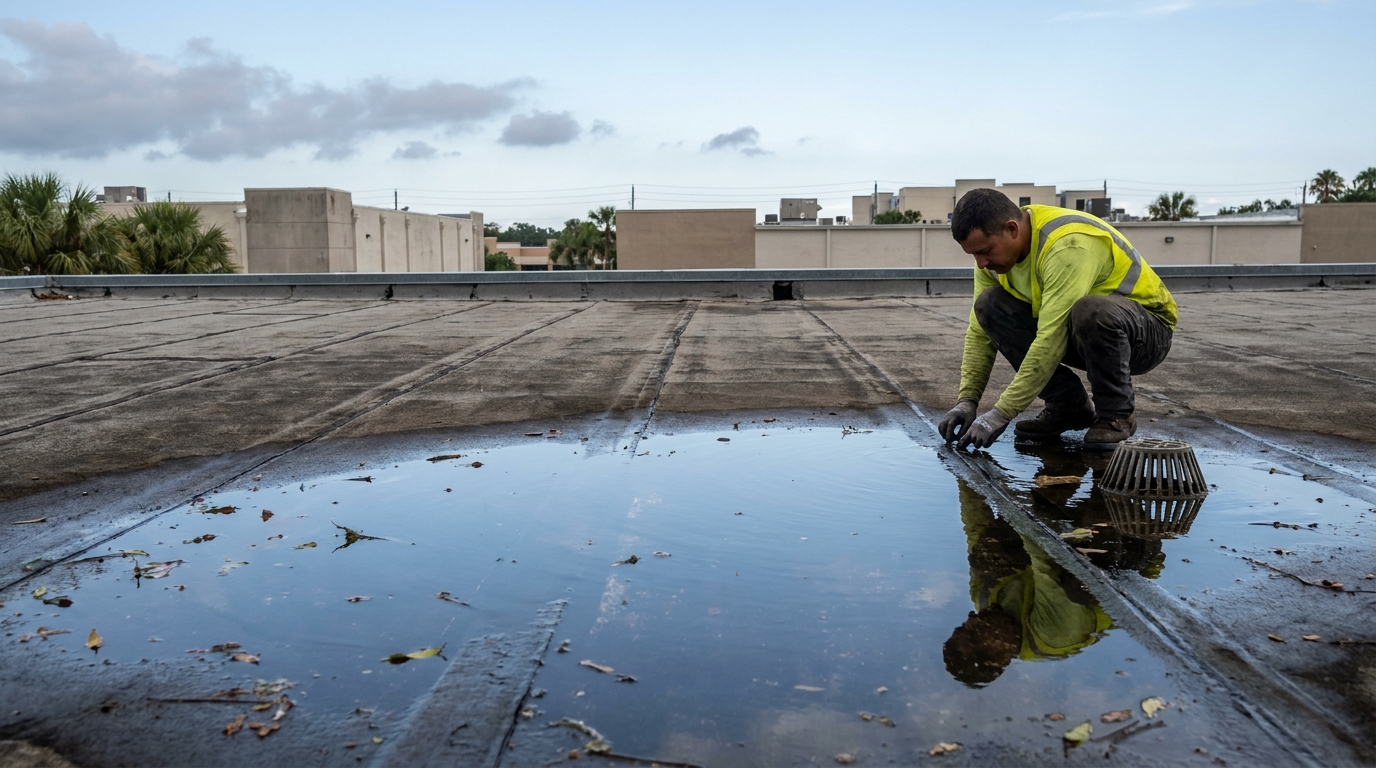
Generally no. Many commercial roof warranties exclude drainage-related damage, and on low-slope roofs common in St Petersburg, ponding after summer thunderstorms is a frequent cause of premature membrane failure — address drainage during design, not after. On low-slope commercial roofs common in St Petersburg, ponding after summer thunderstorms is a frequent cause of premature membrane failure — and if the deck slope or drain layout is the root cause, the manufacturer will decline the claim. Address drainage during design, not after.
What voids a commercial roof warranty fastest?
Unauthorized repairs by a non-approved contractor, rooftop equipment installed without written manufacturer approval, failure to perform the maintenance required by the warranty's maintenance guidelines, and alterations that cut through the membrane are the most common voids. Keep inspection records, use the manufacturer's approved contractor for any repair, and get any rooftop modification approved in writing before work starts.
Does the warranty transfer if I sell the building?
Sometimes, with strict conditions. The Polyglass sample warranty allows assignment to one successive party only, requires written notice 30 days before the sale or up to six months after, and charges a $500.00 transfer fee plus out-of-pocket travel, lodging, and meal costs. Terms vary by manufacturer, so confirm the specific transfer clause in your actual warranty document before closing.
The bottom line for St Petersburg property managers
Read the warranty before you read the bid. The term length on the cover page tells you very little; the exclusions, the maintenance obligations, the transfer rules, and the labor-cost carve-outs tell you what you actually bought. In a market where hurricane season, Gulf humidity, and low-slope ponding are the dominant failure drivers, the gap between a well-written workmanship warranty and a boilerplate one is the gap between a repair phone call and a replacement budget.
Property managers and building owners in St Petersburg, FL who want a straight read on their current warranty — or a specification-level review before signing a new commercial roofing contract — can reach SCM Roofing, LLC at (855) 726-7663 or https://scmroofingfl.com to get started.