If you manage a commercial property in Tampa, you already know what the Gulf Coast does to a roof. Relentless UV, summer humidity that doesn't quit, wind-driven rain from June through November, and the occasional named storm that tests every seam and fastener. By the time a commercial roof hits the 12-to-15 year mark, most owners assume full replacement is the only path forward. It usually isn't.
Commercial roof coating applications have quietly become one of the most cost-effective ways to extend the service life of an aging roof — often significantly — without the disruption, landfill waste, or capital expense of a tear-off. Done right, a coating system restores waterproofing, reflects heat, and resets the maintenance clock. Done wrong, it traps moisture and accelerates the very failure you were trying to avoid. Here's what Tampa property owners should understand before signing a contract.
What a Roof Coating System Actually Does
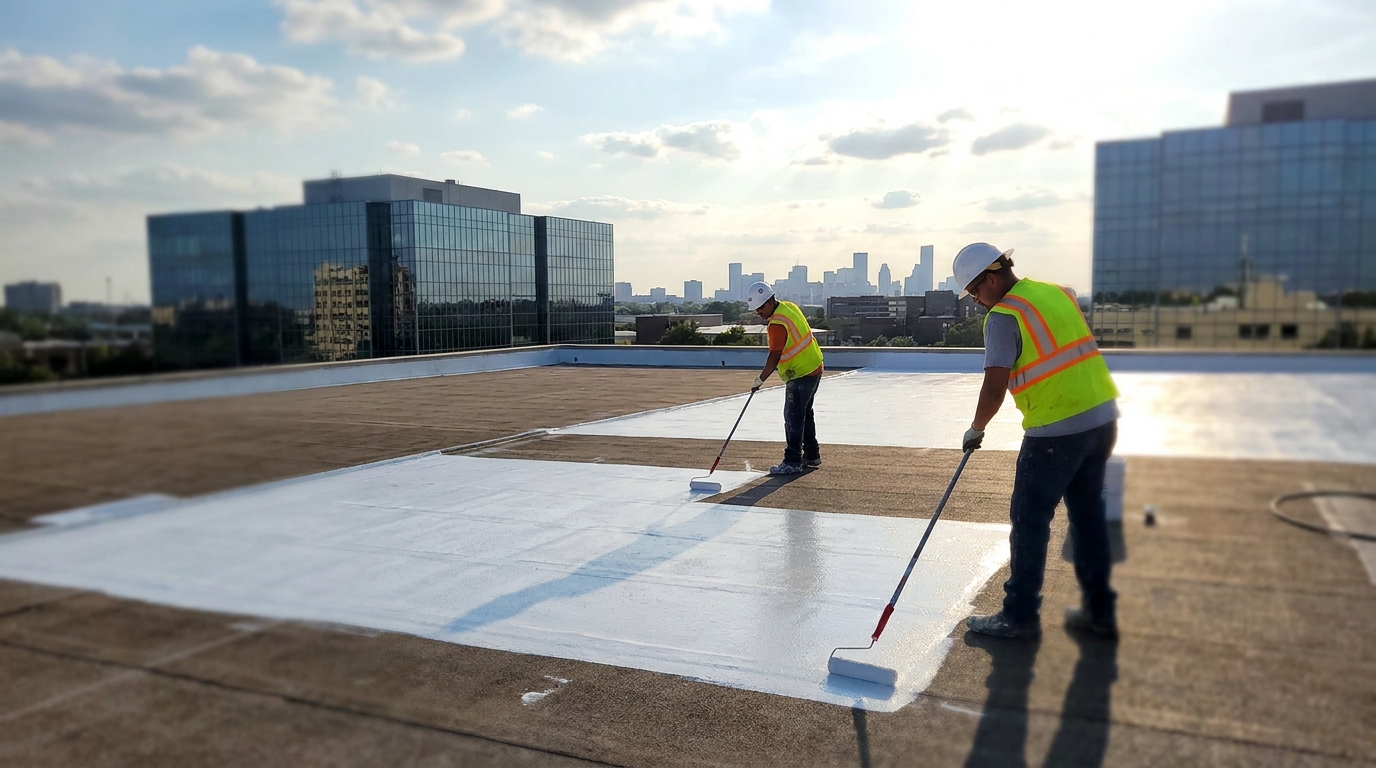
A roof coating is a fluid-applied membrane — typically elastomeric — that bonds to your existing roof and forms a seamless, monolithic barrier. Unlike paint, a properly specified coating is a structural waterproofing layer measured in mils of dry film thickness, not just a finish.
The functional benefits are straightforward:
- Waterproofing restoration: Seams, fasteners, flashings, and pinhole leaks get sealed under one continuous membrane.
- Reflectivity: White elastomeric coatings can reflect a significant portion of solar radiation, meaningfully dropping rooftop surface temperatures on a Tampa August afternoon.
- Cooling load reduction: Lower roof temps mean lower HVAC runtimes — a meaningful operating expense item for warehouses, retail, and office buildings along the I-275 and Westshore corridors.
- Tax and accounting treatment: Coating projects often qualify as maintenance rather than capital replacement, which can change how the work is expensed.
The category most Tampa buildings need is a commercial roof restoration coating — a system specifically engineered to recover an aged but structurally sound roof, not just to dress it up cosmetically.
Which Roofs Are Good Candidates?
Coating systems work on most low-slope commercial roof types common in Hillsborough County:
- Modified bitumen and built-up roofs (BUR): Excellent candidates if the underlying membrane is dry and the substrate is sound.
- Single-ply TPO and PVC: Coatable once they've weathered and the original reflective surface has chalked off.
- EPDM (rubber): Compatible with specific primers and acrylic or silicone topcoats.
- Metal roofs: Ideal for coatings — they address rust, fastener backout, and seam separation in one pass. We see this constantly on older industrial buildings around the Port Tampa Bay area and in East Tampa.
- Spray polyurethane foam (SPF): Coatings are not optional on SPF — they're part of the system.
What disqualifies a roof? Saturated insulation, widespread membrane delamination, or a substantial portion of wet substrate. If moisture is trapped under the existing membrane, coating over it seals the problem in. A proper infrared or capacitance moisture survey before bidding is non-negotiable.
The Main Coating Chemistries
Elastomeric Acrylic Coatings
Water-based, cost-effective, and easy to apply. Excellent UV reflectivity and good elongation. The tradeoff: acrylics don't tolerate ponding water well, which matters in Tampa where afternoon thunderstorms can dump two inches in an hour and drainage on older roofs is rarely perfect. Best for roofs with positive drainage.
Silicone Coatings
The workhorse for Florida commercial work. Silicone shrugs off ponding water, holds up under intense UV, and doesn't chalk significantly. It's the chemistry most often specified for Tampa flat roofs that don't drain perfectly — which is most of them. Downside: dirt pickup over time, and recoating requires specific surface prep.
Polyurethane Coatings
Tougher than acrylic or silicone, with better impact and foot-traffic resistance. Useful on roofs with rooftop equipment that gets serviced frequently — common on grocery, restaurant, and medical buildings throughout South Tampa and Carrollwood.
Elastomeric Roof Coating Hybrids
Modern silicone-acrylic and modified bituminous emulsions blend properties for specific use cases. The right pick depends on your substrate, drainage, and how the building is used — not on what's on the truck.
How a Tampa Coating Project Actually Goes
A legitimate commercial roof coating application follows a sequence that doesn't get shortcut:
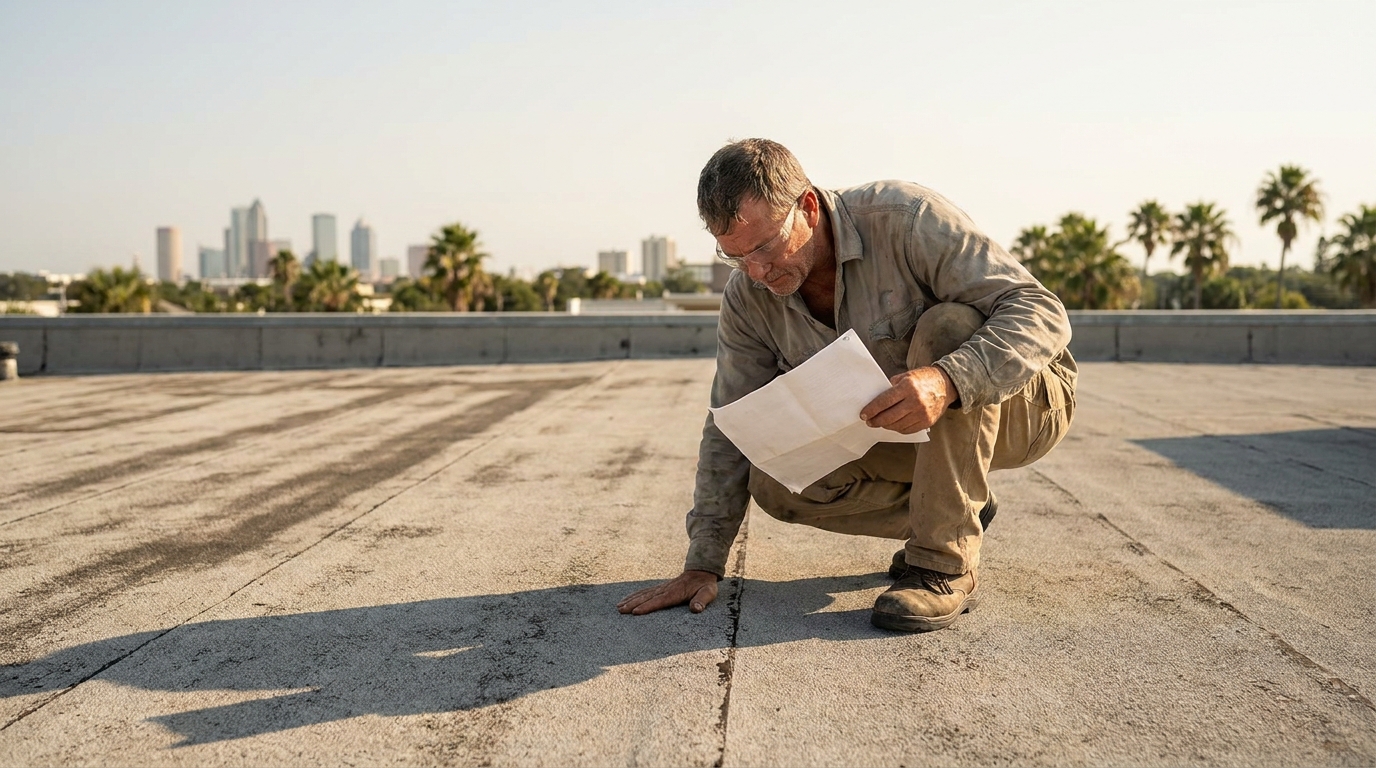
- Inspection and moisture survey. Core cuts in suspect areas, infrared scan, drainage assessment, and a measured drawing of the roof.
- Permit and code compliance. Commercial roofing in Tampa falls under the Florida Building Code with local enforcement through the City of Tampa Construction Services Division or the Hillsborough County Development Services Department, depending on the property's jurisdiction. Coating projects often require permits, and wind-uplift documentation matters here — Tampa sits in a high-velocity wind zone.
- Cleaning. Power wash to remove chalk, dirt, biological growth, and loose material. This step is where bad jobs are born; coatings won't bond to a dirty roof.
- Repairs. Replace wet insulation, reinforce seams, address flashings, install new pitch pans where needed.
- Primer. Substrate-specific. Skipping primer to save a day kills adhesion warranties.
- Reinforcement. Polyester fabric embedded in coating at seams, penetrations, and transitions.
- Base and topcoat. Applied at manufacturer-specified mil thickness, verified with wet-film gauges.
- Inspection and warranty registration. Multi-year manufacturer warranties are available, but only when the system is installed by a contractor authorized to register them.
Timing the Work in Tampa
Coating chemistry cares about humidity and dew point. Tampa's wet season — roughly June through September — compresses the working window for water-based systems. The most productive months for commercial coating work locally tend to be October through May, with project planning ideally done before hurricane season ramps up. If your roof is borderline heading into June, prioritize getting it sealed before storm season rather than waiting for cooler weather.
Cost vs. Replacement: The Honest Math
A quality coating system in the Tampa market typically runs well below the cost of a full tear-off and replacement, with significantly less business disruption. For a large commercial warehouse, that gap can be substantial. The catch: coating only makes sense on a roof that's a candidate. Spending coating money on a roof that needs replacement is the worst of both worlds.
A reputable contractor will tell you when coating is the wrong answer. That conversation — honest scope, no upsell — is what separates restoration specialists from roofers chasing the easier sale. SCM Roofing, LLC has built its reputation in the Tampa market on that kind of straight talk, reflected in a 4.9-star rating across more than 239 Google reviews as of April 2026. One customer wrote that the contract "was not one-sided" and that "customer service was outstanding" — the kind of feedback that matters when you're trusting someone with a major building asset.
FAQ: Commercial Roof Coatings in Tampa
How long does a commercial roof coating last?
Properly specified silicone and polyurethane systems carry multi-year manufacturer warranties. Real-world service life depends on substrate condition, mil thickness, and recoat maintenance.
Can a coated roof be recoated later?
Yes — that's the point. A coated roof can typically be cleaned and recoated at the end of its warranty period, extending life again without a tear-off. This is how owners can significantly extend the total lifespan of a roof without a tear-off.
Will a coating stop active leaks?
Only if the leaks are addressed as repairs first. Coating over an active leak without diagnosing the source seals water inside the assembly.
Does a white coating really lower energy bills?
In Tampa's climate, yes — measurably. Cool-roof coatings reduce rooftop surface temperatures dramatically, which lowers HVAC load on the top floor or under-roof spaces.
Do I need a permit?
Most commercial coating projects in the City of Tampa and unincorporated Hillsborough County require permitting. Your contractor should pull it; if they suggest skipping the permit, that's a signal to walk away.
What is the best time of year to schedule a commercial roof coating in Tampa?
October through May is the optimal window in Tampa. Cooler temperatures and lower humidity give water-based coatings the curing conditions they need. If your roof is in marginal condition as spring ends, prioritize coating it before June rather than waiting — active storm season is the worst time to discover your roof isn't sealed.
How do I know if my roof needs a full replacement instead of a coating?
The deciding factor is moisture. A pre-coating infrared or capacitance survey maps wet insulation across the entire field. If saturated areas cover a substantial portion of the substrate, a coating traps the problem rather than solving it. An honest contractor presents the moisture survey findings first and lets the data drive the recommendation.
The Bottom Line
For Tampa commercial property owners, roof coating systems are one of the highest-leverage decisions in the building's lifecycle when the roof is a genuine candidate. They preserve capital, reduce cooling costs, and reset the maintenance timeline. The keys are honest assessment, the right chemistry for your substrate and drainage, and disciplined application by a contractor who treats prep work as seriously as the topcoat.
Property managers and owners in Tampa who want a straightforward evaluation — including whether coating is actually the right call for your building — can contact SCM Roofing, LLC at https://scmroofingfl.com or by calling (855) 726-7663 for an inspection and estimate.
"