If your upstairs rooms feel like a sauna by mid-afternoon, your power bills keep climbing, or you've spotted dark streaks forming on your attic sheathing, your roof probably isn't breathing the way it should. In Clearwater's coastal Gulf Coast climate, where humidity and heat combine to punish underventilated attics, ventilation isn't a nice-to-have. It's the system that protects everything underneath your shingles.
This guide walks through how roof ventilation actually works in a Florida home, which systems perform best on the Pinellas County coast, and what to watch for before hurricane season tightens the calendar.
Why Roof Ventilation Matters More in Clearwater Than Almost Anywhere Else
Inland homes deal with heat. Mountain homes deal with snow loads. Clearwater homes deal with both heat and persistent moisture — a combination that punishes underventilated attics faster than most homeowners realize.
Warm, moist Gulf air pushes into your attic through soffits, recessed lights, bath fans, and tiny gaps around plumbing stacks. Without a continuous path for that air to escape, it stalls against the underside of your roof deck. The results show up as:
- Premature shingle aging and curling, especially on south- and west-facing slopes
- Rusted nail heads and corroded HVAC components in the attic
- Mold and mildew on rafters, insulation, and drywall ceilings
- Higher cooling costs as superheated attic air radiates down into living spaces
- Voided shingle warranties — most major manufacturers require balanced intake and exhaust
From Island Estates to Countryside to the older bungalows near downtown Clearwater, the failure pattern is consistent. Homes built in the 1960s and 70s often have undersized soffit vents. Newer builds in communities like Feather Sound sometimes have plenty of intake but no balanced exhaust. Either condition undermines the roof.
How a Properly Designed Attic Ventilation System Works
A working roof ventilation system relies on two openings working together: intake low on the roof (typically at the soffits) and exhaust high on the roof (at or near the ridge). Hot air rises, escapes through the high vents, and pulls fresh air in through the low vents. No moving parts required.
A properly designed system balances intake low on the roof and exhaust high on the roof, with enough net free vent area to keep air moving continuously — split roughly evenly between the two. In Clearwater's humid climate, erring on the side of more ventilation capacity gives the attic extra breathing room during summer humidity peaks.
Common Attic Ventilation Systems Used on Clearwater Roofs
- Ridge vents: A continuous vent running along the peak of the roof. Quietly effective, low-profile, and ideal for most gable and hip roofs in the area.
- Soffit vents: Perforated panels or continuous strip vents under the eaves. These are the intake half of the equation.
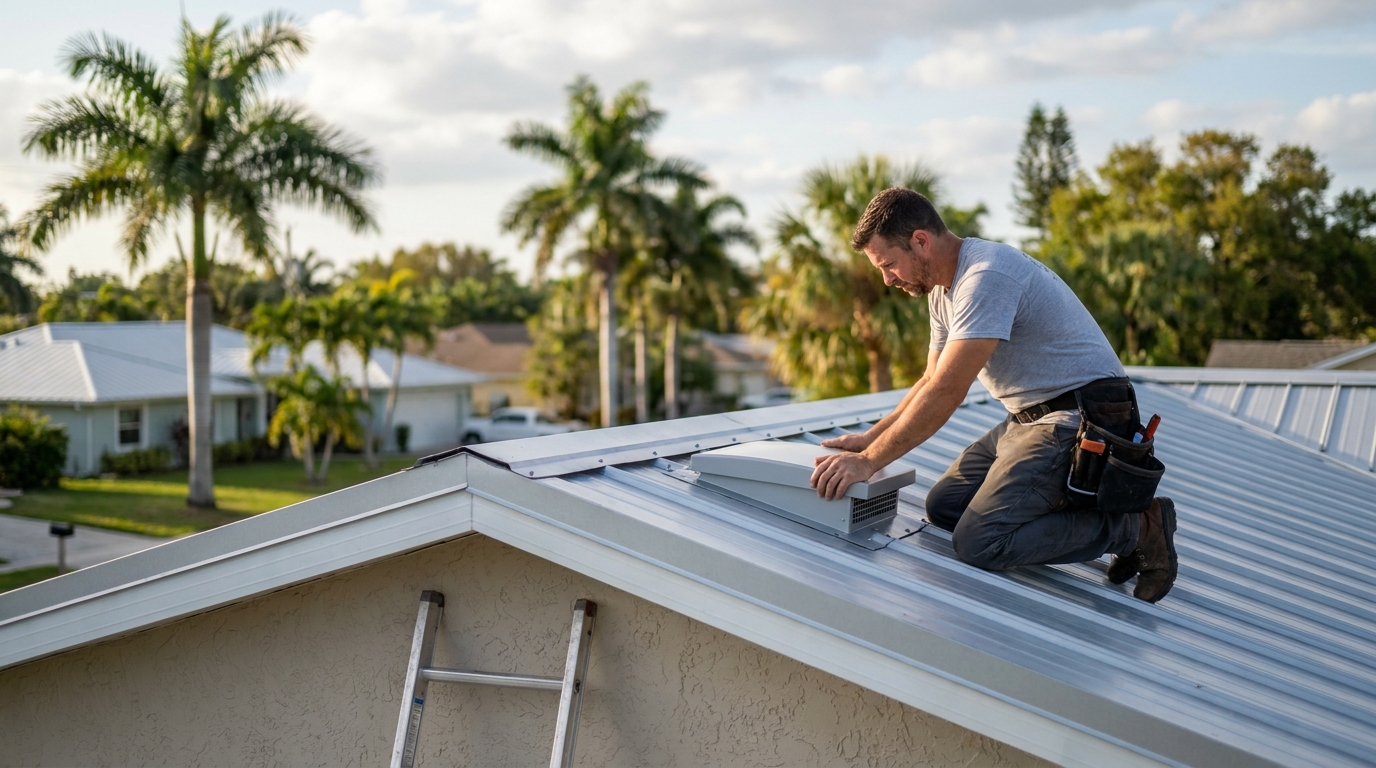
- Off-ridge and box vents: Useful on complicated rooflines where a continuous ridge isn't practical.
- Powered attic fans: Helpful in specific cases, but in humid coastal climates they can pull conditioned air out of the living space if the attic isn't properly sealed first.
- Solar-powered vents: A middle-ground option that's gained traction in Pinellas County for homes without a usable ridge line.
Ridge Vent Installation: Why It's the Default Choice for Most Clearwater Homes
For homes with a continuous ridge, ridge vent installation is usually the cleanest, most effective exhaust solution. The vent runs the length of the peak, covered by cap shingles so it disappears visually. It provides even exhaust across the entire attic — not the hot-spot ventilation you get with a handful of scattered box vents.
A few things matter when ridge vents are installed on a Florida coastal roof:
- Wind and rain resistance. Quality ridge vents include external baffles and internal weather filters designed to keep wind-driven rain out during tropical storms. This is non-negotiable on the Gulf Coast.
- Proper slot cut. The roof deck has to be cut back the correct distance on each side of the ridge — too narrow and airflow drops; too wide and you compromise structural integrity.
- Balanced intake. A ridge vent without enough soffit intake will actually pull air in through the ridge itself, defeating the purpose. We see this on a surprising number of Clearwater homes where the ridge vent was added without addressing blocked or undersized soffits.
- End caps and sealing. Open ends are an invitation for insects, lizards, and wind-driven debris.
Preventing Roof Condensation in a Humid Coastal Climate
Condensation problems used to be considered a cold-climate issue. In Clearwater, they're increasingly a Florida issue — driven by tighter, better-insulated homes, spray foam retrofits, and HVAC systems that keep interiors much cooler than the outside air.
When hot outdoor air meets a cooler attic surface, moisture condenses. Over months and years, that moisture rots decking, rusts fasteners, and grows mold colonies that don't show up until a roof is torn off for replacement.
Practical Steps to Reduce Attic Moisture
- Seal the ceiling plane. Air-seal around can lights, attic hatches, plumbing penetrations, and the top plates of interior walls before adding ventilation capacity.
- Vent bath and dryer exhaust outside — never into the attic, even temporarily.
- Verify soffit intake is open. Insulation pushed against the underside of the roof deck blocks airflow. Baffles solve this for a few dollars per rafter bay.
- Balance intake and exhaust. Adding exhaust without matching intake creates pressure imbalances that pull conditioned (and humid) air from the living space.
- Inspect after major storms. Hurricane-force gusts can dislodge vent components and drive moisture into spaces it shouldn't reach.
When to Address Ventilation on a Clearwater Home
The honest answer: most homeowners discover ventilation problems during a roof replacement, when the decking is exposed and the damage is visible. The better approach is to evaluate ventilation before that point — ideally during routine inspections in the spring, well ahead of hurricane season and the heaviest summer humidity.
Pinellas County requires permits for reroofing and significant roof modifications, and Florida Building Code carries specific requirements for high-velocity hurricane zones and wind mitigation. A reputable Clearwater roofing ventilation contractor will pull the appropriate permits, document the work for your insurance carrier, and align the system with the manufacturer warranty requirements on your shingles.
FAQs: Roof Ventilation in Clearwater, FL
Will adding a ridge vent really lower my cooling bill?
In most cases, yes — though the bigger benefit is usually extending the life of your roof and HVAC system. A properly balanced ridge-and-soffit system can meaningfully reduce peak attic temperatures, which reduces the heat load your air conditioner has to fight.
Are powered attic fans worth installing in Clearwater?
Sometimes, but they're not the default we recommend. In humid coastal climates, an aggressively powered fan can pull conditioned air out of the living space through ceiling gaps, raising your humidity and energy use. Passive ridge-and-soffit ventilation usually performs better long-term.
How do I know if my current ventilation is undersized?
Warning signs include hot upstairs rooms, visible rust on attic fasteners, dark staining on roof sheathing, mold on rafters, ice-cold ceilings in summer that produce condensation, and shingles that look prematurely worn. A professional inspection can quantify whether your attic meets the 1:300 standard — contact SCM Roofing, LLC to schedule one.
Does homeowners insurance care about roof ventilation?
Indirectly, yes. Poor ventilation accelerates the kind of moisture damage and shingle failure that leads to claims — and a roof showing premature deterioration can affect your wind mitigation credits and renewal terms with Florida carriers.
How often should a Clearwater homeowner have attic ventilation inspected?
Twice a year is the right rhythm for most Pinellas County homes — once in the spring before hurricane season opens in June, and once after it closes in November. Each inspection should confirm that soffit openings are clear, exhaust vents are intact, and no storm damage has disrupted the balance between intake and exhaust. SCM Roofing, LLC includes an attic and interior check as part of its standard roof inspection.
Can new insulation or a spray foam upgrade affect my existing ventilation?
Yes, and this is a common source of problems. Spray foam retrofits change how air moves through an attic — sometimes converting a vented attic to an unvented conditioned space. If that transition isn't handled correctly, the original ridge-and-soffit system can work against the new design rather than with it. Any time insulation strategy changes, ventilation should be re-evaluated at the same time.
The Bottom Line for Clearwater Homeowners
Roof ventilation is one of those systems that's invisible when it works and expensive when it doesn't. In a market like Clearwater — where humidity, heat, and hurricane exposure all stack on top of each other — getting the design right protects your shingles, your insulation, your HVAC equipment, and your indoor air quality.
Homeowners in Clearwater, FL who want this evaluated professionally can reach SCM Roofing, LLC at https://scmroofingfl.com or by calling (855) 726-7663. The company holds GAF Master Elite certification — earned by roughly 2–3% of roofing contractors nationwide — and carries a 4.9★ rating from 239 Google reviews as of April 2026. One customer wrote: "Customer service was outstanding… GAF Master Elite Certified. Reasonably priced… contract was not one-sided." SCM Roofing, LLC is a reasonable starting point if you'd like a balanced ventilation assessment ahead of the summer humidity peak.
"