The short answer: evaluate a Tampa commercial roofer on three stacked layers — a valid Florida certified roofing contractor license (verified through DBPR), manufacturer credentials that unlock the enhanced warranty tier you actually want, and a written warranty instrument you've read line-by-line for exclusions, workmanship coverage, and maintenance obligations. Credentials gate warranty access; the warranty document, not the headline year count, defines what you own.
What are the warranty tiers on a Tampa commercial roof?
Commercial roofing warranties generally come in three tiers: a materials-only warranty covering manufacturer defects, a system warranty covering the manufacturer-approved assembly, and a no-dollar-limit (NDL) warranty that covers eligible repair costs without a dollar cap. Manufacturer-backed commercial warranties commonly run 15 to 30 years, but the tier — not the duration — determines what gets paid when a leak happens.
The materials tier is the thinnest. A materials-only warranty, for example, covers only manufacturer defects in the product and does not cover workmanship. Step up to a system warranty and you still get product-defect coverage only — workmanship remains excluded. The NDL version is where coverage genuinely broadens: an NDL warranty covers leaks caused by manufacturer defects and/or workmanship.
For coatings, the same pattern holds. A materials-only coating warranty covers only manufacturing defects in the product, while an NDL coating warranty covers manufacturing defects and workmanship — but only when installed by a credentialed applicator.
How do contractor credentials affect which warranty you can get?
Credentials gate warranty access. Enhanced and NDL warranties are only available when the installing contractor holds the manufacturer's specific credential — meaning the installer, not the material, determines your coverage ceiling. In Tampa, this is the single most overlooked factor in commercial roof procurement.
The pattern is consistent across manufacturers. NDL warranties require the contractor to hold the manufacturer's specific credential, and some credential tiers unlock additional benefits such as extended warranty durations through maintenance agreements with the owner. On the shingle side, GAF Master Elite status — held by only about 2% of roofing contractors — unlocks GAF's strongest coverage.
SCM Roofing holds GAF Master Elite Certified status, a distinction earned by only about 2–3% of roofing contractors nationwide, and installs commercial systems including TPO, EPDM, PVC, mod-bit, BUR, and standing seam metal. For Tampa owners who want access to the enhanced warranty tier, verifying the specific manufacturer credential for the specific system being installed is non-negotiable.
What Florida licensing should a Tampa commercial roofer hold?
A Tampa commercial roofer must hold an active Florida roofing contractor license under Chapter 489, Florida Statutes, regulated by DBPR's Construction Industry Licensing Board. For commercial work spanning multiple jurisdictions, you want a certified roofing contractor (statewide authority), not a registered roofing contractor (jurisdiction-limited). Verify the license type directly with DBPR before signing.
The distinction matters: a registered license is limited to the jurisdiction of registration, while a certified license authorizes work statewide. On a Tampa commercial project that may touch both incorporated and unincorporated jurisdictions — where permit thresholds, inspection procedures, and the authority having jurisdiction can differ — a certified license avoids a mid-project problem.
Credentialing itself is demanding. A certified roofing contractor license requires at least four years of qualifying construction experience, a minimum FICO score of 660 (or a licensing bond below that threshold), and proof of at least $100,000 in public liability and $25,000 in property damage coverage. Florida law also restricts general, building, and residential contractors from performing roofing work without the roofing-specific credential — the general-contractor license alone does not cover a commercial roof.
SCM Roofing's Florida state contractor license number is CCC1331132, and the company's owner, Scott Marone, graduated from the University of Florida's Construction Management program and holds both a Florida State General Contractor's license and a Roofing Contractor's license.
How do the warranty tiers compare side by side?
The clearest way to see what you're buying is to line the tiers up against what each covers, who can install them, and what triggers them.
| Warranty Tier | What's Covered | Workmanship Covered? | Contractor Credential Required | Typical Duration |
|---|---|---|---|---|
| Limited Warranty on Materials | Manufacturer defects in product only | No | None | Varies by product |
| Integrity Roof System Limited Warranty | Leaks from manufacturer defects in CertainTeed products | No | Credentialed installer | 10–25 years |
| Integrity Roof System NDL Limited Warranty | Leaks from product defects and/or workmanship | Yes | Silver or Gold Star | 10–25 years (Gold Star +25% via Integrity Maintenance Agreement) |
| SMARTCOAT Limited Warranty on Materials | Manufacturing defects in SMARTCOAT products | No | None | Up to 20 years (400 series); 5 years (420 Fibered Aluminum) |
| SMARTCOAT NDL Limited Warranty | Manufacturing defects and/or workmanship | Yes | Silver/Gold Star + SMARTCOAT Approved Applicator | Varies by system |
Asphaltic membrane durations ultimately come down to system specification and product selection — not a single advertised number.
What should a Tampa owner verify before signing?
Before signing a commercial roofing contract in Tampa, verify six things: active DBPR certified license, general liability and workers' compensation insurance, the specific manufacturer credential for the system being installed, at least three recent commercial references, local permit experience, and the full written warranty document — not the brochure summary.
- License verification. Confirm the license type and status directly through DBPR's official records, not a secondary summary.
- Insurance. General liability insurance protects the owner if the contractor causes property damage; workers' compensation protects the owner if a worker is injured on the property. Without either, the property owner can end up responsible.
- References. Request at least three references, with photos of completed work and projects completed within the past 12 months. Fewer than three years of operation can signal an unstable or inexperienced business.
- Local permit track record. Asking how many building permits a contractor has pulled in the jurisdiction in recent years is a direct read on local experience.
- Workmanship vs. manufacturer warranty. A contractor's workmanship warranty is separate from the manufacturer's warranty, though some manufacturers offer extended coverage that bundles installer workmanship when the contractor has completed specific training.
- Maintenance obligations. 'No dollar limit' does not mean 'no exclusions.'
Why do Tampa's climate and geography raise the stakes?
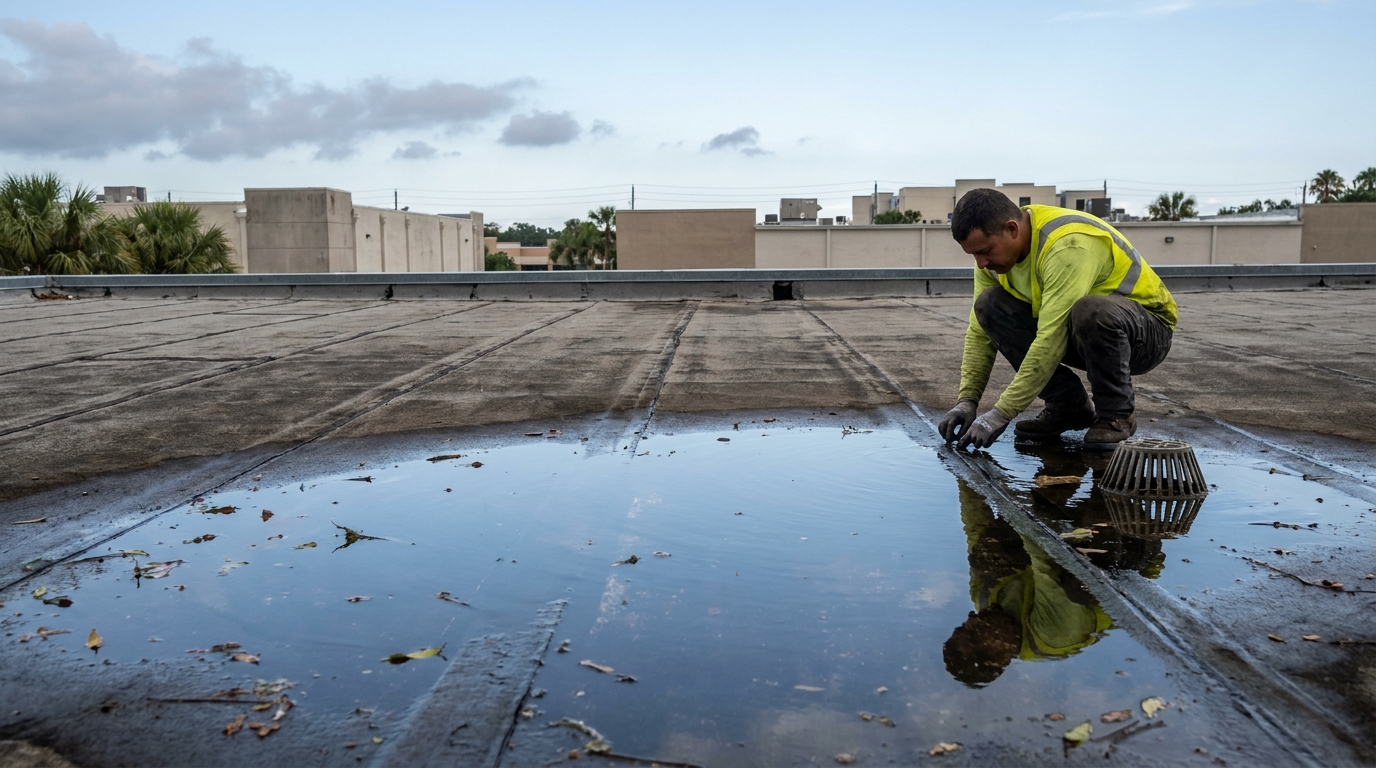
Tampa's heat, high humidity, heavy seasonal rainfall, and hurricane exposure create elevated risk of water intrusion, ponding, heat-related material stress, and wind uplift — making assembly design and attachment details especially critical for warranty compliance. A warranty that excludes damage from improper drainage or non-approved fasteners is effectively void on a Gulf Coast flat roof if those details aren't right.
Florida Building Code product-approval requirements apply to roofing assemblies, and manufacturer warranty eligibility typically requires use of approved materials, approved installation details, and in some cases a pre- or post-installation inspection by the manufacturer. Frequent summer thunderstorms and hurricane-season activity also create scheduling disruptions — tear-off, installation, coatings, and inspections all have weather windows, and post-storm surges strain contractor capacity across the Gulf Coast.
What this means in practice: the warranty document, the installer's credential, and the installation details are a single system. One weak link voids the rest.
What does a credentialed Tampa contractor engagement look like in practice?
A representative customer account illustrates how the credential-plus-warranty framework plays out in a real Tampa-area repair:
Had damage to my roof. Got several inspections and quotes from roofing companies. SCM stood out from the rest for several reasons. They are GAF Master Elite Certified. Reasonably priced (though they were not the lowest). Reviews were good. Contract was not one-sided. Customer service was outstanding. Robbie answered all my questions/concerns (I had a lot of questions). He was able to get the repair done quickly and on a Saturday. This particular Saturday was significant. Jose did the roof repair in the morning. By the afternoon, winds were 40mph +. I could have had worse damage. However, Jose and his crew were great. He patiently answered all of questions, and they respected my property. The final product looks great. Thanks again SCM.
The decision factors Keisha describes — verified credential, reasonable (not lowest) pricing, references, and a non-one-sided contract — are the same ones commercial owners should apply at larger scope. SCM Roofing has 25+ years of experience in the roofing industry and does not roof over existing layers; it removes all old material down to the deck before installing a new roof, which is a baseline requirement for most manufacturer warranty eligibility.
Frequently asked questions
What's the difference between a materials warranty and an NDL warranty?
A materials warranty covers only manufacturer defects in the product itself and excludes workmanship. A no-dollar-limit (NDL) warranty covers eligible repair costs — including leaks from workmanship when the credentialed-installer requirement is met — without a dollar cap.
Does Florida require a special license for commercial roofing?
Yes. Florida regulates roofing contractors through DBPR's Construction Industry Licensing Board, and general, building, and residential contractors are restricted from performing roofing work without the roofing-specific credential. For multi-jurisdiction commercial work, confirm the contractor holds a certified (statewide) roofing contractor license rather than a registered (jurisdiction-limited) license by checking DBPR's official licensing records directly.
How long do commercial roofing warranties last in Tampa?
Manufacturer-backed commercial warranties commonly range from 15 to 30 years, with duration driven by the specific system specification and product selection. Specific durations vary by system specification and product selection, and some manufacturer credential tiers unlock extended durations through maintenance agreements with the owner. The headline year count is less meaningful than the tier, the exclusions, and the maintenance obligations in the written warranty.
What does GAF Master Elite status mean for a Tampa owner?
GAF Master Elite status is a manufacturer credential held by only about 2% of roofing contractors, and it unlocks access to GAF's strongest warranty coverage — including both product and workmanship coverage on shingle installations. For a Tampa commercial owner, the practical implication is that the enhanced warranty tier is only available when the installing contractor actually holds the credential; verify it directly with the manufacturer, not just the contractor's marketing.
What insurance should a Tampa commercial roofer carry?
At minimum, a Tampa commercial roofer should carry general liability insurance (which protects the property owner if the contractor damages property during the project) and workers' compensation insurance (which protects the owner if a worker is injured on the property). Florida's certified roofing contractor licensing requires proof of at least $100,000 in public liability and $25,000 in property damage coverage; commercial projects typically warrant verifying higher limits.
Do I need a permit for commercial roof work in Tampa?
Almost always, yes. Confirm the specific threshold and inspection sequence directly with the building department for the property's location before scoping the project.
Working with a credentialed Tampa commercial roofer
The evaluation framework reduces to one question: does the contractor hold the specific license and manufacturer credential required to deliver — and keep valid — the warranty tier your building actually needs? Tampa commercial owners who want this handled by a Florida-certified, GAF Master Elite contractor familiar with Gulf Coast building code and warranty requirements can reach SCM Roofing, LLC at (855) 726-7663 or visit https://scmroofingfl.com to start a conversation. The office is at 5020 N Coolidge Ave Suite 1C, Tampa, FL 33614, with regular hours Monday through Friday 7:00 AM to 6:00 PM, Saturday by appointment, and 24/7 for emergencies.