If you manage a warehouse off Tamiami Trail, own a retail strip in Murdock, or oversee a medical building near Bayfront Health Port Charlotte, the same question keeps surfacing: what does a commercial roof actually cost per square foot here? The honest answer is that pricing depends on your system, your deck condition, and Florida's wind code — but the ranges are knowable, and you can budget with confidence once you understand the variables.
Here's how commercial roofing pricing breaks down in Port Charlotte in 2026, what drives the numbers up or down, and how to think about a replacement before you collect bids.
The Short Answer: $5.50 to $20 Per Square Foot Installed
Commercial roofing installation in Port Charlotte generally runs $5.50 to $20 per square foot installed, depending on the system type, membrane thickness, and whether you're recovering an existing roof or tearing off down to the deck. That's the working range, and it reflects fully installed cost — materials, labor, accessories, flashing, and cleanup.
Florida's coastal markets, including Charlotte County, typically carry a 10–30% complexity premium over inland benchmarks. That premium comes from high-wind code requirements, impact-rated materials, and the elevated labor cost of working to Florida Product Approval standards. If you're comparing a quote from a Texas or Georgia property against one in Port Charlotte, the Florida number should be higher, and that's not contractor markup — it's code.
What You'll Pay by System Type
Most commercial buildings in Port Charlotte end up with one of three approaches: a TPO membrane (overlay or new), a full tear-off with new insulation, or standing seam metal. Each carries a different cost profile.
TPO Overlay or Recover: Around $7 Per Square Foot
If your existing roof is structurally sound and you're allowed to add a layer rather than tear off, a 45-mil TPO overlay typically falls in the $6 to $8 per square foot range. This is the budget configuration — no demolition, no new insulation, no disposal fees. The catch: Florida code limits when you can overlay versus when you must tear off, and a coastal building that's already been recovered once usually can't be recovered again.
TPO New Construction: Around $12.50 Per Square Foot
For a 60-mil TPO system on a clean deck — common in new builds or where the old roof has already been removed — expect $10 to $15 per square foot. This is the standard configuration most property owners benchmark against. The 60-mil thickness is also the practical floor for commercial buildings in a hurricane-prone market like ours.
TPO Full Reroof with Tear-Off: Around $17.50 Per Square Foot
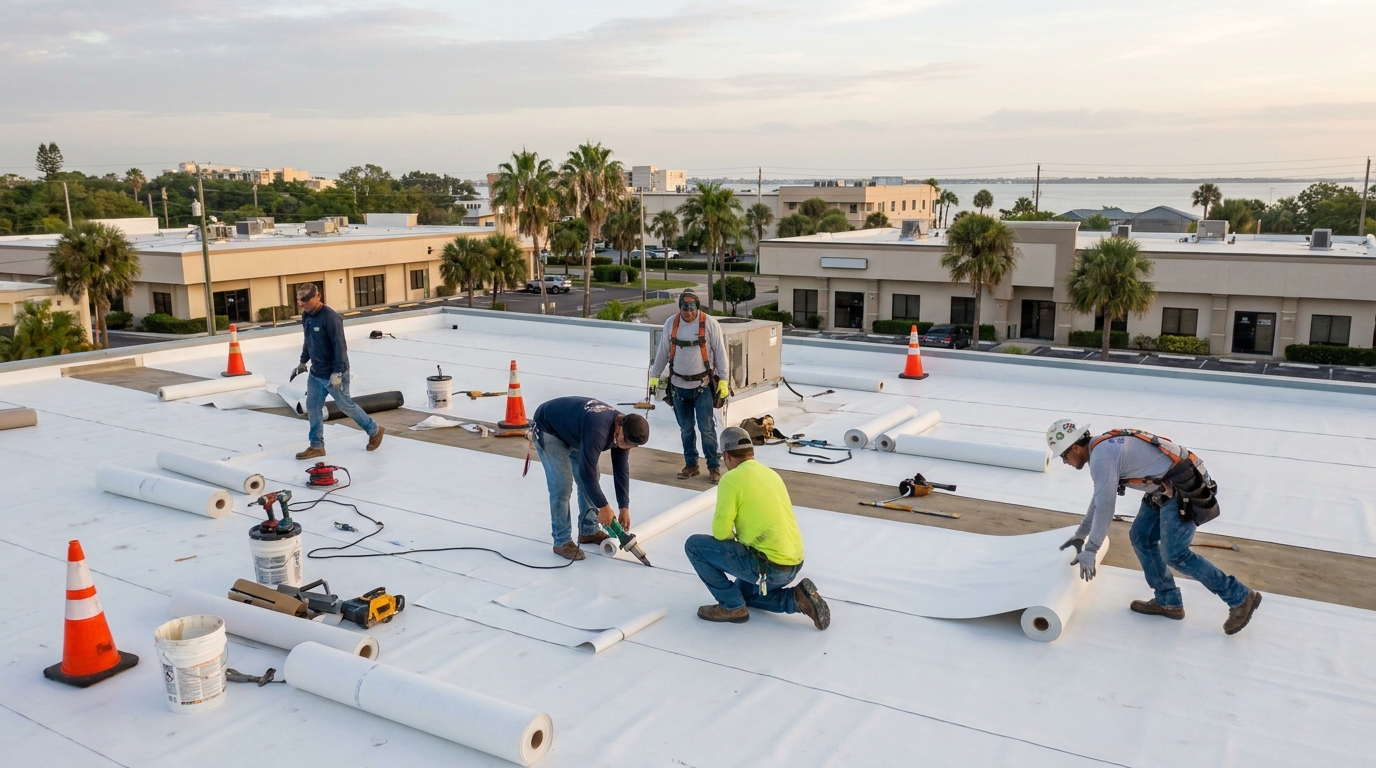
This is what most aging commercial buildings in Port Charlotte actually need: a full tear-off, new insulation, and a fresh 60-mil membrane. The range is $15 to $20 per square foot, and it includes removing the old roof, disposing of it, upgrading insulation to current energy code, and installing the new system. If your roof is more than 20 years old or has visible saturation, this is your likely number.
TPO Premium 80-Mil: Around $21.50 Per Square Foot
An 80-mil membrane adds roughly $2 to $4 per square foot over a standard 60-mil reroof. The thicker membrane buys you longer service life and better resistance to punctures and UV — meaningful in a climate where roofs cook for nine months a year.
Standing Seam Metal: Around $14 Per Square Foot
Standing seam steel runs $10 to $18 per square foot fully installed, including underlayment, trim, flashing, permits, and cleanup. Worth noting: that range is drawn from residential-scale projects, and large commercial metal roofing can differ. If you're considering metal for a warehouse, distribution facility, or church, get a system-specific quote — economies of scale and detailing complexity both move the number.
Mid-Range Commercial Membranes: Around $8.25 Per Square Foot
For general commercial membrane systems in the mid-range tier, comparable Southeast market data puts pricing at $7 to $9.50 per square foot. That's a useful sanity-check number when you're evaluating a bid that doesn't fit neatly into the TPO or metal categories.
What Drives Port Charlotte Pricing Up
The headline ranges above are starting points. Several local factors push individual projects toward the higher end:
- Florida Product Approval and Miami-Dade ratings. Charlotte County requires high-wind-rated assemblies. Fasteners, membrane attachment patterns, and edge metal all have to meet code, and the engineered systems cost more than generic equivalents.
- Hurricane season timing. If you're trying to replace a roof in late summer or fall, contractor availability tightens and emergency work competes with planned projects. Property managers who plan reroofs for the winter and spring months — before the June 1 start of hurricane season — generally get better scheduling and sometimes better pricing.
- Salt air and humidity. Coastal exposure affects material selection. Galvanized fasteners, coated metal flashings, and UV-stable membranes are non-negotiable, not upgrades.
- Deck condition. Once tear-off begins, rotted decking, saturated insulation, and structural repairs show up. A contingency of 5–10% of project cost is reasonable to hold back for what's hiding under the membrane.
- Permitting and inspections. Charlotte County permitting and required inspections add time and cost. These aren't included in the per-square-foot ranges above unless your contractor explicitly bundles them.
How to Budget for a Commercial Roof Replacement
A practical budgeting approach for Port Charlotte property owners:
- Start with square footage. Measure the roof area, not the building footprint. Parapets, mechanical curbs, and slope changes add area.
- Pick a working range. For most existing commercial buildings facing a full reroof, $15 to $20 per square foot is the honest planning number. A 20,000 sq ft warehouse lands in the $300,000 to $400,000 range before contingencies.
- Add a 10% contingency. For deck repairs, insulation upgrades beyond code minimum, and surprises.
- Budget separately for permits and structural work. These rarely fit cleanly into a per-square-foot figure.
- Get at least three written bids. The dossier behind these numbers is clear on one point: no manufacturer publishes binding MSRP for commercial roofing, and pricing is always project-specific. Written bids from licensed Florida contractors are the only accurate way to price your job.
Incentives Worth Asking About
A few cost offsets can apply, though none are automatic:
- Utility rebates for cool roofing. Florida Power & Light and some local co-ops offer rebates for reflective or energy-efficient membranes. Availability varies — confirm with your utility before specifying the system.
- Section 179D commercial building deduction. Federal energy-efficiency tax incentives may apply to qualifying roof assemblies with sufficient insulation R-value. Worth a conversation with your CPA before you finalize specifications.
- Contractor promotions. No standardized manufacturer factory rebate programs exist for commercial roofing, so any promotion will be contractor-specific.
FAQs
How much does a commercial roof cost per square foot in Port Charlotte?
Expect $5.50 to $20 per square foot installed, with most full tear-off TPO reroofs landing between $15 and $20 per square foot. Florida's high-wind code requirements typically add 10–30% over comparable inland markets.
Is a TPO overlay cheaper than a full reroof?
Yes — an overlay runs roughly $6 to $8 per square foot versus $15 to $20 for a full tear-off with new insulation. But overlays are only allowed under specific conditions, and they're not appropriate for roofs with saturated insulation or structural concerns.
When should I schedule a commercial reroof in Port Charlotte?
The window between hurricane seasons — roughly December through May — generally offers better contractor availability and lower weather risk during installation.
What's not included in the per-square-foot price?
Structural repairs, insulation upgrades beyond standard, permit fees, and any unforeseen deck work discovered during tear-off. Build a 10% contingency into your budget.
Getting an Accurate Number for Your Building
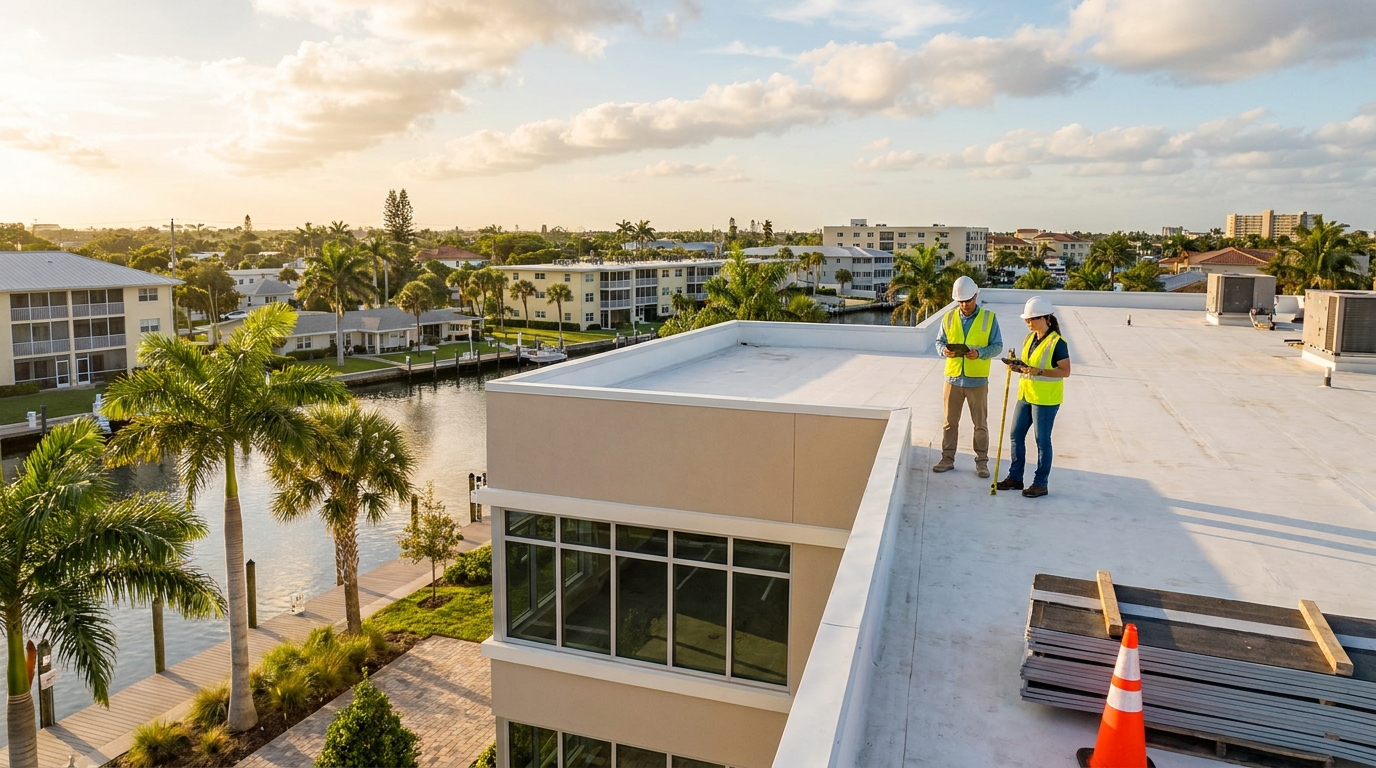
Per-square-foot ranges are useful for planning, but they don't replace a written bid on your specific building. Roof geometry, deck condition, mechanical penetrations, and code-required upgrades all move the final number, and a good commercial roofing contractor will walk the roof, document conditions, and itemize the scope before quoting.
Property managers and business owners in Port Charlotte who want a project-specific estimate can reach SCM Roofing, LLC at https://scmroofingfl.com for a free assessment. We work in Charlotte County daily, we know what the wind code requires, and we'll give you a written scope you can actually budget against.