If rainwater is actively dripping from your ceiling in Tampa, the leak almost always traces to a compromised roof component above — most commonly damaged or missing shingles or tiles, failed flashing around a penetration or chimney, a deteriorated pipe boot, or clogged drainage pushing water sideways under the roof covering. The ceiling stain rarely sits directly beneath the entry point, because water travels along decking and framing before it drops. Your immediate job is to contain the water indoors, document everything, and get a Florida-licensed roofing contractor on the phone for temporary stabilization — permanent repair comes after the rain stops.
What is actually causing water to drip from my ceiling during a Tampa rainstorm?
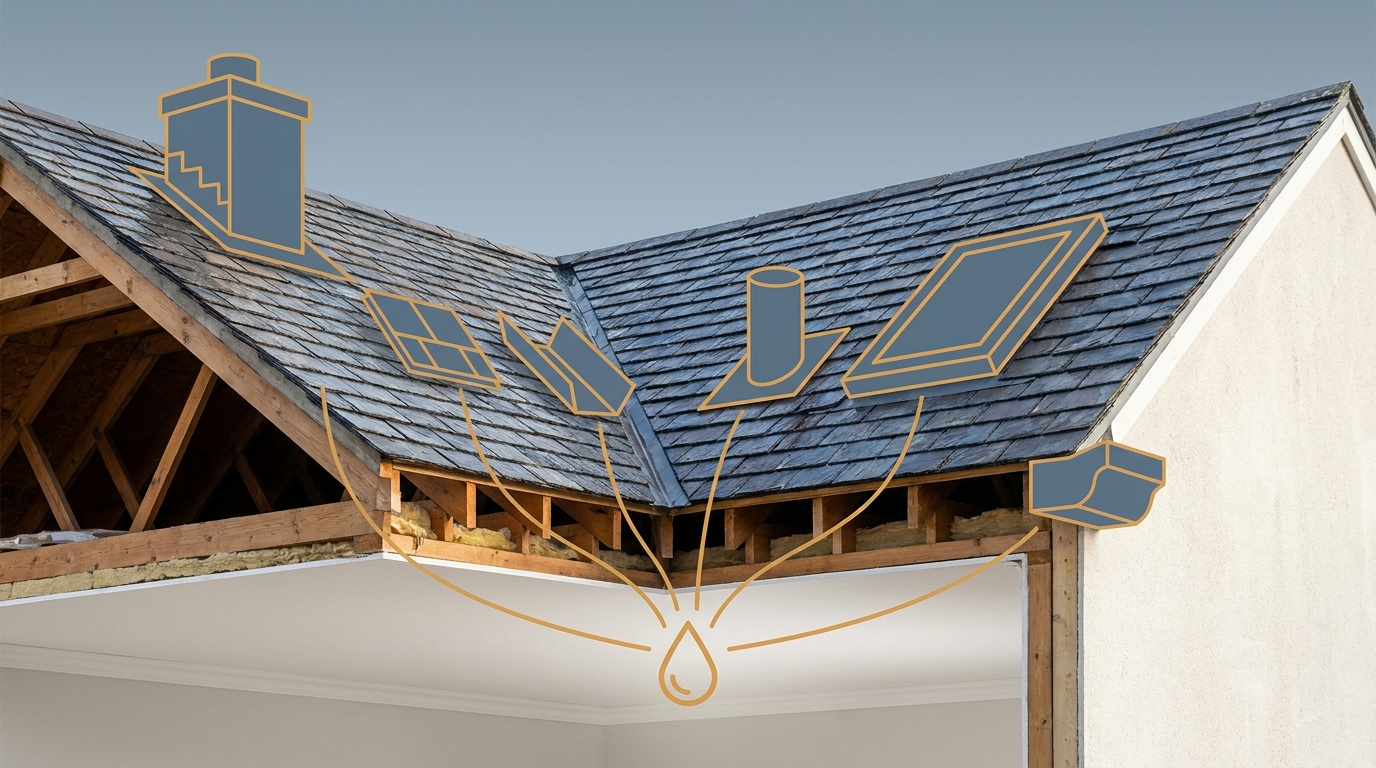
In Tampa, an active ceiling leak during rain is almost always caused by one of five failures on the roof above: damaged or missing shingles or tiles, failed flashing at a penetration or chimney, a cracked or deteriorated pipe boot, clogged or overwhelmed drainage, or wind-driven rain forced under the roof covering. The visible drip is usually displaced from the actual entry point.
Tampa's roof population skews toward asphalt shingle and concrete or clay tile, and each fails differently. Shingles lift and tear during the convective thunderstorms that run daily through summer; tiles crack from foot traffic and debris, exposing the underlayment that is doing the actual waterproofing. Pipe boots — the rubber collars around plumbing vents — are a notorious weak point in the Gulf Coast sun and typically dry-rot years before the surrounding roof does.
Flashing failures at chimneys, skylights, and roof-to-wall transitions are the other dominant cause. Any time two planes meet, there is metal doing the sealing, and once that metal lifts, rusts, or loses its sealant, wind-driven rain finds the gap. On tile roofs especially, a leak that only appears during sideways rain usually points to flashing or underlayment, not the tile itself.
Who should I contact first when my roof is leaking into the ceiling in Tampa?
Contact a Florida-licensed roofing contractor that offers 24/7 emergency service — not a handyman, not a general contractor, and not a public adjuster yet. In Tampa, permanent roofing work must be performed by a licensed roofing contractor whose status you can verify through the Florida Department of Business and Professional Regulation (DBPR). SCM Roofing, LLC offers 24/7 emergency roofing service and holds Florida contractor license CCC1331132.
The reason to call the roofer first — before your insurance carrier — is sequencing. A roofer can tarp the roof, stop the active intrusion, and document the damage with photos. That documentation is what you later hand to your carrier. Calling the insurer first often means waiting for an adjuster while water continues to run into your drywall and insulation.
A public adjuster becomes relevant later, if your claim is denied or underpaid. During the active leak, your priority is a licensed roofer who can perform emergency stabilization and then produce a written scope for permanent repair.
What should I do in the first hour while water is coming through the ceiling?
In the first hour: move belongings out of the drip zone, put a bucket under the water, and relieve pressure on the ceiling by puncturing a small hole at the center of any bulge so water drains in a controlled stream rather than collapsing the drywall. Shut off power to the affected room at the breaker if water is near fixtures or outlets. Photograph everything — the ceiling, the drip, the room, any exterior damage visible from the ground. Then call a licensed roofer.
Do not climb onto a wet roof during a Tampa thunderstorm. Lightning risk is real, and most emergency roofers will not tarp a roof while active lightning is in the area either — they will stage and move the moment it is safe. Use the waiting time to document.
How does emergency response actually work once the roofer arrives?
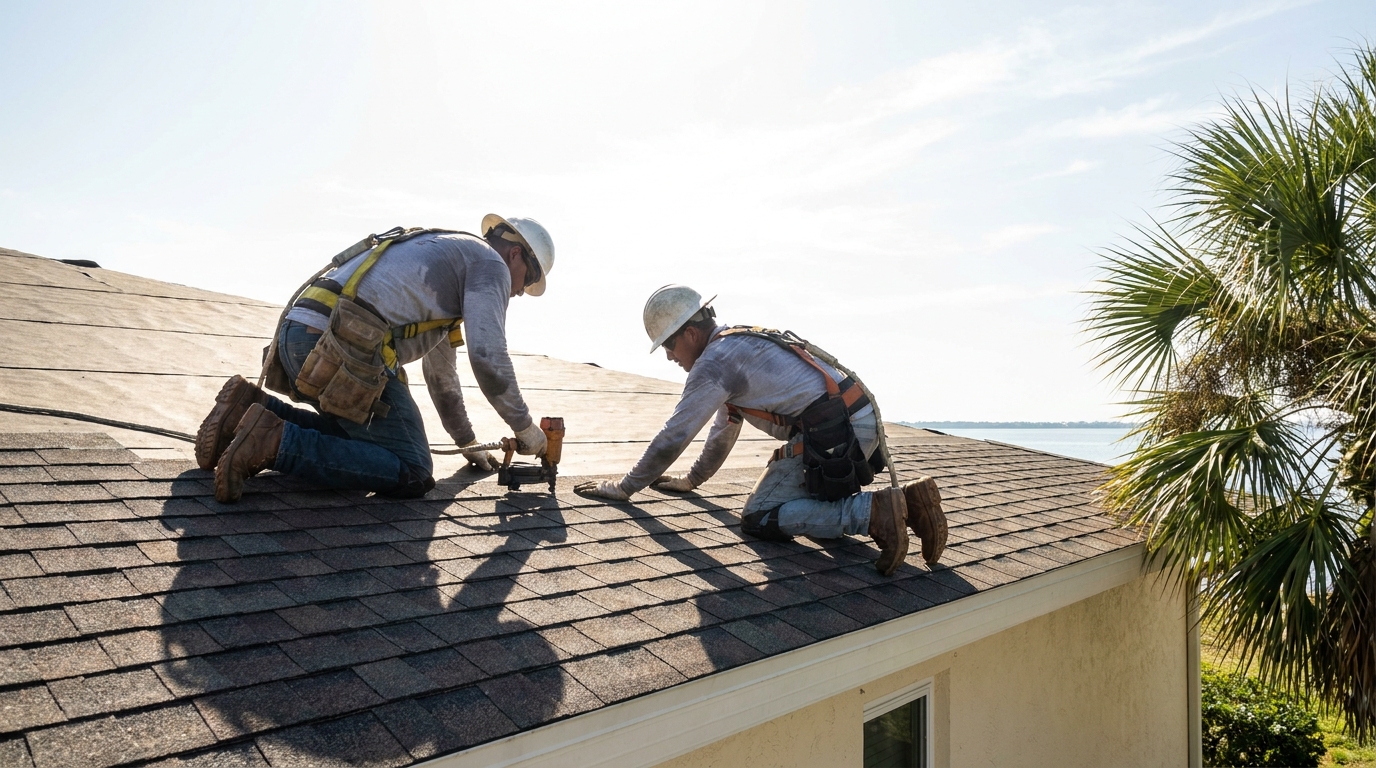
Emergency response in Tampa typically runs in two phases: temporary water exclusion first — usually tarping or a temporary patch — followed by inspection and permanent repair once conditions allow. Tarping buys you a dry interior while the contractor diagnoses the failure, measures the full scope, and prepares a written estimate.
After-hours or post-storm surcharges are common during hurricane season and after named storms, when metro-wide demand constrains crew availability. These are market ranges, not quotes — your number depends on roof type, slope, access, and hidden damage.
SCM Roofing, LLC provides roof repair services including leak repair, storm damage repair, and emergency service, and offers free roof inspections with written reports and photo documentation that prioritize repair recommendations. That written report is what feeds both the repair plan and, when applicable, the insurance claim.
Will my insurance cover this, and what should I know before I file?
Storm-caused roof damage is generally covered under standard Florida homeowners policies, but two carrier mechanics make documentation critical. First, Florida policies typically carry a separate hurricane deductible of 2% of the dwelling coverage amount, distinct from your all-peril deductible. For a home with a 2% hurricane deductible, that out-of-pocket threshold can be substantial before coverage applies.
Second, storm-caused roof damage claims are closely scrutinized by carriers. ACV-versus-RCV disputes and scope omissions are routine, and the quality of your contractor's written scope and photos materially affects the outcome. Hurricane roof repair with insurance documentation is a service SCM Roofing, LLC provides directly.
Any contractor who offers to do so is not operating legally.
Does this repair need a permit in Tampa?
It depends on scope and jurisdiction. Florida statutes set the general building-permit framework, but whether a specific repair pulls a permit depends on the authority having jurisdiction and the size of the work. Within the City of Tampa, some roof-covering work below a certain square-footage threshold may be exempt from permitting; surrounding jurisdictions operate under different rules. Confirm with the applicable building department before work begins.
Temporary emergency protection — a tarp after a declared storm, for example — may qualify for expedited treatment, but permanent repairs remain subject to standard permitting and building code requirements, including high-wind zone fastening standards that apply across the Tampa Bay metro.
Tampa roof leak triage: symptoms, likely causes, and the fix
| Interior symptom | Most likely source | Typical response |
|---|---|---|
| Round stain near a bathroom or kitchen wall | Failed pipe boot above | Boot replacement — minor repair range |
| Stain along a wall or near a chimney | Flashing failure | Flashing rework — moderate repair range |
| Drip only during wind-driven rain | Lifted shingle or tile, exposed underlayment | Shingle/tile replacement, underlayment check |
| Water tracking across a long section of ceiling | Valley, decking, or underlayment damage | Full inspection — potentially major repair |
| Leak appearing days after a storm | Slow saturation of insulation or decking | Attic inspection, moisture mapping |
Why Tampa roofs leak more than inland Florida roofs
Tampa Bay's coastal geography funnels wind and water into neighborhoods across the metro, driving higher storm-related damage frequency than inland Florida markets. The Atlantic hurricane season runs through the summer and fall, and daily summer thunderstorms expose marginal flashing and penetration seals even outside named storms. For this reason, inspecting a roof twice a year — once before hurricane season in June and once after it ends in November — is a reasonable baseline for Florida homeowners, and it is what SCM Roofing, LLC recommends.
Post-storm demand compounds the problem. When a named storm hits, the entire metro competes for the same crews at the same time, which is why response times stretch and after-hours surcharges show up. Scheduling an inspection outside of storm windows is the single most effective way to avoid being in that queue.
Frequently asked questions
Who do I call first for an active roof leak in Tampa?
Call a Florida-licensed roofing contractor that offers 24/7 emergency service before you call your insurance company. The roofer can tarp the roof, stop the active water intrusion, and document the damage with photos — all of which you will need for the insurance claim. You can verify any contractor's license through the Florida Department of Business and Professional Regulation.
Why is my ceiling leaking in a spot that isn't under anything on the roof?
Water rarely drops straight down. Once it penetrates the roof covering, it travels along the top of the decking or along framing members until it hits a seam, a fastener, or a low point — then it drops. The visible ceiling stain can sit several feet from the actual entry point, which is why diagnosing a leak requires an attic inspection and often a water test, not just a glance at the ceiling.
How much does an emergency roof leak repair cost in Tampa?
After-hours or post-storm surcharges of $250 to $600 are common during hurricane season. Actual pricing depends on roof type, slope, access, and hidden damage — get a written estimate.
Should I file an insurance claim for a small ceiling leak?
Not always. Florida's separate hurricane deductible is typically 2% of your dwelling coverage, which can easily exceed the cost of a minor repair. With a 2% hurricane deductible, that out-of-pocket threshold can easily exceed the cost of a minor repair. Get a written repair estimate first, compare it to your deductible, and only then decide whether to file.
Do I need a permit to repair a roof leak in Tampa?
It depends on the scope and the jurisdiction. The City of Tampa may exempt some roof-covering work of 500 square feet or less from permitting, while unincorporated Hillsborough County operates under its own rules. Florida Statute §553.79 provides the general framework, but confirm with the applicable building department for your specific address before permanent work begins.
Can I just tarp the roof myself?
Not during an active Tampa thunderstorm. Lightning risk and wet roof surfaces make DIY tarping dangerous, and an improperly fastened tarp often causes more damage than the original leak by trapping water or tearing shingles when it lifts in the wind. Contain the water indoors, document the damage, and call a licensed roofer for professional stabilization.
How soon after the leak should I schedule permanent repair?
As soon as the roof is dry enough to work on and you have a written scope in hand. Delaying permanent repair after temporary tarping risks hidden damage spreading — wet insulation, saturated decking, and mold growth all accelerate quickly in Tampa's humidity. Most tarps are rated for short-term protection, not weeks of exposure to Gulf Coast sun and storms.
Getting the leak handled
A ceiling leak during rain is a time-sensitive problem with a clear sequence: contain, document, call a licensed roofer, then handle insurance once the water is stopped. Readers in Tampa who want this handled professionally can reach SCM Roofing, LLC at (855) 726-7663 or https://scmroofingfl.com to request an inspection or emergency response. The company serves Hillsborough County along with seven other Gulf Coast counties and operates under Florida contractor license CCC1331132.