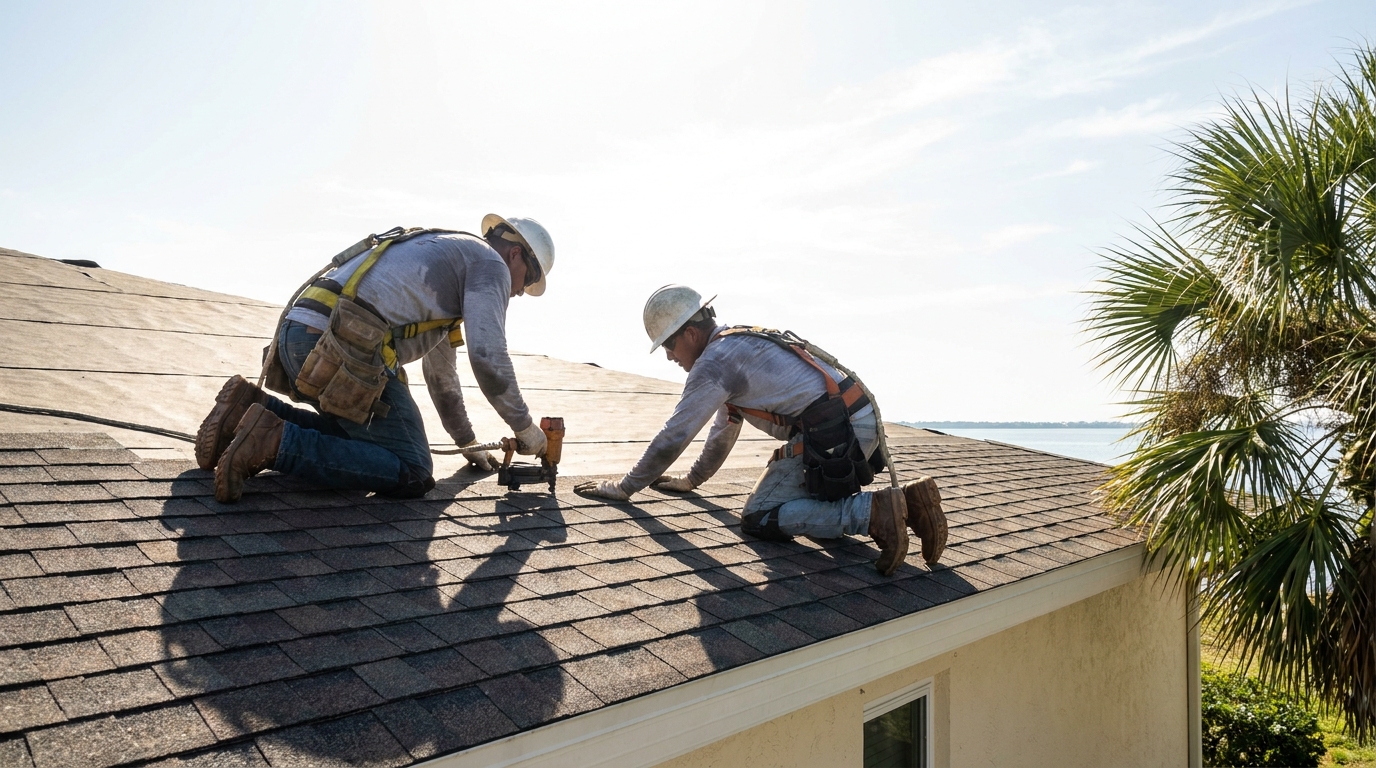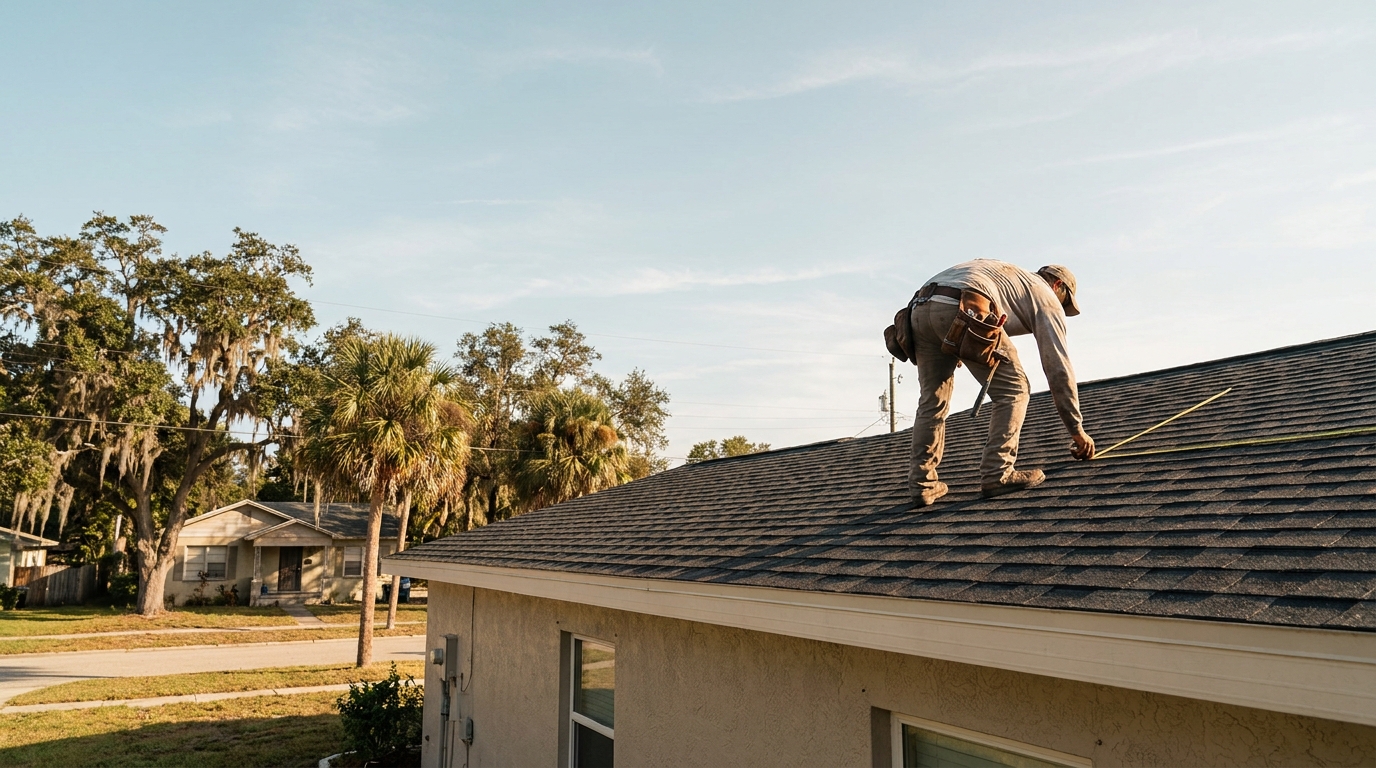
In Tampa commercial roofing, three credential tiers separate qualified contractors from the rest: a Florida state-issued certified roofing contractor license under Chapter 489, manufacturer-specific installer approvals like GAF Master Elite, and hands-on performance credentials such as NRCA ProCertification. Each tests something different — legal authority to contract, system-specific install competence, and individual installer skill — and a serious commercial roofer in Tampa carries evidence across all three.
For property managers vetting bids on a TPO re-cover or a mod-bit tear-off, understanding what each certification actually requires is the difference between hiring a crew that will stand behind a long-term system warranty and one that disappears after the first ponding complaint. SCM Roofing, LLC operates under Florida roofing license CCC1331132 and holds GAF Master Elite Certified status — a credential GAF reports is held by only about 2–3% of roofing contractors nationwide.
What does Florida actually require to contract commercial roofing in Tampa?
Florida requires any person contracting roofing work for compensation to hold an active state-issued certified or registered roofing contractor credential under Fla. Stat. §§ 489.113(1) and 489.117, administered by DBPR's Construction Industry Licensing Board. The license is issued to an individual — not the company — and a business must be qualified through that licenseholder under the relevant provisions of Florida statute.
Roofing sits in the Division II contractor category. Applicants for state certification must pass two separate exams: a roofing trade-knowledge exam and a Business and Finance exam. The Business and Finance exam tests whether the applicant can actually run a lawful contracting business: lien law, workers' comp compliance, bidding, and financial responsibility.
Insurance minimums matter too. Available sources report that Florida requires Division II contractors to carry at least $100,000 in public liability coverage and $25,000 in property damage coverage, under Rule 61G4-15.003, F.A.C., though current rule text should be verified with DBPR. Any Tampa property manager can — and should — ask for current certificates before signing.
How do manufacturer certifications like GAF Master Elite actually work?
Manufacturer certifications are earned, not purchased. GAF Master Elite status, which SCM Roofing, LLC holds, requires a contractor to maintain proper state licensing, carry adequate insurance, demonstrate a verified track record, and commit to ongoing training on GAF's roofing systems. GAF reports this credential is held by only about 2–3% of roofing contractors nationwide.
The practical payoff for a commercial building owner is warranty access. Only certified contractors can register the enhanced, long-form system warranties the manufacturers advertise — the kind that cover both material defects and workmanship for the full term. A general contractor who dabbles in roofing cannot register these warranties, no matter how good their crew is on the day of install.
Similar programs exist across the commercial membrane world, spanning the major TPO, EPDM, and modified-bitumen manufacturers. Each has its own installer approval process, continuing-education requirement, and inspection protocols. When a Tampa property manager asks for an NDL (no-dollar-limit) warranty on a TPO roof, the answer depends almost entirely on whether the installing contractor carries the right manufacturer approval for that specific system.
What is NRCA ProCertification and what does it test?
Unlike a state license (which tests the business owner) or a manufacturer certification (which approves the company), ProCertification tests the person actually on the roof. Specialties cover system types directly relevant to Tampa's commercial market, where single-ply membranes dominate low-slope buildings and tile remains common on Mediterranean-style properties.
For a property manager, a ProCertified lead installer on the job is evidence that the crew foreman has personally passed a hands-on skills test — not just that the company owner holds a credential.
How should Tampa commercial property managers verify these credentials?
Verification is straightforward and should happen before any contract is signed. Florida's DBPR maintains a public license lookup where any state-issued roofing license number can be checked for status, discipline history, and the qualifying agent of record. Local building departments are barred from issuing permits to contractors without an active credential in the appropriate category under Florida statute, so a contractor who cannot pull a permit on your Tampa property has already failed the test.
Florida statute also requires contractors to include their certificate or registration number in advertising — a quick way to screen bids. SCM Roofing, LLC's state license number, CCC1331132, appears on its materials for exactly this reason. For manufacturer credentials, GAF and the other major commercial manufacturers maintain contractor locator tools that confirm current certification status; a lapsed Master Elite designation is a meaningful red flag.
Credential comparison: what each one actually proves
| Credential | Issuing body | What it tests | Who it covers |
|---|---|---|---|
| Certified Roofing Contractor | Florida DBPR / CILB | Trade knowledge + Business & Finance exam (2 exams) | The individual qualifier / business |
| GAF Master Elite | GAF (manufacturer) | Licensing, insurance, track record, training | The contracting company |
| NRCA ProCertification | NRCA | Hands-on installation performance exam | The individual installer on the roof |
| Division II Insurance | Rule 61G4-15.003, F.A.C. | $100,000 liability / $25,000 property damage minimums (per floridageneralcontractorlicense.com) | The licensed contractor |
Why the Tampa market makes credential literacy especially important
Tampa's hurricane exposure, year-round humidity, and intense UV load put commercial roof systems under stress that cooler, drier markets never see. A membrane seam that passes inspection in April can fail by August if the installer wasn't trained on the specific system's heat-welding specifications.
The storm-chaser problem is real after every named storm that touches the Gulf Coast. Out-of-state operators arrive with trucks and door-knockers but no Florida license, no manufacturer approvals, and no intent to be present when a warranty claim surfaces two years later. General or building contractors without a roofing credential are required under Fla. Stat. § 489.113(3) to subcontract roofing work to an appropriately licensed roofing contractor — a rule routinely ignored in post-storm chaos.
Robbie was professional and very responsive. We looked at several roofing companies and SCM was very competitive. They were also able to start the job the soonest( before hurricane season). Juan and his team came out promptly at 7am and completed the job in one day. Amazing! I highly recommend this company.
Frequently asked questions
Does a Florida general contractor license cover commercial roofing?
No. Under Fla. Stat. § 489.113(3), a general or building contractor who does not hold a roofing credential must subcontract roofing work to an appropriately licensed roofing contractor. A GC can oversee a project that includes roofing, but the roofing scope itself must be performed by someone holding an active certified or registered roofing contractor credential issued by Florida DBPR.
What's the difference between a certified and a registered roofing contractor in Florida?
A certified roofing contractor holds a statewide credential and can work anywhere in Florida after passing the roofing trade-knowledge exam and the Business and Finance exam. A registered roofing contractor holds a locally limited credential tied to specific jurisdictions that still maintain local licensing authority. For most Tampa commercial projects, certified status is the stronger credential.
Why does GAF Master Elite status matter if the roof isn't GAF?
Master Elite status specifically unlocks GAF's enhanced system warranties, so it matters most when the specified system is GAF. For non-GAF commercial membranes — Carlisle TPO, Firestone EPDM, Duro-Last PVC — look for that manufacturer's equivalent installer approval. The underlying signal is the same: the contractor has met training, insurance, and track-record requirements the manufacturer independently verifies.
How can I verify a Tampa roofer's license number?
Florida DBPR maintains a public online license lookup where any state-issued roofing license number can be verified for active status, the qualifying agent, and any disciplinary history. Fla. Stat. § 489.119(5) requires contractors to include their license number in advertising, so a legitimate bid will carry a number you can cross-check in minutes before signing.
What insurance should a Tampa commercial roofer carry?
Available sources report that Division II contractors in Florida are required to carry at least $100,000 in public liability and $25,000 in property damage coverage under Rule 61G4-15.003, F.A.C., and current rule text should be confirmed with DBPR. Contractors must also comply with Florida workers' compensation law under Chapter 440 or qualify for a documented exemption. Always request current certificates of insurance naming your property.
What happens if an unlicensed contractor roofs my commercial building?
Under Fla. Stat. § 489.127, performing roofing work without an active credential is unlicensed contracting subject to criminal penalties, with enhanced consequences during a declared state of emergency. Fla. Stat. § 489.128 may render the contract unenforceable, and local building departments cannot legally issue permits to unlicensed contractors under Fla. Stat. § 489.13(1) — leaving you without inspections or warranty standing.
Putting it together
Credentials aren't bureaucratic checkboxes — they're how a Tampa property manager transfers risk off the balance sheet and onto the contractor and the manufacturer. A state license says the contractor can lawfully perform the work. A manufacturer approval says the system warranty will actually register. An NRCA ProCertification says the person on your roof has personally demonstrated the skill. Serious commercial roofers carry all three, and will produce documentation on request.
SCM Roofing, LLC brings 25+ years of experience in the roofing industry, operates under Florida roofing license CCC1331132, and holds GAF Master Elite Certified status — one of the roughly 2–3% of U.S. contractors to earn that designation. The company's commercial scope covers TPO, EPDM, PVC, mod-bit, BUR, and standing seam metal systems. Tampa property managers who want this handled professionally can reach SCM Roofing, LLC at (855) 726-7663 or https://scmroofingfl.com to start a conversation about their building.