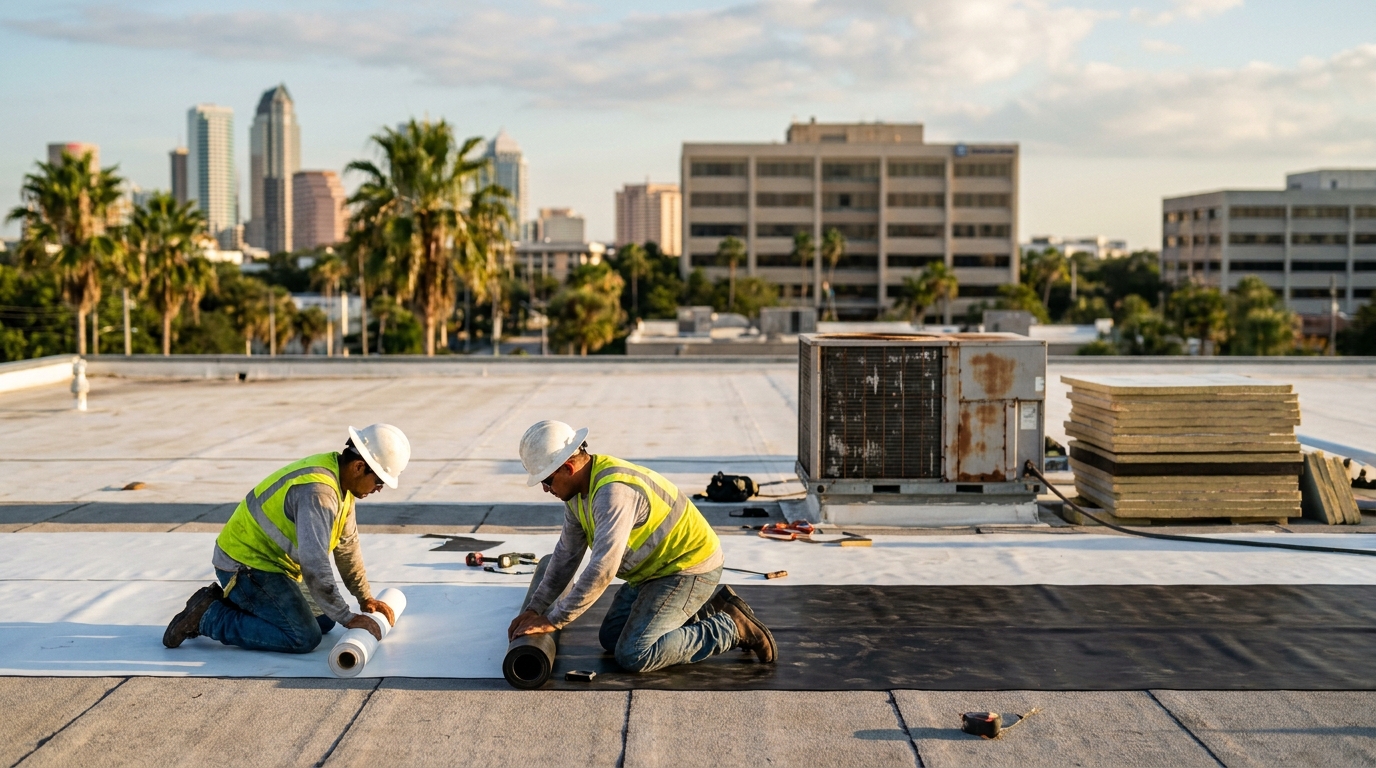
If you own or manage a commercial building in Tampa with a flat or low-slope roof, you've almost certainly run into the same fork in the road: TPO or EPDM? These two single-ply membranes dominate the commercial roofing market, and choosing between them isn't just a materials question — it's a decision that affects cooling bills, hurricane resilience, and how often you'll be writing checks for repairs over the next 25 years.
Here's the honest breakdown, with Florida-specific context, so you can walk into your next bid meeting knowing exactly what you're comparing.
TPO vs EPDM Commercial Roofing: The Short Answer
TPO (thermoplastic polyolefin) is a white, heat-welded membrane engineered to reflect sunlight. EPDM (ethylene propylene diene monomer) is a synthetic rubber membrane, typically black, bonded with adhesive seams. Both can last 20 to 30+ years with proper installation and maintenance.
For most Tampa commercial buildings, TPO is the stronger fit. The reason is simple physics: TPO reflects roughly 80–85% of solar radiation, keeping its surface measurably cooler than dark roofing and delivering meaningful cooling savings in hot climates. EPDM's standard black surface absorbs heat, and while Tampa isn't a desert, our sustained Gulf Coast heat and humidity push that black membrane harder than it would be pushed in, say, Boston.
That said, EPDM has real advantages — lower upfront cost, a longer proven track record, and excellent cold-weather flexibility — so the right answer depends on your building, your budget, and your priorities.
Installed Cost: EPDM Wins on Day One
In current 2026 pricing guidance, TPO installed cost runs approximately $4.00–$7.00 per square foot in many comparisons, with broader ranges reaching $5.50–$10.50 depending on system details. EPDM typically comes in slightly lower at about $3.50–$6.00 per square foot installed, with broader ranges reaching $4.50–$8.00 or more depending on scope.
For a 1,500-square-foot roof, that works out to roughly $6,000–$10,500 for TPO and $5,250–$9,000 for EPDM as general benchmarks. Florida pricing, particularly in storm-prone markets like Tampa, tends to run above national averages due to wind-uplift requirements, labor rates, and project staging — so local bids should be treated as your authoritative figure rather than any national range.
Add-ons like insulation, tear-off, and access or labor charges can push totals well past base figures, especially on multi-story buildings near the Westshore business district or downtown where staging is tight.
Energy Efficiency: TPO Pays You Back
This is where Tampa's climate tilts the math. TPO's white, reflective surface commonly reflects about 80–85% of solar radiation and is widely favored for hot climates and energy-conscious buildings. EPDM's standard black surface absorbs that same heat, increasing the cooling load for any air-conditioned space below.
That cooling-cost gap is why TPO's modestly higher upfront price typically gets recouped over time on Florida buildings. If your facility runs air conditioning the better part of the year — which describes nearly every commercial property from South Tampa to Brandon — that recovery window matters.
TPO also meets cool-roof energy code provisions, which is a meaningful consideration as Florida continues tightening commercial energy standards. In some markets, TPO's reflective performance can qualify for utility rebates, which can further close the gap between TPO's installed cost and EPDM's lower entry price.
Lifespan, Warranty, and What Actually Holds Up
EPDM has a longer documented performance history in commercial roofing, and quality EPDM is extruded for uniform thickness and built to established ASTM specifications. According to current industry comparisons, EPDM service life is often cited at approximately 25–40 years depending on system, climate, and maintenance.
TPO typically delivers around 20–30 years in most current comparisons, with performance at the upper end achievable on 80-mil membranes with proper installation. Early TPO formulations had cracking and weathering issues, but current products from established manufacturers have addressed those concerns.
Warranties are where TPO has pulled ahead at premium thicknesses:
- TPO: Up to 25–35 years (thickness-dependent); available on select premium systems. Fully adhered installations generally yield better warranty terms.
- EPDM: Warranty terms scale with membrane thickness — thicker mil selections unlock longer no-dollar-limit coverage on both materials and labor through manufacturer programs.
Warranty terms always vary by manufacturer, membrane thickness, installation method, and contractor certification — read the fine print before you sign.
Seam Integrity: TPO's Heat-Welded Edge
This is the comparison point that matters most during hurricane season. TPO seams are heat-welded with a hot-air gun, creating a monolithic bond that is generally viewed as stronger than taped or adhesive seams. That fused connection becomes part of the membrane itself rather than a separate bond layer.
EPDM uses adhesive, tape, or contact cement seams, which perform well but depend on bond quality and maintenance over time. The rubber itself handles cold-weather flexing exceptionally well, but seam performance is more variable than a heat-welded system — particularly under the wind-driven rain conditions Tampa sees during tropical weather.
For Tampa buildings exposed to tropical storms and hurricanes, the heat-welded seam is a meaningful durability advantage — particularly on buildings with significant roof penetrations, HVAC curbs, or parapet detailing.
Thickness Options and Roll Sizes
Both membranes are most commonly installed at 60 mil in commercial applications, which is considered the standard commercial thickness for both TPO and EPDM. EPDM offers additional tiers including 45-mil and 90-mil options, while TPO's primary commercial offerings are 45-mil, 60-mil, and 80-mil.
EPDM also wins on roll dimensions, with black membranes available in wider rolls than white EPDM, which means fewer seams on large warehouse roofs. TPO comes in widths up to 20 feet. Fewer seams mean fewer potential failure points — a real consideration on large-footprint buildings like distribution centers along the I-4 corridor.
Climate Suitability for Tampa
Tampa's climate profile — sustained heat, high humidity, intense UV, frequent thunderstorms, and hurricane exposure from June through November — favors TPO for most applications:
- TPO strengths in Tampa: Reflective surface counters our cooling load; heat-welded seams resist storm-driven water; meets cool-roof code provisions.
- EPDM strengths in Tampa: Lower upfront cost on standard projects; excellent flexibility; thicker mil options provide strong puncture and hail resistance for storm-prone applications.
EPDM is best suited for cold climates and certain storm-prone applications where its rubber flexibility shines. TPO dominates in warm, sunny markets — which is exactly what we have along Florida's Gulf Coast.
Maintenance and Repair Realities
Both membranes need semi-annual inspections and run a similar annual maintenance budget. Where they diverge is repair cost per incident: TPO repairs typically cost more per event and may require welding equipment, while EPDM repairs are simpler and cheaper using adhesive-based patches. TPO's heat-welded seams reduce how often you'll need seam-related work; EPDM's adhesive seams are cheaper to fix but more likely to need attention over time.
Frequently Asked Questions
Which membrane lasts longer in Florida heat?
TPO's reflective surface holds up better against sustained UV and heat exposure. Current industry comparisons place EPDM's service life at roughly 25–40 years and TPO's at roughly 20–30 years, but in Tampa's climate, TPO at 60-mil or 80-mil is generally the more conservative choice because its white surface actively manages heat rather than absorbing it.
Is TPO worth the higher upfront cost?
In hot climates, the reflective performance advantage and stronger heat-welded seams make a compelling case for TPO. The energy savings from reduced cooling load, combined with potential utility rebates in some markets, typically work to offset the modest upfront premium over a building's ownership horizon.
What thickness should I specify?
For commercial buildings in Tampa, 60-mil is the practical minimum and the recognized commercial standard for both TPO and EPDM. Bumping to 80-mil TPO or 90-mil EPDM is worth considering for extended-warranty and high-durability applications, particularly on buildings with heavy HVAC equipment or significant foot-traffic exposure on the roof plane.
Do I need a permit for a commercial reroof in Tampa?
Yes. Commercial roof replacements require permits through Florida's local building authority, and inspections are tied to Florida Building Code requirements. Work with a licensed roofing contractor who pulls the permit and handles inspections directly.
How do TPO and EPDM seams compare when it comes to storm damage claims?
TPO's heat-welded seams form a continuous, monolithic bond that is generally more resistant to wind-driven water infiltration — the primary failure mode in tropical storm events. EPDM seams rely on adhesive or tape bonds, which can degrade over time and are more likely to be the origin point of a post-storm leak. For Tampa buildings filing insurance claims after hurricane events, seam condition is often the first thing an adjuster inspects.
Can EPDM be made reflective like TPO?
White EPDM membranes are available and do provide improved solar reflectivity compared to the standard black surface, but they come at a premium over black EPDM and are typically available in narrower roll widths, which means more seams on a large roof. For owners whose primary goal is maximum reflectivity and cool-roof qualification, TPO generally remains the more practical and cost-effective path to that outcome.
Choosing the Right Installer Matters More Than the Membrane
Whichever membrane you choose, installation quality will determine whether you get 15 years or 30 years out of it. Look for contractors with manufacturer certifications (GAF Master Elite, Carlisle Authorized Applicator, and similar programs), transparent contracts, and a history of commercial work in the Tampa Bay area.
SCM Roofing holds a 4.9-star rating across 239 Google reviews as of 2026, with customers consistently citing professional installation, clear communication, and competitive pricing using quality materials. One customer noted they chose SCM specifically because the company is "GAF Master Elite Certified" and that "customer service was outstanding." Another wrote that the installation crew "worked meticulously together from the start to the finish" and that "cleanup was great too as you could not tell they were ever here."
Tampa commercial property owners weighing TPO vs EPDM for a reroof or new build can reach SCM Roofing, LLC at https://scmroofingfl.com for a site evaluation and a written estimate. Our team works across Tampa's commercial market and can walk you through membrane selection, thickness options, and warranty tiers based on your building's specific exposure and budget — so the decision is informed rather than guessed.